Vol. VII, Issue 6
Author: Chitra Kolluru
Editor’s Note: This reflective account, in 2 parts, facilitates a deepening of our understanding of sacrifice and self-giving in the light of the teachings of Integral Yoga.
PART 1

The English dictionary explains sacrifice as the act of giving up something that is important or valuable in order to be able to get or do something more important. It also refers to the act of killing an animal as a ritualistic offering to a god. Again, the idea is of propitiating some higher deity with a lower possession to seek something higher. Sometimes this sacrifice is painful and involves taking on suffering to possess something greater later.
In the path of Integral Yoga, the Mother explains the term and says, ‘sacrifice’ is the joyful total self-giving of the individual consciousness to the Divine in a “perfect delight” of service (CWM, 2: 170). The key difference between the traditional dictionary meaning and the Mother’s explanation of the term lies in the experience of making the sacrifice.
While in the traditional sense, there is a sense of loss or giving up and an experience of pain, even fear and the inclination to escape if possible; in the Yogic sense the Mother speaks of sacrifice as an experience of joy, which includes a sense of elation in the act of self-giving, an offering to the Divine and hence a feeling of happiness and fulfilment knowing that the humble offering is accepted.
This gives rise to a sense of gratitude, and a feeling of being an instrument under the Mother’s gaze. The experience in the two approaches is quite different — pain being predominant in the former, joy being predominant in the latter.
From our archives:
Sacrifice and Egoism
Reading through the writings of Sri Aurobindo and the Mother and also about their yogic accounts, multiple veils are lifted, and many shades of Sacrifice emerge and take shape in one’s mind, in one’s life. Sri Aurobindo defines sacrifice as something that is made sacred by offering to the Divine, that is to say, that which is offered undergoes a transformation. It is baked to become strong and sturdy like a freshly made pot and sometimes even burnt under the intense light of the Divine Force and is transfigured into something that morphs into a more useful instrumentation for the Divine.
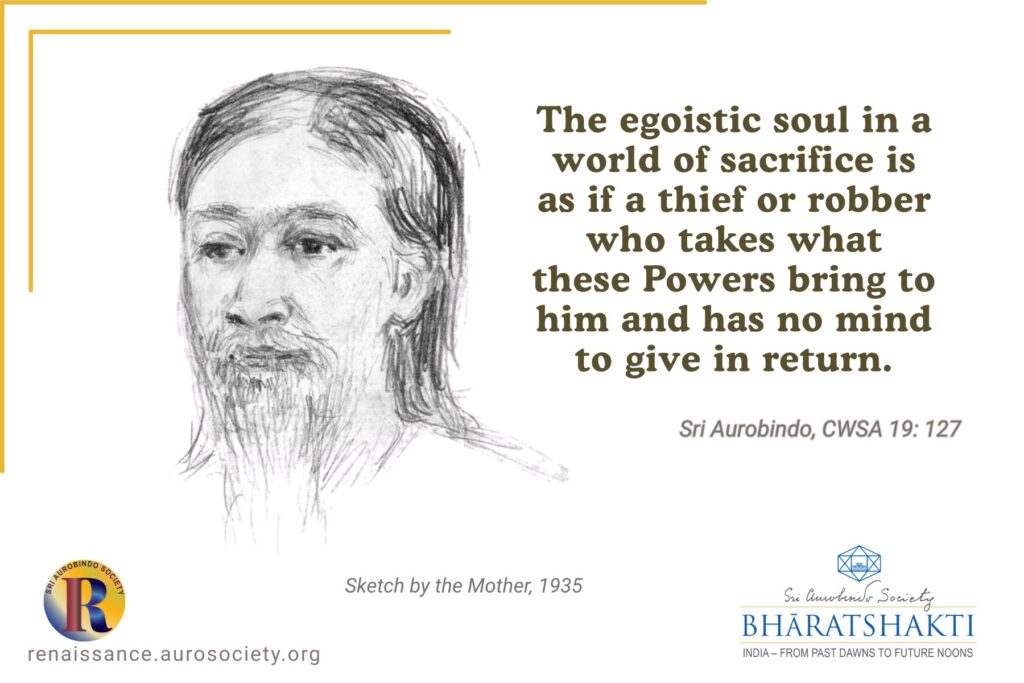
This transformation on the face of it, may look like an uncomfortable or even a painful experience, but it is important to understand this from the point of view of the one who wants to be transformed (here the pot, in Integral yoga, the sadhak). To be able to understand this better, we must delve a bit deeper into who is seeking or going through the experience.
As we go through daily life we are mostly driven by the need for material pleasures,outer desires and accomplishments sought and experienced on the surface; these are transient in nature and once fulfilled we soon move to the next desire. This is a never ending race, strewn with temporary highs and desperate disappointments when experiencing the transient nature of success, until out of exhaustion we turn to the One source of all happiness and contentment, the Divine. There are of course, many unfortunate people, who till the very end of their life are chasing material comforts and surface desires.
READ
The Human Aspiration – Deliberations on The Life Divine
But either due to disillusionment (vairagya) or through an inner turn if one sought deeper and more permanent contentment, an aspiration rises to get close to the Divine, to make Divine works the purpose of one’s life, to be of some use to the Divine cause, to align with the Divine Will and be the instrument of the Divine, each signifying a growing closeness to the Supreme. This aspiration could look like a desire, but unless it takes the form of an opening to, an absorption in and a self-giving to the Divine, it is not truly aspiration.
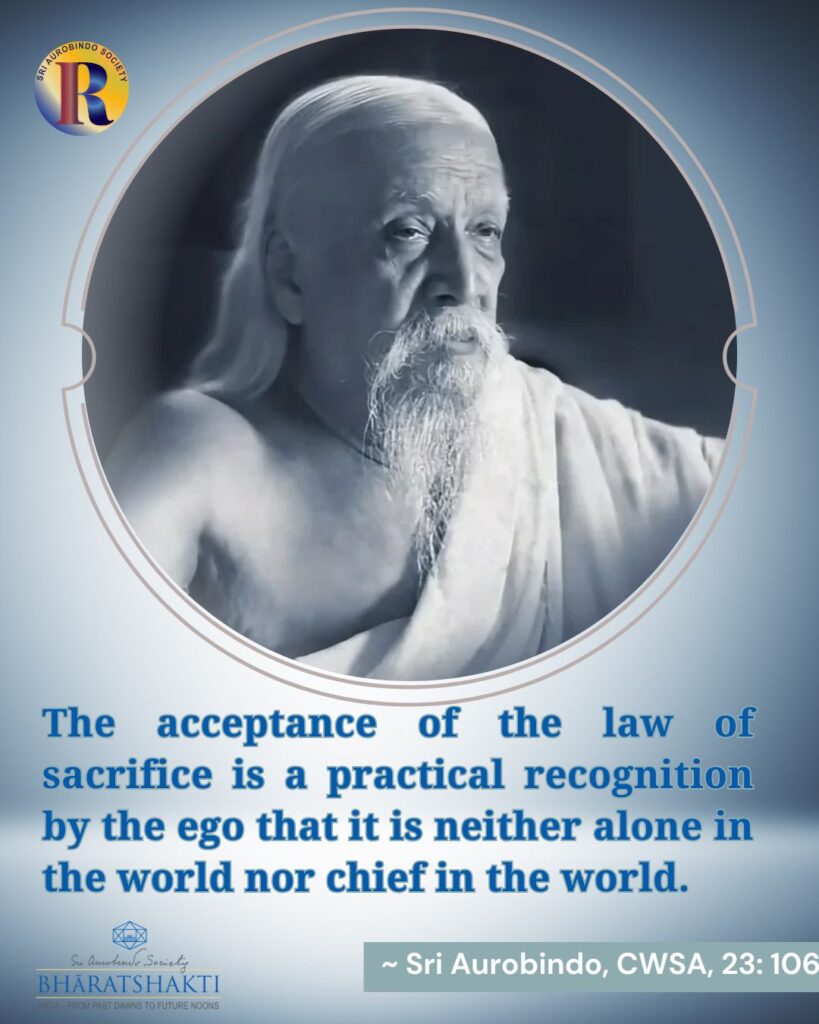
A peculiar relationship starts to form with the Divine when one can gain by giving, grow by dissolving one’s ego, feel enriched and strong by joyously giving up what we have thought and viewed of ourselves as so far. In essence, since we are all made of the God stuff, once we start to recognize the God stuff in us and strive to slowly grow that, we start to feel more complete. It is this aspiration that is behind the act of sacrifice – an aspiration to transfigure into something useful for the Divine. This is best understood through some real examples.
***
If one offers money or wealth in some form to the Divine it is with the aspiration that the money will be put to a more sacred use and will serve a higher purpose. What if one offers one’s work to the Divine, say a poet offering his craft to sing praise of the Lord or in adoration of the Divine Mother or an ode to the Supreme?
Not only is the poet’s skill then put to a better use and the skill is uplifted, but he also experiences a Grace, whereby his piece or poem or song is no longer befitting his capability but has been uplifted far beyond. He then basks in the sheer delight of the experience that is his to cherish. He would then go on to do God’s work by inspiring many and spreading the lore of the Lord.
The vibrations resulting from such beautiful offerings would do their work in the universe. Deep in the devotion of the Lord if one were to offer oneself, if one were to sacrifice one’s individuality, one’s ideals, values, experiences, notions built through experience, one’s mental constructs to the Divine and truly offer them in obeisance beseeching to the Lord to mould them as he deem fit, to nurture them as he sees right and in a way that would serve His Will in the world, then the Lord will have him flower as a beautiful, elevated, harmonized, inspiring individual whose very life will be an inspiration to many.
Continued in Part 2
~ Design: Beloo Mehra