Volume VI, Issue 11-12
Author: Charan Singh Kedarkhandi
Editor’s Note: The book titled Understanding Contemporary India in the Light of Sri Aurobindo (Auropublications, Sri Aurobindo Society, 2022), authored by Dr. Beloo Mehra, Director, BhāratShakti was released on April 25, 2022 during the National Seminar on Sri Aurobindo’s Nationalism organised by Sri Aurobindo Society. We present a review of the book by Dr. Charan Singh Kedarkhandi.
About the Reviewer: Dr. Charan Singh Kedarkhandi is a poet, thinker, spiritual seeker and a student of the Indian knowledge tradition. He is an Assistant Professor of English at Government P.G. College in Joshimath near Badrinath in Uttarakhand. He writes and speaks regularly on various aspects of Sri Aurobindo’s Vision and was instrumental in establishing Sri Aurobindo Study Centre in Joshimath.

Book Details
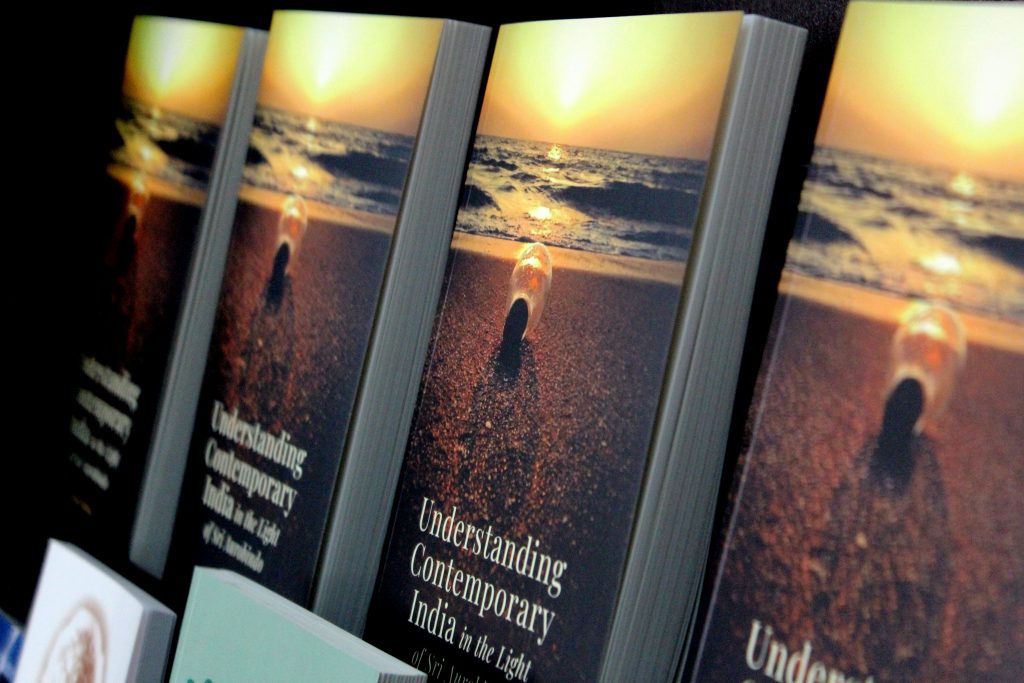
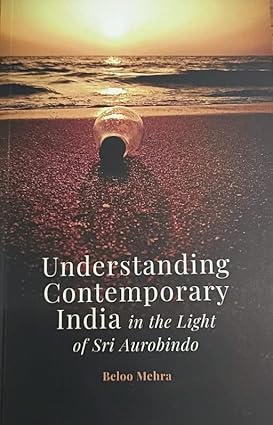
Title: Understanding Contemporary India in the Light of Sri Aurobindo
Author: Beloo Mehra
Publisher: AuroPublications, Sri Aurobindo Society, 207 pages
ISBN: 978-81-7060-430-3
Click to buy
Book Review
One-line summary: A wonderful book to understand contemporary India and Sri Aurobindo!
The year 2022 marked the 150th birth anniversary of Sri Aurobindo, who according to Romain Roland, represented “the most complete synthesis achieved up to the present between the genius of the West and the East”. Seekers and savants contributed their offering to Sri Aurobindo in the form of books, paintings, movies, documentaries and conferences, in order to open the consciousness of Bharat toward the Force Indomitable that the Mahayogi is.
One such fragrant offering is: Understanding Contemporary India in the Light of Sri Aurobindo, a 210 page book of 17 essays by Dr. Beloo Mehra.
Dr. Beloo Mehra is an educator, researcher, writer and editor. Her formal education includes a postgraduate degree in Economics from Delhi University and a PhD in Education from University of Illinois at Urbana-Champaign, USA. Spiritually speaking, she considers herself a person who is seeking her “true intellectual swaraj” (p. 23) with the help of Rishi Sri Aurobindo and The Mother, “her guides, teachers, companions and inspiration”.
Why Sri Aurobindo?
Because, she has “tasted a few drops [from the vast ocean of his Wisdom] so far, but that has been enough to convince [her]… that each drop carries an endless ocean within itself” (p. 22). You must have got the cue or clue by now: she has tasted a few drops from the Elixir Divine in the ocean of Infinity.
This book is written for India, the Bharat of Sri Aurobindo’s dreams and aspirations. In her Prologue, the scholar author writes that the book is meant for “all who are concerned about India’s future as a nation, as a civilization” and “for all who can play their part in this intellectual awakening”. (p.9)
Watch: Author’s Brief Commentary
Some of the major titles of these remarkably refreshing essays are: Introducing Sri Aurobindo; Are We Listening to our Mother? (first-person address to her children by Bharat Mata); On Intellectuals and Thinkers; Are We Quick to Blame the Culture?; Hinduism and Inter-Religious Harmony in India; The Age of Commercialism; Equality and Freedom: Reading What a Yogi Writes about Woman; and Fundamentals of Indian Thought for Re-Envisioning Education for New India. This flaneur was fortunate enough to receive a copy of the book from the author herself, when I visited her office at the headquarters of Sri Aurobindo Society at Pondicherry.
Sri Aurobindo has written at length about the innate infirmities of our nation and one such bottleneck to her national growth and her dream of world-teacher is ‘thought phobia’, our incapacity for deeper and wider thinking and our alacrity for cut copy paste armchair intellectual revolutions. This ‘thought-phobia’ continues after independence with a few “signs of recovery”. (p. 9)
As a deft raconteur and one who is deep in love with Bhawani Bharati, Dr. Mehra has masterfully depicted the agonies and angers of Bharat Mata in the chapter titled Are We Listening to our Mother?:
“Think for yourself. Read more widely, do not follow trends. Surely you are capable of reading more than 200 characters! Do your own research… Do not get swept away by the ‘fad’ of the day. Search for deeper truth, the truth that has withstood the test of time. Think. Think hard, and think deep.” (p. 27).
Read more by the reviewer
In this festival of frills, nowadays, it is fashionable to be called an ‘intellectual’. In a chapter devoted to deeper inquiries about who the actual intellectual is and who isn’t, the author quotes Sri Aurobindo’s wisdom infallible and draws parallels with the ‘public intellectuals’ of our times. This essay gives us tremendous insight on the business of intellectuals. The author emphatically writes that mere “opinionising is not thinking” (p. 45).
The essay titled Are we Quick to blame the Culture? deals with the new fashion of a particular segment of Indian society, who is quick to blame Indian (read Sanatan) Culture for the deeper malaise of the nation. The urge to keep skies clean during Diwali and the intensity to save water during the festival of Holi fall in this category. This trend is relatively new and has few takers but it surely “grabs the narrative”. However, the author makes it clear that sincere introspection, as a people and society, is inevitable but that must not be done with jaundiced eyes and faltering analytic abilities:
“A healthy self-critique is a good thing. But it should not be at the cost of a healthy self-appraisal of our cultural strengths and merits… Why do we have to jump to a hasty and often ill-informed or misinformed conclusion that it is somehow the “Indian culture” that is behind all that is outwardly wrong with Indian society?” (p. 61)
Watch
Reading-Discussion by the Author
With buoyancy and exuberance of sporting the tricolour around, let us be little more considerate patriots and mull over the plain question: Have we built the India that our forefathers envisaged and died for? What about Sri Aurobindo’s India, a resurgent spiritual paradise taking breath in Vedic and Upanishadic ambience? What about the world family? Writing about the young and ‘modern India’ in the essay On Nation and Nationalism, Dr. Mehra calls spade a spade when she pens these lines:
“In Sri Aurobindo’s vision, the modern and free Indian nation was not meant to be a colonial copy with an outer machinery of elaborate bureaucratic structure left over by the British and now merely-to-be-filled by the Indians — though he recognized the necessity for an effective external organization. He envisioned the re-birth of a nation which will be grounded in India’s unique temperament shaped by her spiritual genius and conscious of her true mission”. (pp. 65-66)
Explore more:
Books Featured in Renaissance
Without rediscovery of her inner swaraj, India cannot scale heights of her yesterday glory and reclaim the title of World-teacher, Vishwa Guru. What is that inner swaraj? Well, you have to buy the book!
The author has lived a long professional life in America. She is not blind to the effulgence of the West and highlights the need to learn, whatever we can while “keeping our centre intact”, from the West (pp.115-116). A great teacher must be a great disciple too.
Dr. Mehra’s incisive insights on Indian concept of feminism are also worth mentioning. The reader feels elated to know the actual meaning of nari shakti from this book (p. 164). I started dancing as I read it!
Education is one of most fundamental things we often flounder with. We haven’t developed a comprehensive understanding of education — its purpose, process, instruments, instrumentals, implications and ideals. Chapter fifteen is dedicated to Indian thought and wisdom regarding education, with soul-warming and convincing quotes from Sri Aurobindo.
A good book is never a sealed vault; it is an open window. This book is one such window from where you can see and savour the brilliant horizon touching your eyesight!