Volume VI, Issue 11-12
Author: Narendra Murty
Editor’s Note: There is a common misperception among many that Sri Aurobindo was an extremely grave and serious person. But going through the voluminous correspondence of the Master with Nirodbaran, Dilip Kumar Roy and several other disciples, we find a deeply endearing human and humourous side of the great Mahayogi.
Even when it came to a serious topic such as the conflict between science and religion, Sri Aurobindo could use his charming wit and satire to make a profound point in response to a sceptic’s observation. Read to find more.

The conflict between science and religion in Europe is one of the momentous battles fought in the intellectual domain of man. The most widely known portrayal of this battle is the confrontation between the Roman Catholic Church and Galileo. Over a period of 300 years, which in Europe is known as the Age of Enlightenment, religion as represented by the Church establishment ceded ground to the emerging scientific thought.
Closer to our age, rationalists and philosophers like Bertrand Russell often used humour and satire to discredit and make fun of religion and God. One such satirical attack on the theology of the Church about the proclaimed Benevolence and Omnipotence of God and the seeming impotence and indifference of God to the existence of evil in the world was launched by Anatole France, the French poet and novelist in his book The Gods Are Thirsty.
Question by Dilip Kumar Roy
Dilip Kumar Roy, poet, musician and yogi shared a very deep and intimate bond with Sri Aurobindo. The letters they exchanged forms a huge body of correspondence. Though all of Sri Aurobindo’s responses are recorded in the four volumes of Letters on Yoga and other works such as Letters on Poetry and Art and Letters on Himself and the Ashram, in most cases, the questions that Dilip Kumar Roy put to him are not recorded in these volumes.
In a letter dated 01.08.19321, Dilip Kumar Roy put to Sri Aurobindo a question regarding the seeming impotence and non-interference of God in the affairs of man. Quoting Anatole France, he wrote:
“I so much enjoyed Anatole France’s joke about God in the mouth of the arch-scoffer Brotteaux in his book Les Dieus ont soif (The Gods are Thirsty) that I must ask you to read it.
He addresses Father Longuemarre thus: ‘Either God would prevent evil, but could not, or he could but would not, or he neither could nor would, or he both could and would. If he would but could not, he is impotent; if he could not would not, he is perverse; if he neither could nor would, he is impotent and perverse; if he both could and would, why on earth doesn’t he do it Father?’
I wonder what God might answer to it supposing he should have ever felt inclined to?”
From Renaissance Archives:
Sri Aurobindo on the Principle of Evil
The question, as Anatole France framed it, is one of central problems of Western philosophical thought. Bertrand Russell also raises the same question using his own brand of humour and sarcasm in his various writings like Why I am not a Christian and Unpopular Essays.
By and large, Western theologians have not been able to come up with a response that would satisfy sceptics like France and Russell. They have skirted the issue coming up with explanations like “We cannot know God’s design” or “Lesser mortals like us cannot judge God’s action,” etc. Their responses lean more on the side of their Christian belief or dogma, and display a failure to meet head on the intellectual challenge on its own terms.
A Bit of the Background
The attacks of the rationalists like France and Russell reflect the zeitgeist, the spirit of the times. That was the spirit of Enlightenment in modern Europe, variously known as the spirit of free thinking or free enquiry, modernity or modern scientific thinking, or rationality. Sri Aurobindo terms this stage of human evolution as the Rational Age or the Age of Reason in The Human Cycle.
It was a time in Europe when Christian religion and theology were in the wane after an oppressive reign over the mind of man for more than 1000 years beginning from about 500 AD to 1500 AD – commonly known as the Medieval Age. The Rational Age was now on the march. The Christian religion had lost its throne and pride of place in the minds and hearts of men. Science and rationality as the dominant forces, were in the ascendency.
A new found confidence in the power of human rationality. The miracles of science and technology brought about by the works of Copernicus, Kepler, Descartes, Galileo and Newton had changed man’s worldview from the theological to the scientific. God’s creation and the explanation of the world were no longer dependent on the teachings of the Church fathers and the theologians. Science was coming up with its answers based on experimentation in every field of human endeavour.
Science was the new god in Europe. The attacks of rationalists like France and Russell expressed this rational and scientific worldview.
Sri Aurobindo’s Response
Taking up France’s challenge, comes Sri Aurobindo’s sharp, witty, tongue-in-cheek response defending God’s non-interference in human affairs. Reading this I wonder whether even the good Lord himself would have managed such an inimitable response to the sarcasm of Anatole France, meeting it blow by blow.
“Anatole France is always amusing whether he is ironising about God and Christianity or about that rational Humanity (with a big H) and the follies of his reason and his conduct. But I presume you never heard God’s explanation of his non-interference to Anatole France when they met him in some Heaven of Irony. I suppose, it can’t have been in the heaven of Karl Marx, in spite of France’s conversion before his death.2 God is reported to have strolled up to him and said:
‘I say, Anatole, you know that was a good joke of yours; but there was a good cause too for my non-interference. Reason came along and told me: Look here, why do you pretend to exist? You know you don’t exist and never existed or, if you do, you have made such a mess of your creation that we can’t tolerate you any longer. Once we have got you out of the way, all will be right upon earth, tip-top, A-1: my daughter Science and I have arranged that between us. Man will raise his noble brow, the head of creation, dignified, free, equal, fraternal, democratic, depending upon nothing but himself, nothing greater than himself anywhere in existence.
‘There will be no God, no gods, no churches, no priestcraft, no religion, no kings, no oppression, no poverty, no war or discord anywhere. Universal education will stamp out ignorance and leave no room for folly or unreason in any human brain; man will become cultured, disciplined, rational, scientific, well informed, arriving always at the right conclusion upon full and sufficient data. The voice of the scientist and the expert will be loud in the land and guide mankind to the earthly paradise.
‘A perfected society; health universalised by a developed medical science and sound hygiene; everything rationalised; science evolved, infallible, omnipotent, omniscient; the riddle of existence solved; the Parliament of Man, the Federation of the world; evolution, of which man, magnificent man, is the last term, completed in the noble white race, a humanitarian kindness and uplifting for our backward brown, yellow and black brothers; peace, peace, peace, reason, order, unity everywhere.’
‘There was a lot more like that, Anatole, and I was so much impressed by the beauty of the picture and its convenience, for I would have nothing to do or to supervise, that I at once retired from business, —for, you know that I was always of a retiring disposition and inclined to keep myself behind the veil or in the background at the best of times.
‘But what is this I hear?—it does not seem to me from reports that Reason even with the help of Science has kept her promise. And if not, why not? Is it because she would not or because she could not? or is it because she both would not and could not, or because she would and could, but somehow did not?
‘And I say, Anatole, these children of theirs, the State, Industrialism, Capitalism, Communism and the rest have a queer look —they seem very much like Titanic monsters. Armed too with all the power of Intellect and all the weapons and organisation of Science. And it does look as if mankind were no freer under them than under the Kings and the Churches. What has happened— or is it possible that Reason is not supreme and infallible, even that she has made a greater mess of it than I could have done myself?’
Here the report of the conversation ends; I give it for what it is worth, for I am not acquainted with this God and have to take him on trust from Anatole France.”3
~ Sri Aurobindo, 1 August 1932
~ CWSA, 27: 554-556
The Situation Today
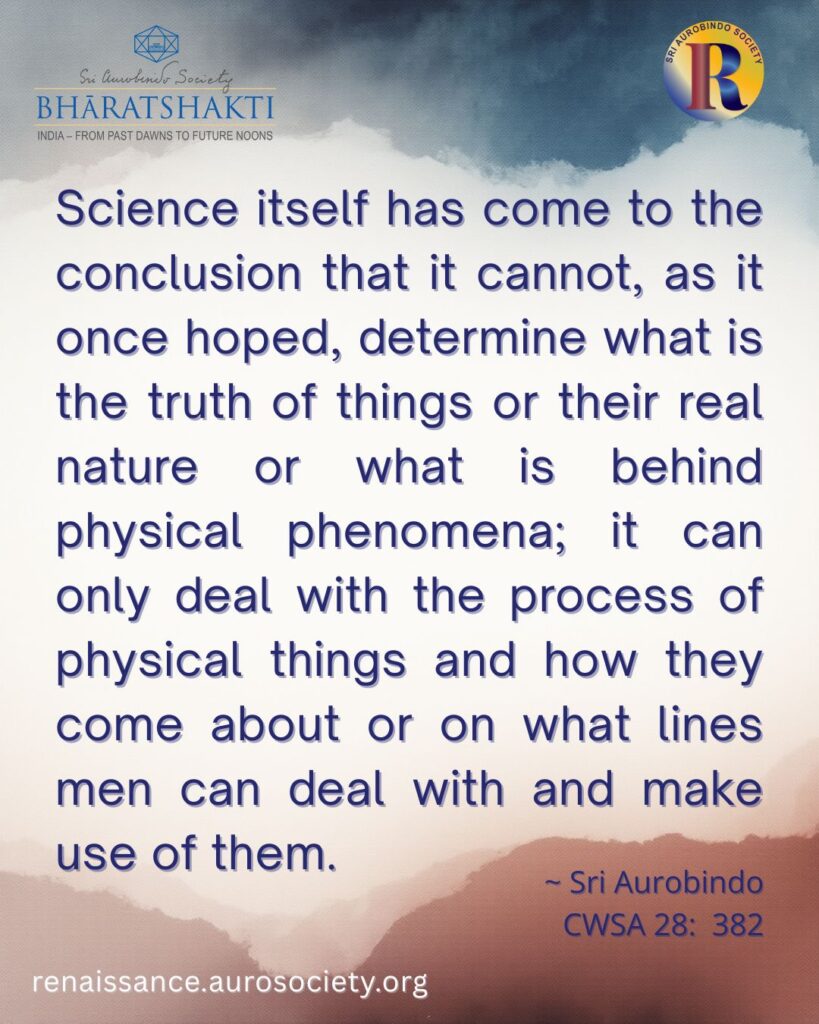
Under the layers of good-natured banter and humour between a Master and a dear disciple (Sri Aurobindo referred to Dilip as “a friend and a son”), the subject matter of the conversation is dead serious and extremely relevant for our times. In Europe, Science had displaced the old religions, but in its turn, science itself became the new religion.
Colonialism helped universalise this Western worldview which values material progress over everything else. As a result, for three centuries now a big chunk of humanity has been looking to science to create a better world – of progress, of abundance, freedom and well-being. This is true even today. The rational mind let go of the churches and the priests and placed all its hopes and trust and resources in the hands of the scientist – to have a better life, to have purpose and meaning in life.
But even after 300 years of science, we are struggling with poverty, disease, illiteracy, malnutrition and social conflict on a global scale. The planet is sitting on an environmental and social time bomb. And the great hope that science and scientific education would make man more rational, more humane, more enlightened also lies reduced to tatters.
Read more in Divine Humour
Human reason itself has reached a dead end. The faith in science as the Messiah, the Saviour has taken a beating, and for good reason. When man displaced religion and put science on the altar, he believed that science would usher in progress and prosperity for all and it would take us to the Promised Land of Peace and Brotherhood as Sri Aurobindo mentions in his humourous reply. But that has not happened!
Sri Aurobindo makes a powerful statement when he writes,
“We have a right to ask whether science, practical reason and efficiency and an unbridled economic production which makes man a slave of his life and body, a wheel, a spring or cog in the huge mechanism or a cell of an economic organism and translates into human terms the ideal of the ant-hill and the bee-hive, is really the whole truth of our being and a sound or complete ideal of a civilisation.”
The only way out of the situation, as suggested by Sri Aurobindo in The Human Cycle, is that the Rational Age should lead us toward the next stage of human evolution, i.e., the Subjective Age, leading further to Spiritual Age. This can materialise only when there is a change in the human consciousness itself. It requires an inward orientation, a search for the inmost truth. And the path for that is called Yoga.
Notes
- In CWSA Volume 27, where Dilip Kumar Roy’s letter is included, quote from Anatole France appears in French. The English translation is found in the first volume of the 4-volume compilation titled Sri Aurobindo to Dilip, published by Hari Krishna Mandir Trust (p. 228) ↩︎
- Anatole France before his death in 1924 became a supporter of the French Communist party. Sri Aurobindo hints at that and even quips that Anatole France could not have met God in a Marxist heaven since Karl Marx did not believe in God. ↩︎
- Though this luminous and humourous exchange has been included in CWSA Vol 27, p.554-556, there we find only the French version of Anatole France’s question. This English version was translated by Sri Aurobindo himself a few days later on Dilip Roy’s request and can only be found in Sri Aurobindo to Dilip, Vol 1). ↩︎
~ Design: Beloo Mehra