Volume VII, Issue 1
Author: Jugal Kishore Mukherji
Continued from Part 2
Editor’s Note: In this part, the author emphasises that an integral spirituality harmonises all knowledge and all experience in the truth of a supreme and all-reconciling oneness. It ordains man to cross beyond death through avidyā and enjoy Immortality by the Knowledge, avidyayā mṛtyuṁ tīrtvā vidyayā’mṛtamaśnute.
To its vision, Matter too is Brahman, annam brahma, and so it does not seek to annul or deny the positive knowledge which Science has gathered from an elaborate investigation and exploration of the processes of life and nature. It only completes it by pointing out that the true foundation is above while the branchings are downward, so that to know the essential truth of things as distinguished from their phenomenal appearances, one has to probe upward and inward instead of remaining content with only surface scrutiny.

Spirituality Reconciled to Science
Such then is the outlook of an integral spirituality that includes and accounts for all so that each truth of experience takes its due place of honour in the whole; it illumines, integralises, harmonises the significance of all knowledge, lower or higher, and gathers together all experience in the truth of a supreme and all-reconciling oneness.
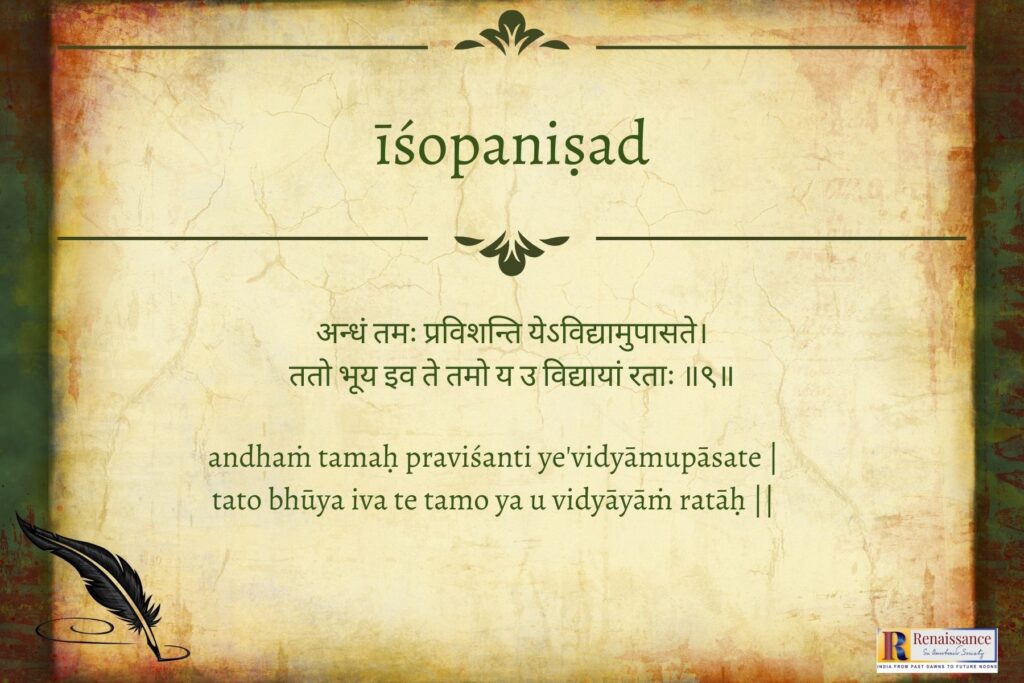
This spirituality is bold enough to declare in unequivocal terms that although it is a fact that without vidyā, the knowledge of the Oneness, avidyā, the relative and separative multiple consciousness, is a night of darkness and disorder, andhaṁ tamaḥ; bhūri anṛta, it is equally true that by excluding the field and operation of avidyā as if it were a thing non-existent and unreal, vidyā itself becomes a sort of obscurity and a source of imperfection, bhūya iva te tamaḥ.
This spirituality ordains man to cross beyond death through avidyā and enjoy Immortality by the Knowledge, avidyayā mṛtyuṁ tīrtvā vidyayā’mṛtamaśnute.
To its vision, Matter too is Brahman, annam brahma, and so it does not seek to annul or deny the positive knowledge which Science has gathered from an elaborate investigation and exploration of the processes of life and nature. It only completes it by pointing out that the true foundation is above while the branchings are downward, ūrdhavudhna nīcīna-śākha (Rig-Veda), ūrdhamūlo’vākśakha (Gita), so that to know the essential truth of things as distinguished from their phenomenal appearances, one has to probe upward and inward instead of remaining content with only surface scrutiny.
Ordinarily it is supposed that when we get to the higher knowledge, the knowledge that seeks to know the truth of existence from within, in its source and reality, by spiritual realisation, the world-knowledge becomes of no concern to us; but “in reality they are two sides of one seeking. All knowledge is ultimately the knowledge of God, through himself, through Nature, through her works” (Sri Aurobindo, CWSA, 23: 513).
And therefore, since all sincere pursuit after knowledge, if not vitiated and coarsened by a too earthward tendency, tends ”to refine, to subtiliise, to purify the being”, a spirituality turned towards an all-embracing realisation of the supreme here upon earth cannot and will not exclude and throw away the forms and achievements of the so-called lower knowledge, nor will it shrink from the splendid toil and many-sided victory which the Cosmic Spirit has assigned to himself in the human creature. In the words of Sri Aurobindo:
“…all activities of knowledge that seek after or express Truth are in themselves rightful materials for a complete offering; none ought necessarily to be excluded from the wide framework of the divine life.
“The mental and physical sciences which examine into the laws and forms and processes of things, those which concern the life of men and animals, the social, political, linguistic and historical and those which seek to know and control the labours and activities by which man subdues and utilises his world and environment, and the noble and beautiful Arts which are at once work and knowledge,—for every well-made and significant poem, picture, statue or building is an act of creative knowledge, a living discovery of the consciousness, a figure of Truth, a dynamic form of mental and vital self-expression or world-expression,—all that seeks, all that finds, all that voices or figures is a realisation of something of the play of the Infinite and to that extent can be made a means of God-realisation or of divine formation.”
Even after his spiritual attainment, siddhi, a man of integral spirituality will continue to take interest in the knowledge of the world, in the “contemplation of God in Nature”, and his “aim in the sciences that make for knowledge should be to discover and understand the workings of the Divine Consciousness-Puissance in man and creatures and things and forces, her creative significances, her execution of the mysteries, the symbols in which she arranges the manifestation. The Yogin’s aim in the practical sciences, whether mental and physical or occult and psychic, should be to enter into the ways of the Divine and his processes, to know the materials and means for the work given to us so that we may use that knowledge for a conscious and faultless expression of the spirit’s mastery, joy and self-fulfilment.” (ibid., p. 142)
In spirituality understood in the way as we have ventured to delineate above — and which, we trust, recaptures the spirit of our ancient Indian Wisdom, purāṇi prajñā, lies the harmonising light and law. And the supposed antinomy between Science and Spirituality is at least resolved from the latter’s side. But what about the former? Is Science ready to clasp the hand of co-operation stretched by such a dynamic spirituality? Or will it rather by its very nature remain estranged from all spirituality of whatever sort that may be?
Here, again, our answer is in the negative. But to substantiate our proposition, we must first of all see what Science is, what its methodology, and what the outlook implied in its successful pursuit.
The Common Ground of Essential Attitude
One fact immediately arising out of even a cursory view of nature is the permanence of an over-riding rhythm in the sensate world of becoming and movement. In the absence of this rhythm, nature would have been totally incomprehensible, our memory useless, all science impossible and the activity of man blind and aleatory. Science is the discipline through which man attempts to catch this rhythm and imprison it in the framework of a precise formulation.
Now, all that is ordinarily knowable in phenomena is function and all discursive knowledge of which science is only a specialised form is nothing more than functional correspondence. Science replaces the study of the ontological content of a phenomenon by a functional explanation, and this explanation is sought by the application of both theory and experiment. The explanation in Science is not “revelatory” but “prognostic”: “scientific truth is a prediction, or rather a predication…. Above the subject, beyond the immediate object, modern Science bases itself on pro-ject.” (G. Bachelard, Le Nouvel Esprit Scientifique).
Now it is a striking fact of good augury that a proper pursuit of scientific research calls for and develops in the scientist certain qualities of head and heart, a psychological poise and a certain global attitude that are at the same time very much needed in the fulfilment of a dynamically positive spiritual seeking. Mention may be made of:
- an intense mental concentration that ruthlessly eliminates all idle wandering of mind;
- a boundless patience and an unflagging perseverance in the ceaseless search after truth;
- strength of “character to seek the truth even when we have reason to fear that it will not be to our liking”; (A. d’Abro, The Rise of the New Physics, pp. 9-10)
- “sincerity to accept the truth when this truth happens to contradict all that we have previously professed;” (ibid.)
- “modesty to recognise that man… must stoop to experiment” to attain to truth; (ibid.)
- a spirit of heroic adventure that does not shun problems, rather confronts them with zest only to conquer them;
- a creative imagination eager to strike out new pathways, to open up new vistas and explore new avenues to the unknown and the unconquered;
- determination not to get lost in the diversity of appearances but rather to penetrate deeper and wider into the mystery of things until one gets at the veiled connections and the underlying essential unity (cf. bahūnāmekaṁ bījaṁ bahudhā yaḥ karoti);
- readiness to sacrifice one’s time and energy in an attempt to raise, even if a little more, the veil covering the face of truth;
- a positive and discriminating and constructive faith that steers clear of the two extremes of superstitious belief and sterile doubt.
It is not without significance that the Mother has remarked: “the method of scientific work is a marvellous discipline. Those who follow it in all sincerity truly prepare themselves for Yoga. It requires but a slight turn, somewhere in their being, which will enable them to come out of their a little too narrow point of view and enter into an integrality which will surely lead them toward the Truth and the supreme mastery” (Bulletin of Sri Aurobindo International Centre of Education).
It may be noted in this connection that “Yoga [itself] is scientific to this extent that it proceeds by subjective experiment and bases all its findings on experience; mental intuitions are admitted only as a first step and are not considered as realisation—they must be confirmed by being translated into and justified by experience” (Sri Aurobindo, CWSA, 28: 380).
But in order to obviate any possible chance of misunderstanding it must be forthwith stated that the “subjective discovery must be pursued by a subjective method of enquiry, observation and verification; research into the supraphysical must evolve, accept and test an appropriate means and methods other than those by which one examines the constituents of physical objects and the processes of Energy in material Nature” (Sri Aurobindo, CWSA, 22: 676).
Here at this point there is some scope for serious misgivings about the prospect of reconciliation between Science and Spirituality. For, it is generally asserted that the methods adopted by the seekers of Yoga to attain to knowledge as well as the very content of this “knowledge” go counter to the basic methodology of Science and are hence altogether to be put out of court! But these objections are more apparent than real and spring from a superficial view of things and from entire misunderstanding of the case for spiritual seekers. For, what is after all the methodology of Science and, shorn of all appendages, what are its fundamental traits?
To be continued in the next issue…
READ
Part 1
Part 2
~ Design: Beloo Mehra