Volume VII, Issue 1
Author: Ashish Iyer
Editor’s Note: As the new and rising India continues to wake up to the timeless truths of her heritage and carefully re-examine their significance in the contemporary world, it is also walking steadily on the path to discover erased or forgotten chapters of her more recent history. For instance, India today refuses to believe that freedom was or could have been won by ahimsa alone, and has been steadily bringing to light the immense role played by revolutionaries of many hues in India’s long struggle for freedom from the British colonial rule.
In this regard, let us recall a letter of Sri Aurobindo dated 19 April 1949. The correspondent’s question is in italics; Sri Aurobindo dictated his response to his secretary.
Correspondent: It is common today to read and hear the statements of influential Indian leaders condemning the revolutionary efforts of their compatriots in bygone years. Yet I think that there is little doubt but that the Bengali “revolution”, to name one phase of the larger movement, was of paramount importance in the understanding and realisation of the goals for which the nationalism of the 20th century was heading.
Sri Aurobindo’s response:
Sri Aurobindo has received your letter. He says there were two wings to the Independence Movement. First, there was the external political and constitutional movement. And secondly there was the revolutionary movement which meant a preparation for an armed revolt. He considered both the movements necessary and had his share in preparing both.
In the current issue, we feature a review of a recent book by Sanjeev Sanyal titled Revolutionaries: The Other Story of How India Won Its Freedom. The reviewer Ashish Iyer is one of the two new authors to join the Renaissance Authors team from this issue.
About the Reviewer:
Ashish Iyer is an Indology and history enthusiast with a deep, lifelong engagement in literature and research. Having read over hundreds of books, he brings a wide and nuanced perspective to every book he explores. For the past 5-6 years, he has been reviewing books with a focus on cultural depth, historical accuracy, and narrative integrity. His reviews aim to bridge scholarly insight with accessible, thoughtful critique.

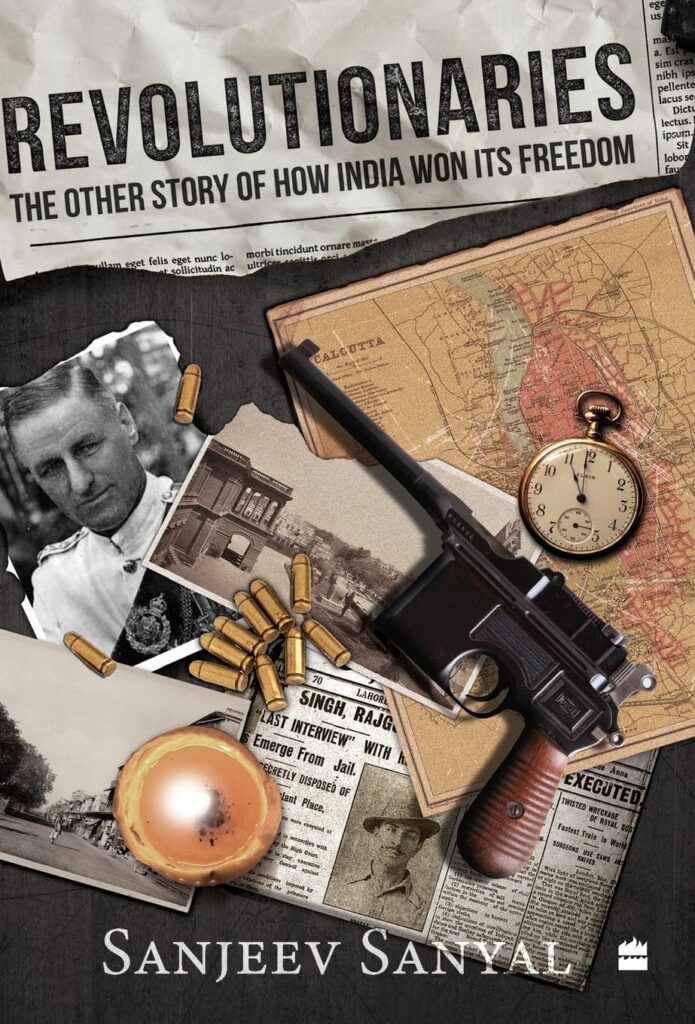
Book Details
Title: Revolutionaries: The Other Story of How India Won Its Freedom
Author: Sanjeev Sanyal
Publisher: HarperCollins India (10 January 2023); Prakash Books India Pvt Ltd, New Delhi; 364 pages
ISBN-10: 9356295948 ISBN-13: 978-9356295940
Click to buy
I recently read Sanjeev Sanyal’s book titled ‘Revolutionaries: The Other Story of How India Won Its Freedom‘. My one-line summary and suggestion to all: Read it not merely as a lesson in history, but as an act of remembrance.
This book feels like lifting a veil revealing a vast, restless world of freedom fighters whose names, sacrifices, and dreams were quietly pushed out of our textbooks. Reading it hit me hard. Page after page, it felt as though I was discovering a hidden spine of the Indian freedom struggle. It is the spine that rarely enters public conversation yet carried immense courage, planning, and resolve.
These revolutionaries were not impulsive or “random violent extremists,” as they are so often reduced to by those interested in pushing a particular agenda in the national discourse. They were strategists, thinkers, and organizers who built a sophisticated international network stretching across India, the United States, Britain, and Japan. For decades, they plotted against imperialism with astonishing patience and fearlessness, fully aware of the personal cost they would have to pay.
Sanyal takes us through the lives and movements of figures and moments that shaped this underground resistance. When writing about Aurobindo Ghosh, Madan Lal Dhingra, Veer Savarkar, Udham Singh, Subhas Chandra Bose, Bhagat Singh, Chandrashekhar Azad, the Kakori robbery, the Ghadar Movement, the Naval Uprising, India House, he places each and every one of these carefully within the social and political climate of their times. What makes the book exceptional is not just the breadth of history it covers, but the way it is told.
Not Dry Academic History
Sanyal is a gifted storyteller. This is not dry, academic history weighed down by dates and footnotes. Instead, it unfolds as a deeply human narrative, rich with anecdotes and intimate details that bring these revolutionaries to life. It makes alive for the readers their fears, their hopes, their disagreements, and their unshakable love for the nation. You don’t just learn what they did; you feel who they were.
As the story progresses, you begin to understand why their sacrifices were buried, why their names faded while others were elevated. That realization is devastating. Their pain, their courage, their willingness to give everything for their matrubhumi deserve to be felt and remembered. At times, the book is genuinely heartbreaking. You may find yourself weeping not only for the lives they lost, but for our collective failure to honor them properly.
This book doesn’t just inform; it unsettles, humbles, and awakens. It demands that we remember. I highly recommend it to all interested in India, her past, present and her future. Don’t miss it.
About the Author:
Sanjeev Sanyal is a bestselling writer, environmentalist and internationally recognized economist. Currently, he is the Principal Economic Adviser to Government of India. Prior to joining the government, he spent two decades in international financial markets and was Global Strategist and Managing Director of one of the world’s largest banks. He is the author of several bestselling books including The Indian Renaissance: India’s Rise After a Thousand Years of Decline, Land of the Seven Rivers: A Brief History of India’s Geography, The Incredible History of India’s Geography, and The Ocean of Churn. His columns and articles have appeared in many of the world’s leading publications.
Winner of several prestigious national and international awards for his work in the areas of environmental and development policy, Sanyal has also been a Senior Fellow of the World Wide Fund for Nature (formerly World Wildlife Fund), an Adjunct Fellow of the Institute of Policy Studies, SIngapore, and a Visiting Scholar at Oxford University.
From Renaissance archives:
Remembering Bagha Jatin
~ Web design: Beloo Mehra