Volume VII, Issue 2-3
Author: Beloo Mehra
Continued from PART 1
Greater Individual Fulfillment
In such a society, there would be a wider human tendency to live through and with pain, death and loss as the needed grist for the mill so that individual soul may progress and grow through such experiences. Humanity would recognize that the misery and violence resulting from exaggerated mental, vital and physical ego are crude but necessary steps to a golden future that is evolving through these stumbling efforts.
There would be a kinder and more compassionate understanding and acceptance of those dark moments and life-phases that are part of overall human experience, and these would be seen as opportunities for deepening one’s transformation. Peace would come from the realization that we are on an endless journey to perfection. Tranquility would come from the knowledge that every little victory along the way is a marker to the countless victories that await us, and every little failure along the way is a sure sign of even more countless victories that await us.
Calm courage of the spirit would be the inner guide as individuals move through various stages and phases of life. Individuals would realize the inherent ideal purpose of their work. Writers’ hearts would open wide to receive experiences and realizations that are translated into words and woven in beautiful prose and poetry that avoid unnecessary sensationalism and convey the deepest truths and ideals of human experience.
Artists and sculptors would be creating forms that will carry them and their patrons into the realms and imaginations of formless. Musicians and singers would in their music bring forth the stirrings of the depths of their souls and create a bridge between the form and formless for the listeners. Dancers would bring into being deep, wide formless truths through their graceful forms and movements in front of which all purified human hearts would involuntarily bow in utmost humility.
Children would grow with self-discipline that comes from deeper freedom, not with mindless confusion and mind-numbing authority. Parents would discover the true spirit behind the words – “child is the father of man.” Teachers and students would be co-learners in their journeys to discover and uncover the truths of the world; they would collaborate in a mutually respectful manner and deeply appreciate and grow from their differences.
Education would not be a business, and businesses would be managed through human-centered and consciousness-based approaches. Business leaders would worry less about the balance in their bank accounts but more about the balance in their junior-most employee’s retirement accounts.

Collective Fulfillment
Wealth-generation as an important social activity would have regained its heart and would realize its purpose in creating a warm luxurious reign of beauty, harmony, comfort and contentment for all. The weakest and poorest sections of the society would be looked after by an enlightened socialistic economic setup where individual freedom and enterprise is just as valued and encouraged as state-run programs and enterprises. A spiritualized ethic of compassion and caring for all creation would guide social action.
In this future society, we may find small, sufficiently self-reliant economic and social aggregates that are freely formed by individuals who have come together because of common interests, backgrounds, and affiliation. These aggregates would encourage people to practice the kind of work that is deeply meaningful and fulfilling, but in the name of self-reliance and self-sufficiency there will be no pressure to cover all needed areas of economic activity.
The sphere of economic activity would be determined by the creative potential of the people in a community, and the availability of natural and other resources available to them where they are based. Reasonably regulated exchange of goods and services among the aggregates would be preferred without encouraging mass and unlimited production of goods and services that could lead to unbridled commercialism, industrialism, and rule of the market.
A small group of elected officials would use a consensus-based decision making process to manage the necessary administrative functioning of the aggregate. Politics, law-enforcement, and other much-needed administrative and governmental activities would be chosen as life’s work by those individuals who see these fields of action as instruments with a deeper purpose to bring forth the ideal of Divine Life on earth. These individuals would work toward increasing transparency in legislative, executive and judicial branches of government.
Such smaller aggregates would be loosely and freely held together by a common spirit that ties them to larger aggregates. People would be relatively freer to move from one social aggregate to another, would be able to make decent living in new places, and this type of migration and assimilation would somehow be smoother because of the already-loosening hold of one’s social and cultural egos that could prevent one from connecting to somewhat unfamiliar cultural and social norms.
The tendency of political, social and cultural aggregates would not be to dominate or devour the ones that are relatively weaker and poorer, but to aid them to grow and develop with their unique identities and traditions intact and blossoming. Cultural traditions, practices and values would not be marketable items, but there would be a free-flowing exchange of ideas and thoughts leading to new forms of synthesis of a variety of traditions and practices.
The larger aggregate would be secure in the unity of its spirit and in the diversity of its forms. With full confidence in such deep and inner security these aggregates would interact with other large and small aggregates and collectivities in the spirit of mutual respect and peaceful co-existence. Compassionate progressivism, free-spirited interdependence, shared prosperity and a free unity of nations would guide international diplomacy.
More Must Be Done
Such a vision of future society representing an age of true subjectivism sounds very ideal and a really great improvement over what we have at present. As utopian and difficult to achieve as this vision looks to us at present, it must be remembered that even a truly subjective society is not the end of the journey of a conscious, awake humanity.
It is perhaps true that being on the journey itself makes conscious and awake human beings see the glimpses of the perfection that they are inherently capable of creating every moment. But more must be done if an age of true subjectivism has to lead to an age of spirit, if the Truth of a spiritualized society and a divine life based on a supramental consciousness is to be established.
If a subjective age…is to find its outlet and fruition in a spiritualised society and the emergence of mankind on a higher evolutionary level, it is not enough that certain ideas favourable to that turn of human life should take hold of the general mind of the race, permeate the ordinary motives of its thought, art, ethics, political ideals, social effort, or even get well into its inner way of thinking and feeling.
It is not enough even that the idea of the kingdom of God on earth, a reign of spirituality, freedom and unity, a real and inner equality and harmony—and not merely an outward and mechanical equalisation and association—should become definitely an ideal of life; it is not enough that this ideal should be actively held as possible, desirable, to be sought and striven after, it is not enough even that it should come forward as a governing preoccupation of the human mind.
That would evidently be a very great step forward,—considering what the ideals of mankind now are, an enormous step. It would be the necessary beginning, the indispensable mental environment for a living renovation of human society in a higher type. But by itself it might only bring about a half-hearted or else a strong but only partially and temporarily successful attempt to bring something of the manifest spirit into human life and its institutions…
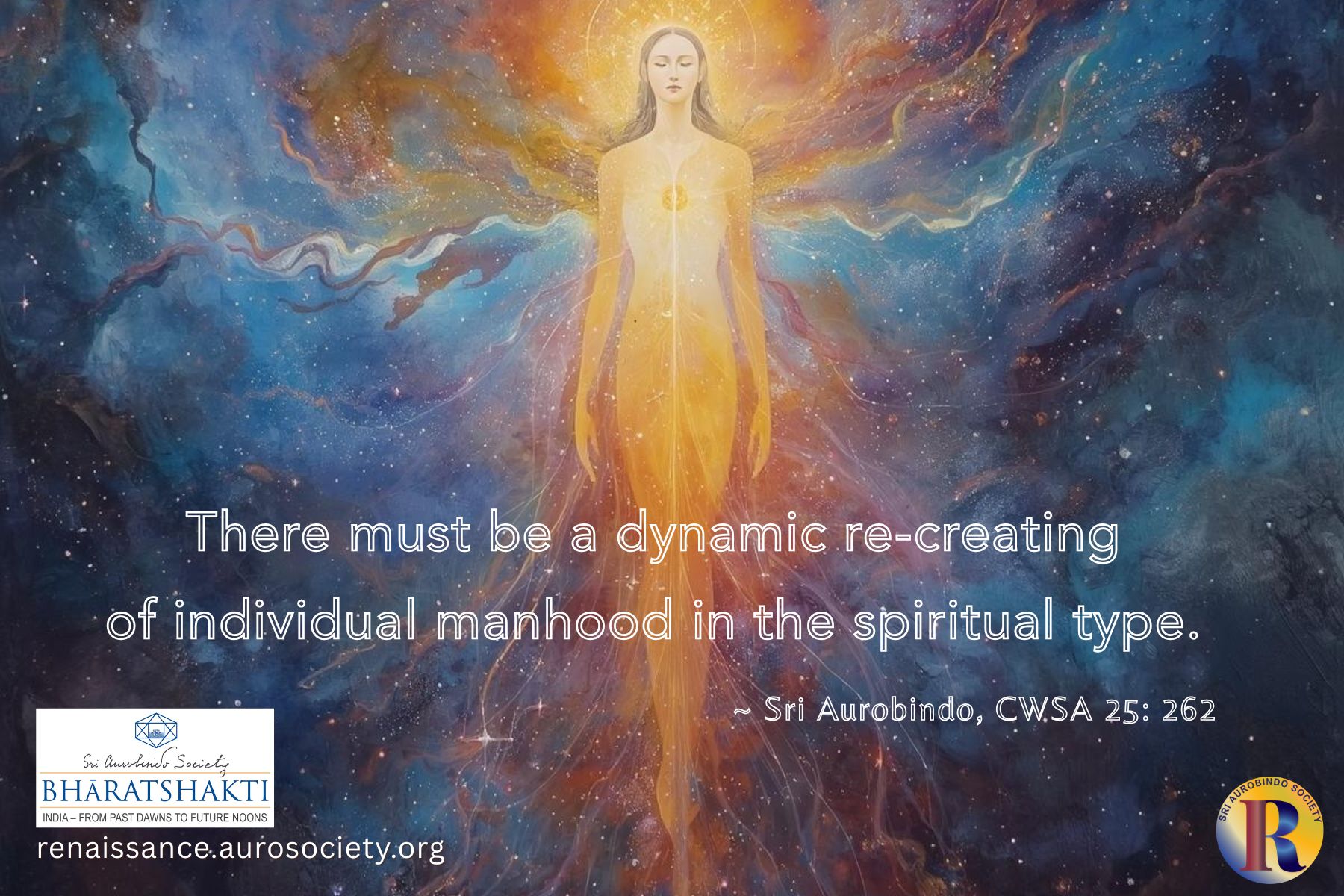
More is needed; a general spiritual awakening and aspiration in mankind is indeed the large necessary motive-power, but the effective power must be something greater. There must be a dynamic re-creating of individual manhood in the spiritual type.
~ Sri Aurobindo, The Human Cycle, CWSA, 25: 261-262
READ PART 1
~ Design: Beloo Mehra