Volume VII, Issue 5
Author: Jugal Kishore Mukherji
Continued from Part 4
Editor’s Note: In this part, the author continues to examine objections raised by Science against Spirituality with the help of insights from Sri Aurobindo. He discusses that there need not be any essential contradiction between the results gathered by Science and those obtained by Spirituality in their respective fields.

IV. Argument: A spiritual experience cannot be scientifically demonstrated and hence lacks in concrete certitude.
Critique: It has been asserted that although the scientific process is in the last analysis reduced to two main activities, discovery and demonstration, “it is in the process of demonstration that we discern man’s efforts as scientific. Discovery is an art, demonstration makes the science”.1
Now, by demonstration the physical sciences ultimately mean “demonstration to the physical senses” — if necessary in a roundabout and indirect way and by means of mathematical and technological devices. But the final appeal in the sciences is always to sense-observation. And this because “science can treat the outer world solely on the level of phenomena (‘things that appear’, ‘appearances’) [and] these can appear only to the senses that we possess…. Phenomena must [thus] ultimately be sensed,… though sense-experience may for some sciences (and perhaps eventually for all) be ultimately reducible to scale-readings.”2
Now, spiritual and supraphysical experiences cannot of course be demonstrated in this way, for, by their very definition, they transcend the order of physical facts and are not thus physically tangible. But that does not mean in any way that spiritual experiences lack in concrete certitude or are vague, amorphous and open to doubts.
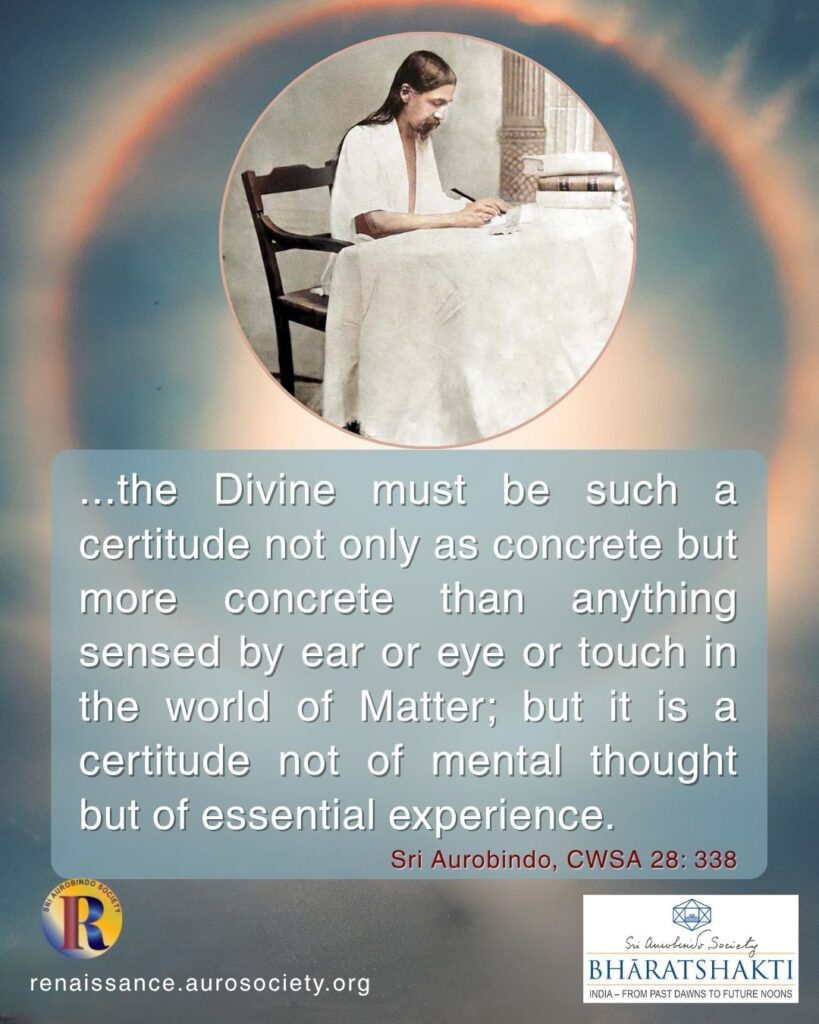
They are “not only as concrete but more concrete than anything sensed by ear or eye or touch in the world of Matter; but it is a certitude not of mental thought but of essential experience…. You can much less doubt it or deny it than you can deny or doubt daylight or air or the sun in heaven— for of these physical things you cannot be sure but they are what your senses represent them to be; but in the concrete experience of the Divine, doubt is impossible.”3
***
V. Argument: The objective Reality being the only entire truth and an objective knowledge the sole entirely reliable knowledge, the value of spiritual experiences is very doubtful since they are subjective and not objective.
Critique: Apart from the general truth that all knowledge and experience, without any exception, — even of the so-called objective external physical things, — is at bottom subjective, we may ask if Science itself, at the end of its victorious analysis of Matter, has not come to the astonishing conclusion that “precisely beyond our natural perceptual world the very concept of thing can be defined only in relation to the man to whom it appears or who himself makes it… contemporary physics compels the physicist to look upon himself as a subject.”4 The words of Heisenberg, the author of the uncertainty principle, are eloquent on this point:
We can no longer consider ‘in themselves’ those building-stones of matter which we originally held to be the last objective reality. This is so because they defy all forms of objective location in space and time, and since basically it is always our knowledge of these particles alone which we can make the object of science….
From the very start we are involved in the argument between nature and man in which science plays only a part, so that the common division of the world into subject and object, inner world and outer world, body and soul, is no longer adequate and leads us into difficulties. Thus even in science the object of research is no longer nature itself, but man’s investigation of nature. Here, again, man confronts himself alone.5
As a matter of fact, subjectivity and objectivity are not independent realities; the subjective and the objective are two necessary sides of the manifested Reality and of equal value. Only they are of different orders of reality.
… the objective and physical… is convincing to the physical or externalising mind because it is directly obvious to the senses, while of the subjective and the supraphysical that mind has no means of knowledge except from fragmentary signs and data and inferences which are at every step liable to error.6
Does not the Kathopanishad point out that in men the Self-Existent has cut the doors of consciousness outward, but a few men turn the eye inward and it is these who see and know the Spirit and develop the spiritual being?
Men of science should note that our subjective movements and inner experiences are a domain of happenings as real as any outward physical happenings, with laws of their own and their special method of scrutiny and affirmation and hence “to refuse to enquire upon any general ground preconceived and a priori is an obscurantism as prejudicial to the extension of knowledge as the religious obscurantism which opposed in Europe the extension of scientific discovery”.7
***
We have come to the end of our survey of the respective standpoints of Science and Spirituality. Because of the inadequacy of space, this survey could not but content itself with the throwing in of some suggestive hints; it does not claim in any way to have disposed of all possible factors of supposed divergence between the two disciplines. But however cursory this survey may have been, it has shown us that the contradictions between Science and Spirituality are most often more apparent than real and hence a luminous reconciliation between them is absolutely a feasible proposition and programme.
The Co-operative Reconciliation
“Half-truth is its own Nemesis. One-sided dogmatism has the opposite dogmatism latent in itself.”
The conflict between Science and Spirituality arises from a misunderstanding of each other’s position, role and field of study. And it is not so much on the positive side, on the side of vindication of one’s own right to exist and grow; it is more often on the negative side, and therefore unnecessary and eliminable, when one tries to deny the right of existence to the other. And this is nothing but an error of misdirected enthusiasm and the folly of the presumptuous vital in man.
A positive spirituality appreciates the worth of the achievements of Science in its own domain: it does not deny the reality of the rich harvest that men of science have gleaned from an elaborate investigation and exploration of physical Nature. But Science too, on its part, should not hesitate to admit that “the material universe is only the façade of an immense building which has other structures behind it”8, and that “there are in the universe knowable realities beyond the range of the senses and in man powers and faculties which determine rather than are determined by the material organs through which they hold themselves in touch with the world of the senses.”9
For indubitable inner experiences testify to the existence of supraphysical planes of existence having their “universal rhythm, their grand lines and formations, their self-existent laws and mighty energies, their just and luminous means of knowledge”.10 And physical sciences should not unduly claim to pronounce anything on these matters for which it has no means of enquiry nor any possibility of arriving at any valid decision.
As a matter of fact, for a harmonious reconciliation between the pursuit of science and the practice of spirituality, it is essential never to lose sight of the fundamental truth that each of them has its own province and its own method of enquiry and each is valid in its own domain. Trouble is bound to arise if there is an unwarranted and illegitimate intrusion of one in the other’s arena.
Science cannot dictate its conclusion to the man of Spirit any more than Spirituality has the right to impose its own on the scientist and his work in the domain of the physical. Indeed, as has been mentioned before, the physical scientist probing into phenomena erects formulas and standards based on the objective and phenomenal reality and its processes, while the Yogi or the supraphysical scientist concerns himself with the essential Reality and his deeper probing brings up the truth of Self and Spirit and all possible experiences of the subjective inner domain.
But there need not be any essential contradiction between the results gathered by Science and those obtained by Spirituality in their respective fields — if only one knows how to read and interpret them. After all, the Reality is one and unique everywhere and hence there must be systems of correspondences expressive of a common Truth underlying all the domains of manifestation.
Thus the truths of the physical universe can very well throw some light on the phenomena of the inner world and vice versa, and the possibility of co-operation between Science and Spirituality in the pursuit after truth remains no longer a fond wish or pious hope. As Sri Aurobindo has so pointedly remarked:
Not only in the one final conception, but in the great line of its general results Knowledge, by whatever path it is followed, tends to become one. Nothing can be more remarkable and suggestive than the extent to which modern Science confirms in the domain of Matter the conceptions and even the very formulas of language which were arrived at, by a very different method, in the Vedanta, — the original Vedanta, not of the schools of metaphysical philosophy, but of the Upanishads.
And these, on the other hand, often reveal their full significance, their richer contents only when they are viewed in the new light shed by the discoveries of modern Science.11
Continued in Part 6
READ
Part 1
Part 2
Part 3
Part 4
Notes
- Charles Singer, “Science” in Encyclo. Brit., Vol. XX, p. 115. ↩︎
- Ibid., p. 114. ↩︎
- Sri Aurobindo, CWSA, 28: 338-339 ↩︎
- Weizsäcker, The World View of Physics. ↩︎
- Heisenberg, The Physicist’s Conception of Nature, p. 24. ↩︎
- Sri Aurobindo, CWSA, 22: 675 ↩︎
- Ibid., p. 677 ↩︎
- Sri Aurobindo, CWSA, 28: 394 ↩︎
- Sri Aurobindo, CWSA, 21: 11 ↩︎
- Ibid., p. 21 ↩︎
- Ibid., p. 16 ↩︎
~ Design: Beloo Mehra