Volume VII, Issue 5
Author: Jugal Kishore Mukherji
Continued from Part 5
Editor’s Note: In this concluding part, the author remarks that a sincere and unbiased pursuit of any branch of human knowledge, if not hampered with erroneous preconceptions and ill-founded prejudices, cannot but lead the seeker to the door-step of the integral approach to Reality as propounded by Sri Aurobindo.

One of the encouraging signs of our day conducive to the reconciliation between Science and Spirituality is the growth of a spirit of modesty in the bosom of Science itself, arising out of a sober and mature comprehension of the limited but definite role that it can play. Science has abandoned the claim to put at our disposal a final truth; it knows that it has no means to decide what is the real reality of things; it can envisage only the how and the process of the operations of material Force in the physical front of things, but the essence of things eludes its grasp.
Science which started with the assumption that Matter is the sole reality has come to realise its inherent impotency before the problem of the reality of things and thus, as Sri Aurobindo has put it,
The rock on which materialism was built and which in the 19th century seemed unshakeable has now been shattered. Materialism has now become a philosophical speculation just like any other theory; it cannot claim to found itself on a sort of infallible Biblical authority, based on the facts and conclusions of Science.1
Gone is the presumptuous conviction that Matter is the basic and unique Reality, and that the Divine, the freedom of the Spirit, the immortality of the Soul are all myths of an unscientific temperament and Honni soit qui trop y pense.
Science is now poignantly aware that the world-knowledge it builds up as an abstracted and therefore partial and imperfect knowledge, leaves out much that is refractory to scientific treatment, and even in its delimited field of enquiry, the formulas of Science, although pragmatically correct and governing the practical how of things, do not disclose the intrinsic how or why; “rather they have the air of the formulae of a cosmic Magician, precise, irresistible, automatically successful each in its field, but their rationale is fundamentally unintelligible”.2
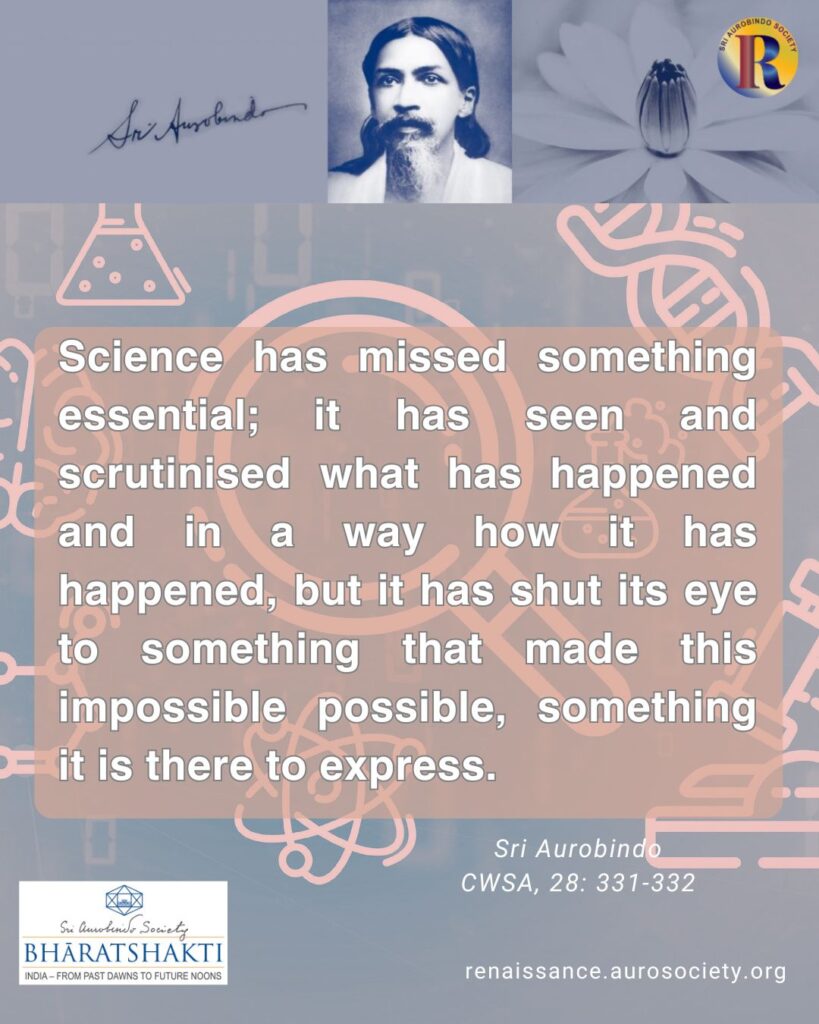
Evidently, present-day “Science has missed something essential; it has seen and scrutinised what has happened and in a way how it has happened, but it has shut its eye to something that made this impossible possible, something it is there to express. There is no fundamental significance in things if you miss the Divine Reality; for you remain embedded in a huge surface crust of manageable and utilisable appearance.”3
Now, to help us to come out of this narrow surface crust and sound the depths and heights of inner and higher spiritual realities and bring their riches into active manifestation in our life, is one of the functions of Yoga and Spirituality. For, to reach a satisfactory solution of the problems, both individual and collective, that are besetting the life of humanity today, men must know not only what Matter is and what its processes and potentialities are, but also spirit and soul and all that is behind the material surface.
As a matter of fact, as Sri Aurobindo has pointed out, if man is not to remain content with his ordinary status of a being of surface ignorance seeking obscurely after the truth of things and collecting and systematising fragments and sections of knowledge, and if he would like his life upon earth to take something of the hue of a life divine, his self-expansion has to proceed on more than one line.
He must know himself and discover and utilise all his potentialities: but to know himself and the world completely he must go behind his own and its exterior, he must dive deep below his own mental surface and the physical surface of Nature. This he can only do by knowing his inner mental, vital, physical and psychic being and its powers and movements and the universal laws and processes of the occult Mind and Life which stand behind the material front of the universe….
He must know also the hidden Power or Powers that control the world… and link [himself] with the Divine and in so doing sublimate the thought and life and flesh so that they may admit the rule of the soul and spirit. But this knowledge must be something more than a creed or a mystic revelation; his thinking mind must be able to accept it, to correlate it with the principle of things and the observed truth of the universe….
But all knowledge and endeavour can reach its fruition only if it is turned into experience and has become a part of the consciousness and its established operations; an opening up of the spiritual consciousness,… the building of a life and action that is in conformity with the truth of the spirit: this is the work of spiritual realisation and experience.4
And in this all-round fulfilment of man’s many-sided aspiration, Science and Spirituality can very well co-operate and offer each other their helping hands, anyonyabaddhavāhu. To outgrow their mutual mistrust and popularly supposed conflict, what is needed is the rise of a dynamic spirituality that accepts embodied Life and its all-sided opulent growth as something worthy of pursuit, also the rise of a mood of science that displays an attitude of unbiased humility before truth whenever and in whatever form it may be found, so that the sceptical folly of a so-called scientific attitude does not confront the supernormal experiences of the inner and higher worlds with “the stiletto of doubt and the bludgeon of denial.”
For it cannot but be stressed to the point of monotonous repetition that what “all our mind-knowledge and sense-knowledge and suprasensuous vision is seeking, is found most integrally in the unity of God and man and Nature and all that is in Nature.”5
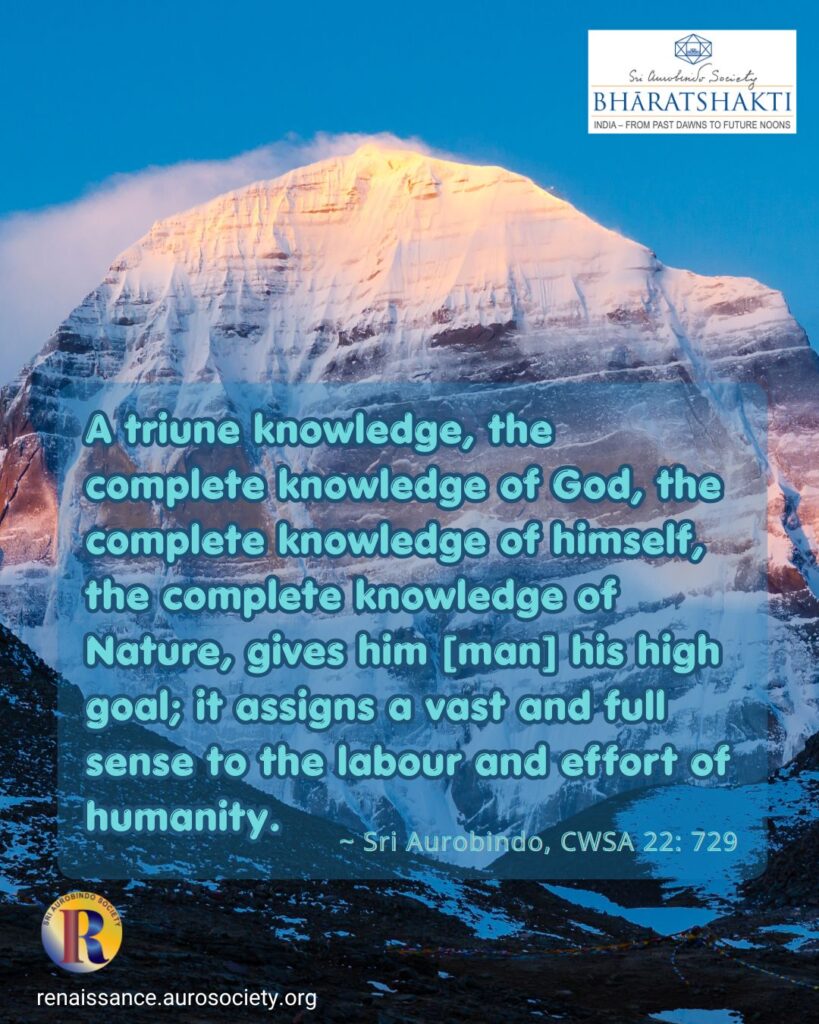
A triune knowledge, the complete knowledge of God, the complete knowledge of himself, the complete knowledge of Nature, gives him [man] his high goal; it assigns a vast and full sense to the labour and effort of humanity.
The conscious unity of the three, God, Soul and Nature, in his own consciousness is the sure foundation of his perfection and his realisation of all harmonies: this will be his highest and widest state, his status of a divine consciousness and a divine life and its initiation the starting-point for his entire evolution of his self-knowledge, world-knowledge, God-knowledge”.6
It is not expected that everybody will be a yogi or everybody a practising scientist. But in order that a few can be effectively the same for the welfare of all, also for the general flowering of Science and Spirituality, it is absolutely essential that the collective mind of man accept (i) the simultaneous necessity of both the disciplines for the eradication of the multipronged ills of man and his society, and (ii) the validity and truth of each of them in its own field of search.
And then will surely open the still locked-up gates to the enormous vistas of the future development of man.
As a matter of fact, a sincere and unbiased pursuit of any branch of human knowledge, if not hampered with erroneous preconceptions and ill-founded prejudices, cannot but lead the seeker to the door-step of the integral approach to Reality as propounded by Sri Aurobindo.
CONCLUDED
READ
Part 1
Part 2
Part 3
Part 4
Part 5
Notes
- Sri Aurobindo, CWSA, 28: 392-393 ↩︎
- Sri Aurobindo, CWSA, 21: 313 ↩︎
- Sri Aurobindo, CWSA, 28: 331-332 ↩︎
- Sri Aurobindo, CWSA, 22: 893-894 ↩︎
- Ibid., p. 728 ↩︎
- Ibid., p. 729 ↩︎
~ Design: Beloo Mehra