Vol. VII, Issue 6
Author: Chitra Kolluru
Editor’s Note: While highlighting the need for purification of all parts of the being as an essential requirement to walk on the sunlit path, the author points out that complete giving up of our lower nature is the most essential sacrifice we must make in order to go closer to the Divine.
Continued from Part 1

In her writing, ‘On the Mysteries of the Ascent towards God’, the Mother says that the consecration to humanity manifests in four ways: Material gifts – sharing money or material objects as gifts; Intellectual Gifts: sharing and spreading knowledge; spiritual gifts: harmony, beauty, rhythm etc, and finally ‘The Integral Gift’: “which can be made only by those who have followed the first three paths, who have synthesized within themselves all the methods of development, of becoming conscious of That which is Eternal: the gift of example” (CWM, 2: 131). To become an example that will inspire, nudge change in others, that will help transform those around, that will hold in them and spread the touch of God.
Sri Aurobindo in one of his aphorisms states,
If mankind could but see though in a glimpse of fleeting experience what infinite enjoyments, what perfect forces, what luminous reaches of spontaneous knowledge, what wide calms of our being lie waiting for us in the tracts which our animal evolution has not yet conquered, they would leave all and never rest till they had gained these treasures. But the way is narrow, the doors are hard to force, and fear, distrust and skepticism are there, sentinels of Nature, to forbid the turning away of our feet from her ordinary pastures.
***
Truly no material riches could satisfy the yearning for the peace in the heart and the delight that one experiences through the touch of higher knowledge. Nature has carefully woven dense veils to mask these riches from our eyes and so mostly these are missed; however, on occasion that there is a touch of illumination or a whiff of Divine Love that passes us by, the fragrance and pull are unmistakable and then no amount of attractions could keep us from treading the Divine path.
But have we not read in our ancient lore that the path to the Divine is long and arduous, fraught with hardships, even dangers; that tapasya is body, mind and heart wrenching at the end of which the Divine could still elude us and we may be left belonging neither to the world nor to the glorious heavens? Here I must acknowledge my near zero understanding of the many spiritual paths and only humbly repeat what Sri Aurobindo has patiently explained in his letters to the sadhaks, that a long, hard, danger-ridden path is not our path.
The sunlit path is one of joyous acceptance of the Divine, allowing the heart to indulge in the love and adoration of the Divine; letting the mind immerse in absorbing and expressing the knowledge that clarifies and unveils to it more and more the Divine; letting the body freely engage in the works that beckon to the nature of the individual and joyously offer to the Divine.
All that the human instrument is capable of executing or creating it can in the world, direct it as a prayer on the divine path. There is but one requirement to walk on the sunlit path, that of purification. It is imperative for the security of the being that we are open to rejection of what is undivine and a constant purification as we embrace the sunlit path, before we call the Mother to grace us with her yoga in us, for she cannot and will not dwell in something that is dark, impure and false.
The second aspect in Sri Aurobindo’s triple labour of Aspiration-Rejection-Surrender is a key step in the Yoga. We must reject in ourselves, every act, word and thought that takes us away from the Divine; once we identify in us a weakness or a vice, we must avoid adamantly languishing in them but take up the long road of rejecting our lower nature, offering and letting go of one weakness after another. The path to continuous vigilance and repeated letting go and to call for the Mother’s help every step of the way is ours to take up.
Sacrifice is not a mental act, it is not a calculated move. It is not an act where one can play the game of getting more than what one gives; it is a complete consecration of that which one can offer in adoration to the Divine, as if nothing else mattered than giving and in the process, feeling closer to the Divine.
Sacrifice is an act of Love; it is when momentarily, love for the Divine takes the form of a love higher than what is common amongst humans. By absorbing a touch of the Divine’s Love, by wanting to give and to lose oneself, one begins to gradually let go of the lower self and feel more of the Divine’s higher self.
In the Vedic act of homa – sacrifice, the yajamana sacrifices willingly his possessions, his wealth to the gods, so that he may propitiate them and seek their favours in rising higher. The yajamana is filled with the joy and anticipation of welcoming the gods and pouring into the fire, the oblations. The hotar, the head priest, Agni is the purohita who sacrifices the offerings on the yajamana’s behest to the gods, who, accepting these, come down to shower their powers.
WATCH
Vedic Yajña: “A mutual debt binds man to the Supreme”
The sacrifice of both the yajamana and Agni is, in fact, an inner sacrifice of bringing about ascension for both the individual and the cosmos through the yajna. The gods also sacrifice by coming down from their position of power and taking birth in the human and growing from there, toiling in the human through the ascension towards the Divine.
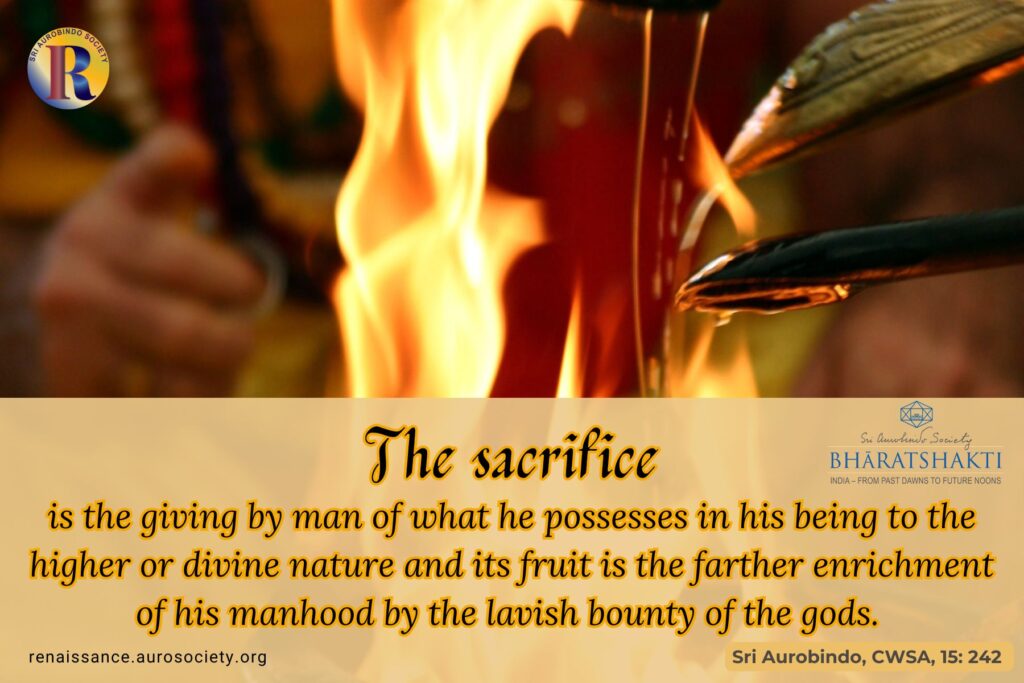
But we would have embraced the spirit of sacrifice in the true sense when we choose to be not the yajamana of the homa, but the ghritha (ghee), the wood and the soma that are offered as oblations to the sacred Fire. In offering themselves, they mix with the eternally purifying Agni and help in its growth and enhance its blaze; thus causing themselves to burn in the sacrifice (homa) in a total self-giving on the altar of the Lord, towards a Divine consecration.
Read PART 1
~ Design: Beloo Mehra