Volume VII, Issue 2-3
Author: Beloo Mehra
Sri Aurobindo’s social philosophy tells us that a spiritualized society is the future direction for humanity. Humanity is gradually and painstakingly being prepared for a great spiritual turning through its upward spiraling journey from symbolic, typal, conventional, individualistic and subjective stages. The road to a spiritualized society goes through the present evolutionary crisis humanity is facing.
A new consciousness – wider, higher, and deeper – alone has the key to the present evolutionary crisis. This new consciousness must enable the transformation of the separative, divisive, egoistic tendencies that move our actions and decisions into unifying, integrative, harmonizing, and ego-less tendencies.
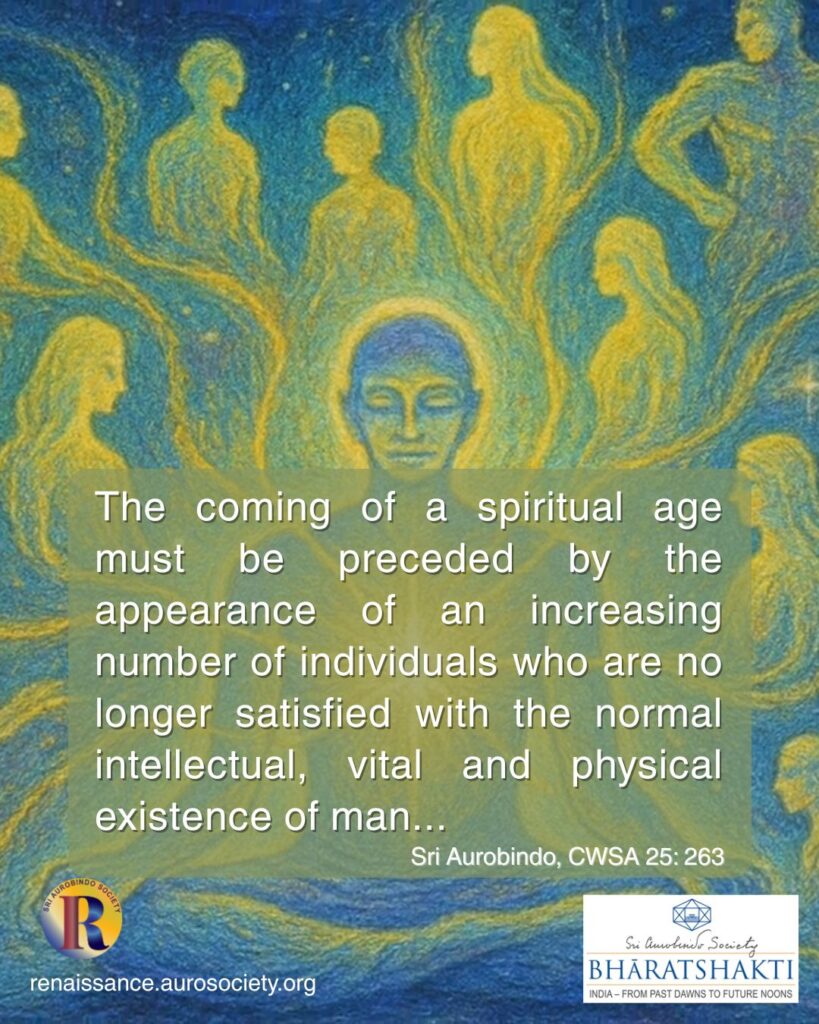
The coming of a spiritual age must be preceded by the appearance of an increasing number of individuals who are no longer satisfied with the normal intellectual, vital and physical existence of man, but perceive that a greater evolution is the real goal of humanity and attempt to effect it in themselves, to lead others to it and to make it the recognised goal of the race.
In proportion as they succeed and to the degree to which they carry this evolution, the yet unrealised potentiality which they represent will become an actual possibility of the future.
~ Sri Aurobindo, The Human Cycle, CWSA, 25: 263
This essay visualizes a future society that may result as more and more individuals begin their inward journeys with an aim to evolve in their consciousness. The analysis begins with a brief description of a few signs we see today that indicate an increasing trend of such inner seeking both on the levels of individual and society.
It then proceeds to a general description of some of the social and economic structures of a future society that has moved beyond the rationalistic-individualistic worldview and is an aggregate of individuals who are seeking their true subjective self. The analysis leads us to the question whether this futuristic subjective society may open the way to a truly spiritual stage of society.
The Signs Today
The subjective stage of human development is that critical juncture in which, having gone forward from symbols, types, conventions, having turned its gaze superficially on the individual being to discover his truth and right law of action and its relation to the superficial and external truth and law of the universe, our race begins to gaze deeper, to see and feel what is behind the outside and below the surface and therefore to live from within.
It is a step towards self-knowledge and towards living in and from the self, away from knowledge of things as the not-self and from the living according to this objective idea of life and the universe. …Subjectivism is in its very nature an attempt at self-knowledge and at living by a true self-knowledge and by an inner strength.
~ Sri Aurobindo, CWSA, 25: 44-48
We live in times when large sections of humanity, having enjoyed all that the individualistic age of reason has been able to give them in terms of material comfort and security, are seeking something deeper and higher. In this self-unfolding process their lives are becoming richer with more and more moments of inner joy and contentment and their hardened ego-selves begin to slowly crack making room for more light and truth.
In the intellectual arena disciplinary boundaries are melting, and new epistemologies are giving challenges to the rigid dichotomy between mental knowing (or knowing by logic and reason) and other forms of knowing including experiential, contemplative, and intuitive. Plenty of voices in the field of transformative pedagogies, initially guided by a keen passion for social transformation and informed by emancipatory and liberatory approaches (such as critical and post-colonial studies, feminist pedagogy, anti-racist and critical multicultural literature), and focused initially on challenging power relations based on social structures of race, class, gender, or sexual orientation, are now turning inward for more sustainable approaches to societal evolution.
These approaches might serve as important steps in the path of individual self-discovery and also the spiraling evolutionary paths of social transformation, leading towards deeper inquiry of self and societies, and gradually moving in the direction of higher and wider realms of individual freedom and liberation. Thoughtful integration of contemplative pedagogies and spirituality-based worldview in intellectual and societal discourse is beginning to supplement these liberatory approaches by incorporating a much deeper understanding of inner freedom.
All these trends are good indicators of the dawn of an age of true subjectivism which is a prerequisite for the advent of a spiritual age. But we may be certain of having entered a truly subjective age when a substantial mass of individuals would have experienced the inner evolution of consciousness and would be leading their lives in accordance with an inner law of the spirit.
True Subjectivism
Sri Aurobindo describes true subjectivism as a seeking in which the individual seeking for the law of his being can only find it safely if he regards clearly two great psychological truths and lives in that clear vision.
First, the ego is not the self; there is one self of all and the soul is a portion of that universal Divinity. The fulfilment of the individual is not the utmost development of his egoistic intellect, vital force, physical well-being and the utmost satisfaction of his mental, emotional, physical cravings, but the flowering of the divine in him to its utmost capacity of wisdom, power, love and universality and through this flowering his utmost realisation of all the possible beauty and delight of existence….
The second psychic truth the individual has to grasp is this, that he is not only himself, but is in solidarity with all of his kind… That which we are has expressed itself through the individual, but also through the universality, and though each has to fulfil itself in its own way, neither can succeed independently of the other.
Through such a true subjective seeking, an individual’s law of the spirit leading him or her in a unique direction specifically suited for the individual’s progress would not be in conflict with the life-direction of other individuals on their unique journeys of seeking for true subjectivism. Free-progress of the individual and infinite variation among the individual paths of progress would capture the group consciousness as the underlying deepest truth of human experience. As Sri Aurobindo reminds,
The society has no right to crush or efface the individual for its own better development or self-satisfaction; the individual, so long at least as he chooses to live in the world, has no right to disregard for the sake of his own solitary satisfaction and development his fellow-beings and to live at war with them or seek a selfishly isolated good.
And when we say, no right, it is from no social, moral or religious standpoint, but from the most positive and simply with a view to the law of existence itself. For neither the society nor the individual can so develop to their fulfilment.
Continued in PART 2
~ Design: Beloo Mehra