Volume VII, Issue 2-3
Author: Sunil Kumar
Editor’s Note: In a crisp and clear manner, Sunil Kumar articulates how Sri Aurobindo’s Integral Yoga is a continuation of Sanatana Dharma, when the latter is seen in the widest light as a sustained inquiry into the nature, possibilities, and destiny of consciousness.

…there is the one fundamental necessity of the nature and object of embodied life itself, which is to seek infinite experience on a finite basis; and since the form, the basis by its very organisation limits the possibility of experience, this can only be done by dissolving it and seeking new forms.
~ Sri Aurobindo, CWSA, 21: 205
In an age that measures progress by technological advancement and market capitalisation, it is worth asking whether humanity has mistaken acceleration for evolution.
India, especially, stands in a paradoxical light: technologically assertive yet spiritually diffused, materially ambitious yet inwardly uncertain. For a civilisation that once treated consciousness as the highest science, the language of sadhana has too often been relegated to private ritual or diluted into self-help vocabulary.
Yet in the thought of Sri Aurobindo and the lived force of the Mother, sadhana was neither retreat nor sentiment. It was the very engine of evolution. Rejecting literalist interpretations, they repeatedly asserted that symbols, deities and narratives are expressions of inner psychological and spiritual experience or, in a very general but deeply layered Indic term, ‘anubhuti’.
Sanatana Dharma, in this light, is not an identity marker nor a defensive slogan. It is a civilisational method — a sustained inquiry into the nature, possibilities, and destiny of consciousness. The darshanas, or schools of philosophy, are adventures in this realm, pointing to a fundamental inquisitive and open-minded approach that does not limit or straitjacket the world into neat compartments. To understand its future relevance, one must return to its central discipline: the transformation of the human being.
Explore More in Renaissance
Sanatana Dharma
Sadhana as Evolutionary Discipline
In the classical Indian sense, sadhana denotes disciplined inner practice directed toward self-realisation. It is effort guided by aspiration. It is tapas — a concentration of will and awareness aimed at transmutation.
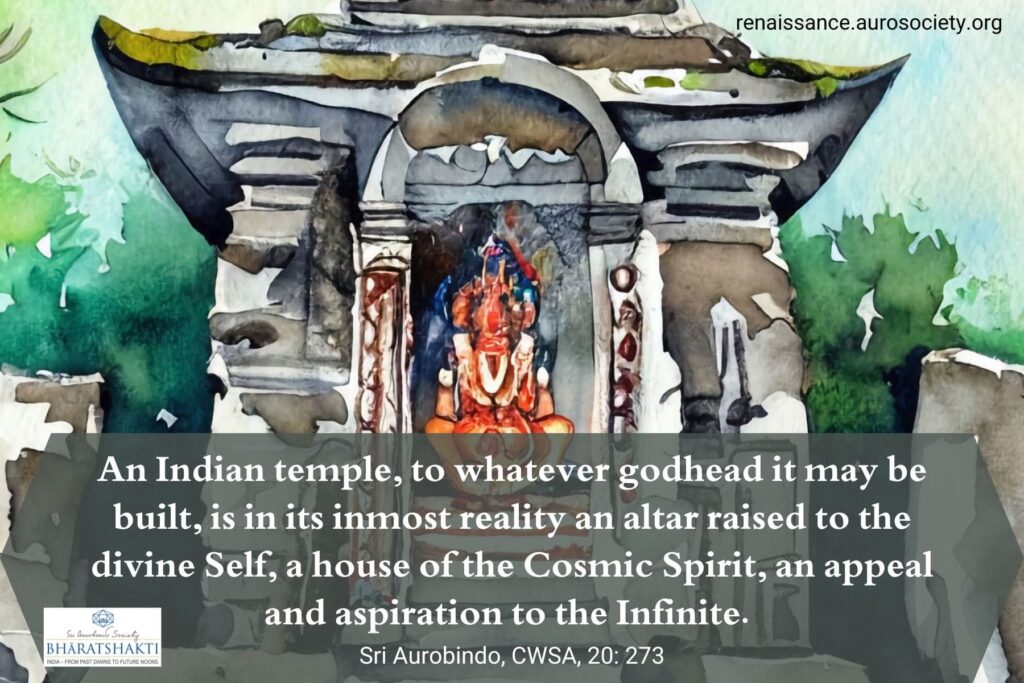
For example, the temples that dot every nook and cranny of the subcontinent are both testimony to the ancient ‘sadhana’ infused world-view and profound examples in Sri Aurobindo’s view of the soul’s aspiration to the divine and as aids to the sadhak. The ultimate temple was where the flames or fire of Yajna were bright. All life was Yoga and a pit-stop on the evolutionary road to superconsciousness.
The Vedic rishis sought illumination; the Upanishadic seers pursued knowledge of the Self; the Gita integrated action, devotion, and knowledge. Buddha, Mahavira and Guru Nanak also represented the cross-currents of Indic thought that emphasised the importance of sadhana as an evolutionary ladder. Across these streams, the underlying assumption was constant: human consciousness is plastic, expandable, capable of ascent.
Sri Aurobindo radicalised this premise. He proposed that evolution is not confined to biology; it is the progressive manifestation of consciousness in matter. Mind emerged from life; life from matter. Why should mind be the final term? The human being, he argued, is a transitional entity — a bridge between mental consciousness and a supramental or superconscious realisation. Sadhana, therefore, is not a private salvation project or a subset of the academic ‘soteriological’ label. It is participation in cosmic evolution.
The Mother made this proposition intensely practical. Transformation was not to be confined to meditation halls; it was to occur in the body, in work, in relationships. Every reaction, every impulse, every difficulty became material for conscious refinement. The spiritual life was not an escape from the world’s disorder but engagement with it as a field of alchemy.
Explore More in Renaissance
Sunlit Path
Beyond Renunciation: The Yoga of Involvement
Much of Indian spiritual history oscillates between world-affirmation and world-renunciation. To give a rough generalisation, the forest and the worldly marketplace stand as symbolic poles. Sri Aurobindo dissolved this binary. The aim was not to withdraw from life but to divinise it, he said. Matter was not an illusion to be transcended but substance to be illumined.
In this sense, Integral Yoga was a continuation of the civilisational instinct of Sanatana Dharma — its capacity to synthesise and refine rather than exclude. The householder and the monk, the warrior and the sage, all found legitimacy within its framework. The battlefield of Kurukshetra and the silence of the Himalayas were not opposites but complementary theatres of consciousness.
To engage the world consciously — this is the new asceticism. The marketplace becomes a monastery when awareness governs action. Politics, art, science, and education become laboratories of evolution when guided by aspiration rather than ambition.
The Superconscious Horizon
Sri Aurobindo’s concept of the Supermind or supramental consciousness is often misunderstood as metaphysical speculation. It is better grasped in my opinion, as an evolutionary hypothesis grounded in yogic experience. Just as mind exceeds instinct, the supramental exceeds mind — integrating intuition, knowledge, and power in a unified field.
The Mother insisted that this was not symbolic language. The supramental will manifest in the very cells of the body.
The material cells have to obtain the capacity to receive and to manifest consciousness. And then what makes for a radical transformation is that in place of, so to say, an eternal and indefinite ascent, there is the appearance of a new type—it is a descent from above. The previous descent was a mental descent, and this one, Sri Aurobindo calls it a supramental descent; the impression is that of a descent of the supreme Consciousness which infuses itself into something that is capable of receiving it and manifesting it.
And then, out of this, when it has been thoroughly churned (how long it will take, one does not know), a new form will take birth, which will be what Sri Aurobindo called the supramental form—which will be… it does not matter what, I do not know what these beings will be called.
~ The Mother, CWM, 11: 95-96
Spiritual realisation was incomplete if it left matter unchanged. This insistence differentiates their vision from purely transcendental mysticism. The goal is not flight into the Absolute but the descent of higher consciousness into terrestrial life.
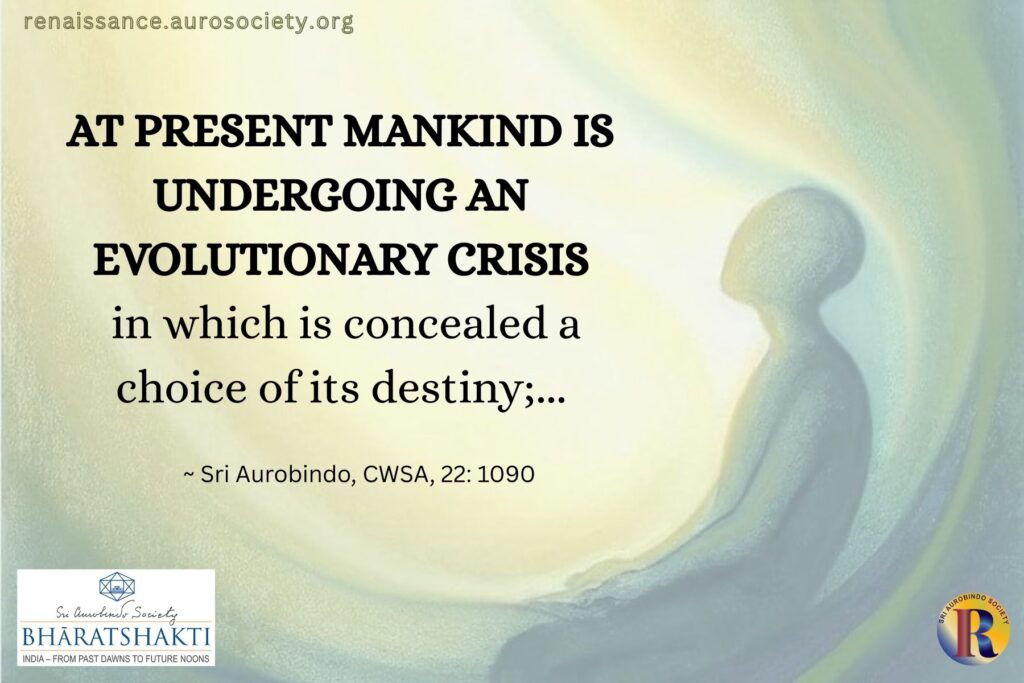
Here lies the civilisational significance of Integral Yoga. If humanity remains confined to ego-bound mentality, technological advancement will only magnify conflict. Sadly, we seem to be advancing further on this path. But if consciousness evolves, technology becomes instrument rather than master. The interdependence and interconnectedness of the individual with the cosmos is fundamental Indic wisdom that has been sidelined and forgotten. The crisis of our age — ecological imbalance, ideological polarisation, mechanised life — is at root a crisis of consciousness.
Sanatana Dharma as a Lodestone
Sanatana Dharma endures because it does not petrify around or gravitate towards a single revelation. It recognises truth as a progressive manifestation. “Sanatana” signifies the eternal principle; “Dharma” the sustaining order. It is not a closed canon but a living current. The Vedas, Upanishads, Gita, Tantra, Bhakti movements — each re-articulated the eternal in new idioms, revealing the profundity and openness of the sadhana civilisational imperative.
Sri Aurobindo’s reinterpreted this perennial framework in evolutionary terms. He did not seek revivalism; he sought fulfilment. The past was not to be embalmed or excised but extended. The spiritual genius of India lay not merely in metaphysical insight but in the audacity to experiment with consciousness.
For a civilisation, this is its lodestone: the commitment to inner growth as the foundation of outer achievement. Political sovereignty without psychological mastery breeds instability. Economic power without ethical clarity breeds corruption. Cultural pride without spiritual depth breeds fragility.
Sanatana Dharma, rightly understood, offers a counterpoint — not as nostalgia but as unfinished aspiration.
The Contemporary Mandate
We inhabit an era in which artificial intelligence challenges definitions of intelligence and sentient awareness itself, where virtual realities compete with physical experience, and where hyper-connectivity coexists with existential loneliness. In such a climate, the evolutionary vision articulated by Sri Aurobindo assumes renewed urgency.
Are we content to refine the machinery of desire, or are we prepared to refine desire itself? Are we satisfied with material expansion, or do we dare to pursue expansion of awareness?
The Mother repeatedly emphasised sincerity — the uncompromising will to confront one’s own motives and limitations. This extended both to oneself and to the divine. Without this foundation, grand ideals collapse into rhetoric and pretentious farce. With it, even modest daily effort becomes an evolutionary force.
Toward a Renaissance of Consciousness
If a renaissance is to occur, it will not be merely aesthetic, intellectual or political. It will be ontological and epistemological. It will involve a revaluation of what it means to be human. The aspiration toward superconsciousness is not an escapist fantasy; it is disciplined optimism rooted in millennia of experimentation.
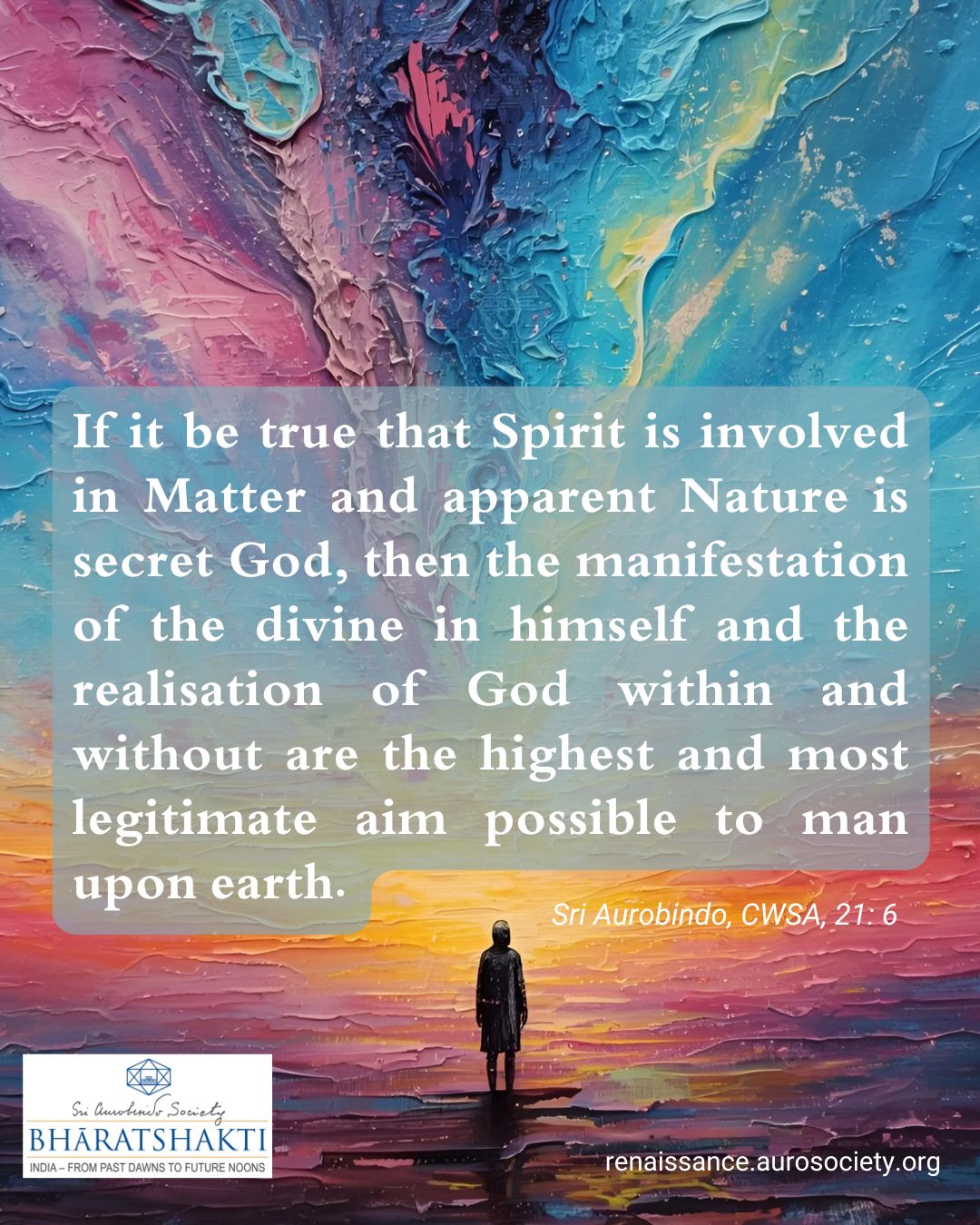
The animal is a living laboratory in which Nature has, it is said, worked out man. Man himself may well be a thinking and living laboratory in whom and with whose conscious co-operation, she wills to work out the superman, the god. Or shall we not say, rather, to manifest God?
~ Sri Aurobindo, CWSA, 21: 6
The future cannot be secured solely by external systems. It must be inwardly earned. From sadhana to superconsciousness, the trajectory remains open. Sanatana Dharma does not command conformity; it invites participation. It asks not for belief, but for an adventure in transformation. In that invitation lies the enduring promise of a civilisation — not to dominate history, but to deepen, enrich, and forge a new path.
ALSO WATCH
~ Design: Beloo Mehra