Volume VII, Issue 1
Author: Preeti Mahurkar
Editor’s Note: In this reflective piece, the author reminds us of the profound difference between recent attempts to unite science and spirituality and the Integral vision of Sri Aurobindo and The Mother. Unlike the scientists, the Supramental Yogins Sri Aurobindo and the Mother were not content to explain reality; they sought to transform it, to work for the divinisation of life on Earth.
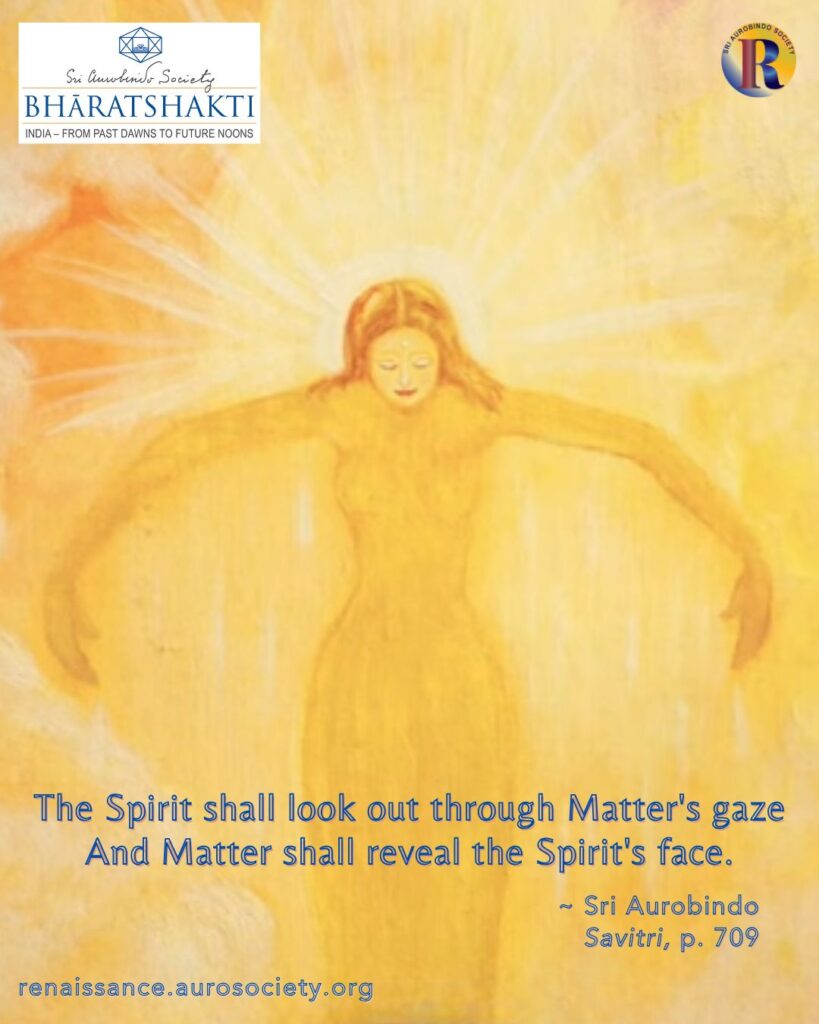
“The Spirit shall look out through Matter’s gaze
And Matter shall reveal the Spirit’s face.”~ Sri Aurobindo, Savitri, p. 709
In recent years, growing attempts to bridge quantum mechanics and spirituality have generated genuine excitement. There is intellectual brilliance, sincerity, and a clear movement away from rigid materialism. Consciousness is increasingly spoken of as fundamental to reality. Yet something essential often remains missing. The bridge, more often than not, stays at the level of ideas—elegant, persuasive, but rarely embodied in the lived realities of daily life.
What we are now beginning to “rediscover” feels uncannily familiar.
When the West Rediscovers What Was Already Known
For much of the modern Western world, integral spiritual visions have remained peripheral—admired at times, selectively referenced, but rarely engaged with as complete and rigorous frameworks of reality. The dominant narrative of progress has long been shaped by materialism: matter as primary, consciousness as secondary, and life as an accidental by-product of physical processes. That narrative, however, is beginning to fracture.
Recently, a widely circulated article celebrated a contemporary thinker credited with “rediscovering” consciousness as the foundation of matter. While this recognition is significant, it carries a deeper irony. What is presented as a breakthrough was articulated, lived, and systematically explored decades ago by Sri Aurobindo and The Mother.
They were not philosophers speculating from the margins. They were explorers of both inner and outer reality. For them, consciousness was not merely fundamental—it was evolutionary, dynamic, and transformative. Spirit and matter were not opposing principles, but two movements of a single unfolding reality.
Spirituality, therefore, was never an abstract pursuit or an escape from life. It was meant to act upon life itself—thought and emotion, relationships and society, culture and the body, even matter down to its cellular foundations.
Sri Aurobindo’s words in Savitri are not poetic idealism; they point toward a destiny where spirit and matter learn to recognize one another in an unfolding dance of consciousness—where science and spirituality meet not in theory alone, but in lived transformation.
If Truth Cannot Be Lived, Is It Truth at All?
A persistent question returns: what is the value of the highest philosophy or the most refined science if it cannot be integrated into life? Of what use are enlightenment or cosmic theories if they do not change how we think, relate, suffer, heal, and act?
Sri Aurobindo confronted this question directly. He dismantled fragmented approaches to spirituality that treated inner realization as a flight from life. In their place, he presented Integral Yoga and declared with uncompromising clarity: “All life is Yoga.”
This was not an inspiring phrase but a demand. Spirituality had to descend into life—into work, relationships, society, and the body itself. Otherwise, it remained incomplete.
Spirituality as Conscious Evolution
For Sri Aurobindo, spirituality was not a ladder out of the world. It was the secret fire within evolution itself. Existence, he saw, unfolds through a double movement. First is involution, where the Divine descends and conceals itself within matter; then comes evolution where that hidden consciousness gradually awakens through life and mind, pressing toward a higher, yet-unmanifested possibility.
Modern science now touches the edges of this truth. Through the double-slit experiment and the observer’s effect, quantum physics reveals that observation influences reality—that what exists as potential collapses into form through consciousness. The universe appears participatory, unfinished, alive with possibility.
This insight echoes ancient wisdom. We hold this divine potential inside us — it is symbolized by the trinity of Brahma, Vishnu, and Mahesh—creation, sustenance, and dissolution occurring in every moment. Each thought, choice, and intention participates in this rhythm. Conscious evolution means creating what serves life, sustaining what supports growth, and dissolving what no longer aligns.
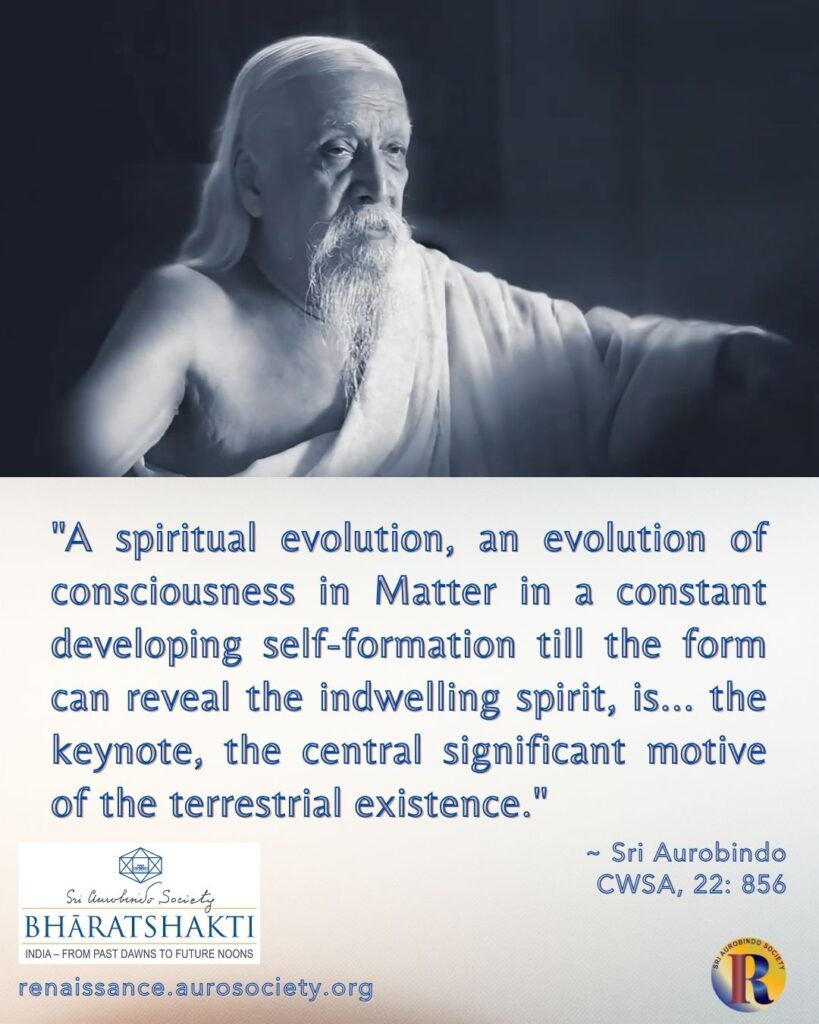
As Sri Aurobindo wrote,
“A spiritual evolution, an evolution of consciousness in Matter in a constant developing self-formation till the form can reveal the indwelling spirit, is… the keynote, the central significant motive of the terrestrial existence.”
Human beings, therefore, are not passive spectators of life, but active co-creators of reality.
From this perspective, humanity is not the peak of evolution, but a transitional stage—a bridge toward a higher, divinised consciousness yet to fully manifest on Earth. A new destiny awaits: the emergence of the supramental consciousness, capable of transforming mind, life, and matter itself. This future is not imposed by nature; it is invited through conscious choice, inner discipline, and collective aspiration.
The Yoga of the Cells: When Spirit Meets Matter
The Mother carried this vision directly into the body. She discovered that the cells possess consciousness—obedient, habitual, and deeply responsive. She described them as “stupidly good-willed.” They follow whatever is impressed upon them.
There are no immutable physical laws, she observed—only habits of matter. And habits can be changed.
When consciousness descends with peace, wideness, and joy, the cells respond. This is the Yoga of the Cells, where spirit educates matter and matter responds with total goodwill. Here, science and spirituality truly meet—not in explanation, but in transformation. Not as escape, but as the divinisation of life on Earth.
A New Paradigm: Toward a New Earth
This marks the profound difference between recent attempts to unite science and spirituality and the Integral vision of Sri Aurobindo and The Mother. They were not content to explain reality; they sought to transform it.
Sri Aurobindo and the Mother offered a new paradigm in which spirituality is not a withdrawal from life, but the means to divinise life—individually and collectively. As consciousness stabilizes in individuals, it naturally seeks expression in relationships, communities, and social structures. They envisaged an enlightened society: a conscious collective forming a living nucleus of truth-consciousness, capable of radiating a new possibility for humanity.
The Invitation
The question they leave us with is simple and unavoidable. If spirituality cannot change our lives here—our behaviour, our bodies, our relationships, our world—then what is it truly meant for?
Their answer was not a belief or doctrine.
It was a path. A living experiment. A conscious journey where spirit and matter learn to recognize one another.
The dance has already begun. The invitation is simply to step into it—consciously.
About the author:
Preeti Mahurkar is a highly accomplished life coach, certified NLP (Neuro-Linguistic Programming) practitioner, emotional intelligence trainer, and career counselor with over 25 years of experience. With a profound commitment to Integral Yoga and Integral Human Development, based on the teachings of Sri Aurobindo and The Mother, Preeti lives and works in Auroville and has dedicated her life to fostering conscious evolution and holistic living.
She channels her expertise and life experiences towards serving humanity in a spiritually aligned environment and is the author of the acclaimed books “I See a New India” and “I See a New Earth Arising,” part of the “Heaven on Earth” series focusing on conscious evolution, social issues, and sustainable development goals. Some of her writings can be read at BhāratShakti Blog.
Also read our series by Jugal Kishore Mukherji
Science and Spirituality: An Unnecessary Antimony and a Harmonious Reconciliation
~ Design: Beloo Mehra