Volume VI, Issue 11-12
Author: Venkat Manthripragada
Editor’s Note: If all life is indeed Yoga, how do we engage with seemingly ordinary situations and circumstances in which we find ourselves? They appear ordinary on the surface but when seen with the right inner attitude, they can be great lessons along the path of our inner journeys. This submission by one of our new authors touches upon something very pertinent to our daily lives — challenges in human relationships.
Read how a chance meeting with a stranger becomes an opportunity to reflect on life, becoming conscious of one’s inner movements, stilling the mind, being present for others, the power of compassionate listening and more.

This morning, the world felt unusually tender — the kind of morning where silence holds a secret.
As I walked through the garden of our housing society, I noticed a man sitting alone on a wooden bench. Perhaps in his early forties, his body was still, but his mind wandered far away, carrying a storm too heavy for words.
There was something sacred in his stillness, something broken yet dignified.
I greeted softly, “Good morning.”
He looked up, managed a faint smile, yet his eyes remained clouded, caught between thought and sorrow.
I asked gently, “Is everything alright?”
He replied, “No problem, sir,” but the hollow ring of his voice betrayed his words.
I sat beside him. Sometimes the soul does not need answers — only presence. What began as polite conversation slowly unfolded into something deeper — the trembling need to be understood. At first, he spoke mechanically, as if reading from an old script. But soon, like a bud sensing the sun, his heart began to open.
“You seem burdened,” I said softly. “Something unspoken sits within you.”
He hesitated, then admitted, “I had a fight with my wife this morning. I keep thinking what went wrong.”
I smiled gently. “Let us make one rule,” I said. “Don’t tell me your name, apartment number, or your wife’s name. Let your story stand free of identity — pure and human.”
He nodded. A small release passed through him — the relief of being nameless.
He spoke in circles at first — recounting not one quarrel but many, all echoing the same cry: I am always the one hurt. I listened, not as a judge, but as a mirror. Then, quietly, I said, “Let us not revisit every wound. Tell me only about today — one moment, without past or blame. Just what happened.”
He paused, exhaled, and began again. Words came slower this time — honest, raw, stripped of defence. When his story found its stillness, I asked gently, “Now that you have spoken, how much of it was truly honest?”
He looked startled. After a silence, he whispered, “Not all of it. Perhaps not even half. The reason for our fight was so small… it feels almost shameful.”
I said, “The cause is never the cause. It is the unseen current beneath — a tone, a word, a fragile boundary crossed unknowingly. When confidence leaves us, ego takes its place. But when we see the other as they are, without resistance, we begin to hear what is unspoken.”
Some words of Sri Aurobindo I had read decades ago flashed in my mind. Sitting silently with the force of these words I waited patiently for a few minutes.
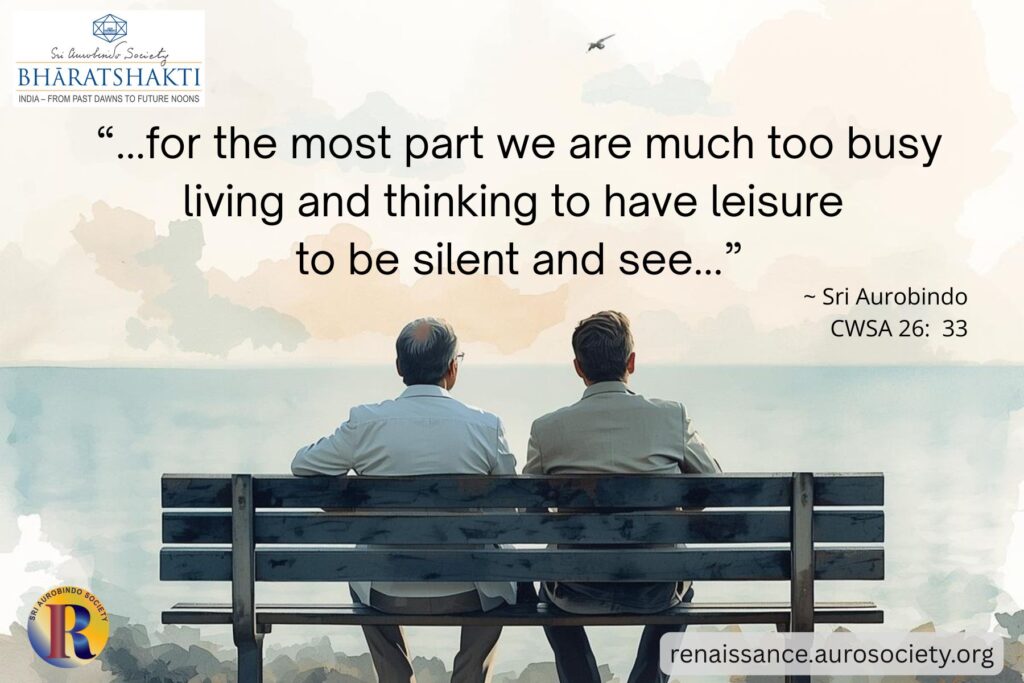
“…for the most part we are much too busy living and thinking to have leisure to be silent and see…”
He nodded slowly, his eyes softening. “It was such a trivial reason. I now see that her words came from care, not criticism. My reaction came from pride, not truth.”
I smiled. “You see — the truth was always there, waiting beneath the noise.”
He said with quiet resolve, “I will go and apologize.”
I replied, “Apology is not always in words. Sometimes, your silence, your tone, your gentleness becomes the apology. Words can wash away guilt, but not the other’s hurt. Real apology blooms through conduct, not confession.”
He frowned. “But when I know I’m wrong, shouldn’t I say sorry?”
I said softly, “She is your wife — she will read your heart before she hears your words. Don’t rush to undo what happened. Let it settle into understanding. Forgiveness is not granted by words; it grows through awareness.”
I was reminded of Sri Aurobindo’s words,
“There is nothing mind can do that cannot be better done in the mind’s immobility and thought-free stillness.”
I could see that calmness now returning to him — the storm subsiding. His shoulders loosened, his breath slowed. The invisible weight he carried seemed to dissolve into the morning air.
He asked with hope, “Should I start meditation?”
I said, “Meditation is not something you start — it starts when your longing becomes sincere. For now, begin with reflection. Each time anger arises, from you or from her, write it down. When you write, you release. When you reread, you realize.”
I added, “And if you can, sit by a lake or under a tree. Let nature hold your silence. Answers do not come through thinking; they arise through stillness.”
As we parted, Sri Aurobindo’s words echoed in the quiet morning:
“When mind is still, then Truth gets her chance to be heard in the purity of the silence.”
He smiled then — a real smile, the kind born not from happiness but from clarity. The sunlight streamed through the trees, wrapping the moment in gentle grace.
Two strangers.
One bench.
And between them — the stillness that heals all hearts.
About the author
A senior software professional, Venkat Manthripragada, age 57, is deeply interested in identifying meaningful and lasting solutions for problems and challenges in our societal life. Based in Bengaluru, he is currently completing a Master’s degree in Psychology with focus on Psycho-Oncology, Suicide Prevention and Consciousness-based Counselling in the lines of Sri Aurobindo’s principles.
~ Design: Beloo Mehra