Vol. VII, Issue 7
Author: Amal Kiran
Editor’s Note: Many seekers when they come to Integral Yoga, after having been exposed to or having walked the paths of other Yogas or religio-spiritual traditions, wrongly understand that just because Sri Aurobindo spoke strongly against any kind of sectarianism it automatically means that Sri Aurobindo also considered his ideal to be realisable by means of the past religions and the old Yogas.
In this very important writing – presented here in 2 parts, Amal Kiran helps us probe deeper and reflect carefully on Sri Aurobindo’s central stress on a new life, a transcendence of the spiritual past as well of the past in any other form, though in that spiritual past there are naturally some helpful hints for the new life.
This essay appears in the author’s book titled The Sun and the Rainbow: Approaches to Life through Sri Aurobindo’s Light – Essays, Letters, Poems, Short Stories published by Clear Ray Trust, Puducherry, 1981, pp. 71-76.
*****
Time and again the question has cropped up: Can Sri Aurobindo’s ideal be realised by means of the past religions and the old Yogas?
An answer in the negative, insisting on the newness of the ideal and the consequent need of a new spiritual praxis, is usually given. But a very positive criticism is couched in the following terms which call for our notice by the striking quotations they incorporate from Sri Aurobindo himself and the sweeping conclusions drawn on the strength of them:
“Many people are of the opinion that for the Supramental Yoga we require exclusively Sri Aurobindo and the Mother. The devotion of these people is commendable, but we must see what Sri Aurobindo has said on his Integral Yoga. Otherwise there is every possibility of sectarianism being developed.
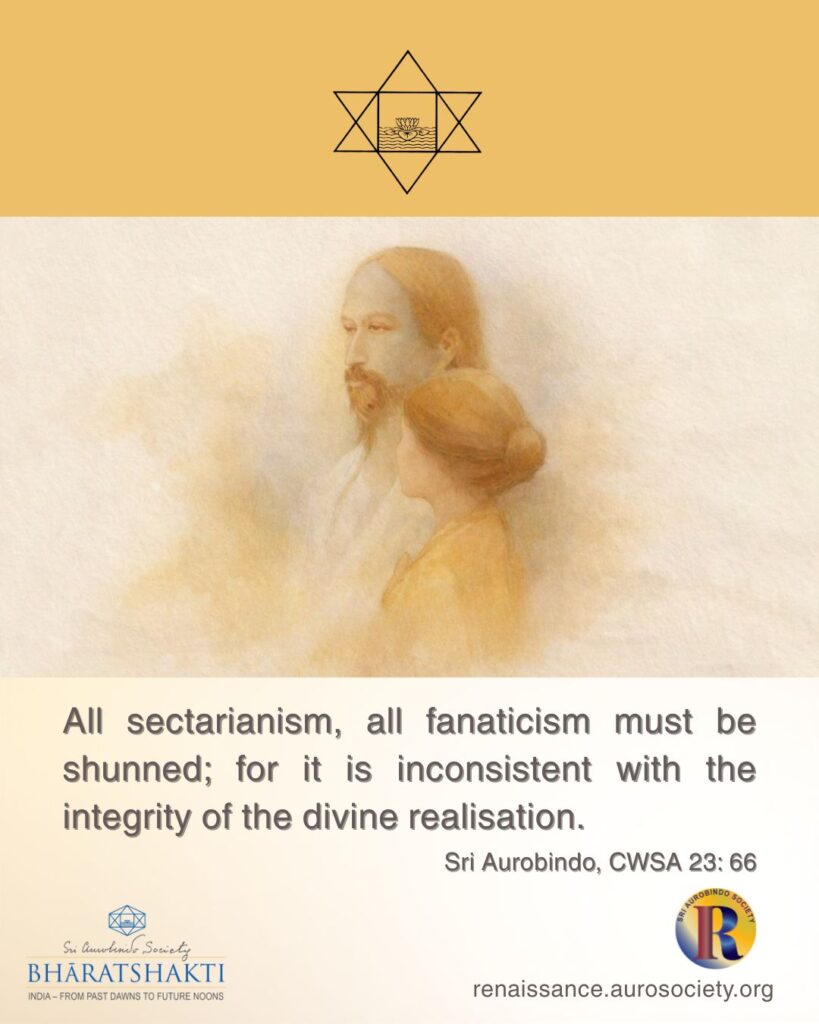
“Sri Aurobindo was dead against sectarianism. He wrote in The Synthesis of Yoga, in the Chapter ‘The Four Aids‘: “The sadhaka of the integral Yoga will make use of all these aids, according to his nature; but it is necessary that he should shun their limitations and cast from himself that exclusive tendency of egoistic mind which cries, “My God, my Incarnation, my Prophet, my Guru,” and opposes it to all other realisation in a sectarian or a fanatical spirit. All sectarianism, all fanaticism must be shunned; for it is inconsistent with the integrity of the divine realisation.”
***
“Then again in Letters on Yoga we read these lines: “I have no objection at all to the worship of Krishna or the Vaishnava form of devotion, nor is there an incompatibility between Vaishnava Bhakti and my supramental yoga. There is in fact no special and exclusive form of supramental yoga: all ways can lead to the supermind, just as all ways can lead to the Divine.”
“So I think the matter ends here. Sri Aurobindo warned us and gave his final word which we must remember.”
Well, have we truly the “final word” here?
The words of a Master of the Integral Yoga are bound to be such that they seem to lend countenance to various standpoints at various times and places. They present many aspects of truth and can be quoted by one side or another to suit particular purposes. Unless taken in the context of the entire Aurobindonian vision they cannot yield their full significance.
But even if the quotations made from The Synthesis of Yoga and from Letters on Yoga are taken on their own merits, do we really get the impression that Sri Aurobindo considered his ideal to be realisable by means of the past religions and the old Yogas?
Continue to Read in Part 2
~ Design: Beloo Mehra