Vol. VII, Issue 10
Author: Prema Nandakumar
Continued from Part 3
Editor’s Note: We continue with our ongoing series by Prema Nandakumar on the Puranas. The 2 parts featured in this issue were published in the November 2023 issue of Mother India, Vol. 56 (11), pp. 956-962.
In this part the author writes that while Vishnu Purana helped disseminate Krishna consciousness in the sub-continent, the Bhagavata Purana has been considered a personification of the Lord Himself.

Why the Bhagavata?
By the time the Puranas came to be set down, the hierarchy of gods had almost crystallised in the Indian psyche. Vishnu, Shiva and Shakti held prime positions. Here again, Vishnu looms large and roughly speaking is the prime deity in the earliest of them, the Vishnu Purana; and holds the reins in the last of them all, the Bhagavata. In both of them Krishna is the enthralling god and we seem to plunge forward to hold on him. How so? Why are we so fascinated by Krishna, the last of the avataras till now?
One of the reasons seems to be the projection of Krishna’s childhood. Vamana as a lovely boy we had seen, but we had not seen him in action among people. It was Vishnu Purana that brought us the destruction of Putana and Sakatasura, the dancing on the Kaliya snake, the killing of demoniac beings like Denuka, Pralamba (who was actually killed by Balarama), the playing of childhood games like Harinaa Kreedanam, the lifting of the Govardhana Hill.
Most important of all was the Rasakridaa; and the author does not minimize the irreverence of tradition indulged in by Krishna. Maitreya asks whether this union of Krishna with the married cowherdesses was right. Parasara’s answer comes in simple terms: “The Lord pervades the five elements, earth, water, fire, space and air. In the same manner the Lord pervades those cowherdesses and the cowherds and the millions of sentient beings. Hence the Rasakridaa was not wrong.”1
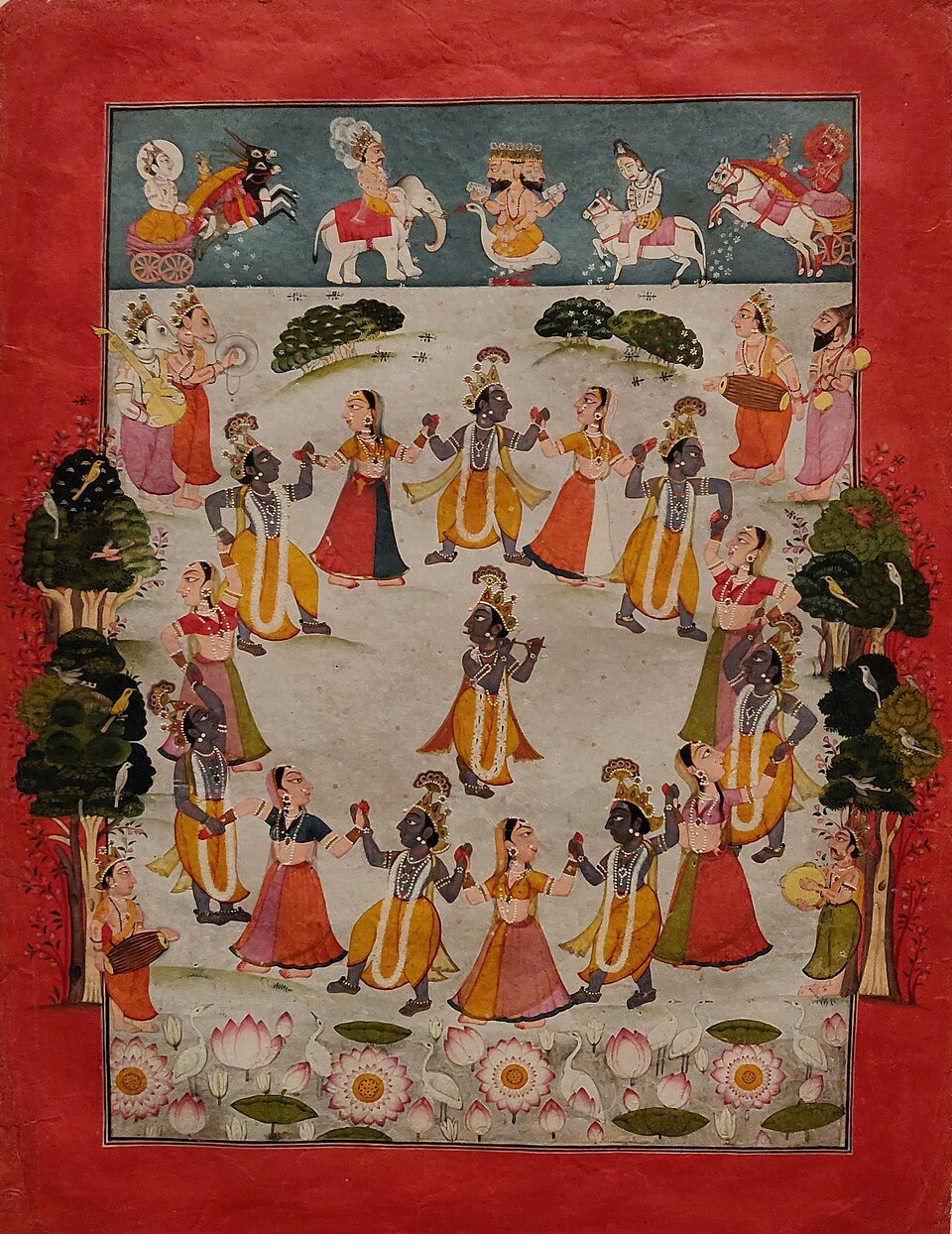
But there are other reasons that also seem relevant. Being the last of the incarnations so far, Krishna remains closest to our consciousness. Was it not only yesterday we laughed no end when he was caught stealing butter, then wandered with him all over Brindavan, watched him take a personal interest in building the stately capital of Dwaraka, admired the manner in which he held the reigns while directing Arjuna’s chariot in the Kuruskshetra field? Ah, have our tears dried since we learnt of his passing at Prabhasa after being hit by Jara’s arrow? Memories… memories… memories…
So the Indian psyche has recorded and re-recorded Krishna’s life in a million ways, in dramas and songs, in sculpture and painting, but for all this immense Krishna literature the Vishnu Purana remains the fount. It was this Purana that helped spread the Krishna cult far and wide and inspired Perialwar to sing of Krishna’s childhood, boyhood and youth in mellifluous Tamil poesy. Hence the great Sri Vaishnava acharya Alavandar referred to it as the gem among Puranas, the Puraana Ratna. Another great acharya, Vedanta Desika, has caught this metaphor and says the Purana is a faultless gem indeed:
Atraasam, maanadham, ratnam, sthiram, bhogyam, prakaasakam
mahaargham mangalam maanyam suraksham sugraham nrunaam”
(“Faultless, priceless, permanent, meant for enjoyment, brilliant, auspicious, worthy of praise, a jewel to be guarded, easy for handling by aspirants.”)
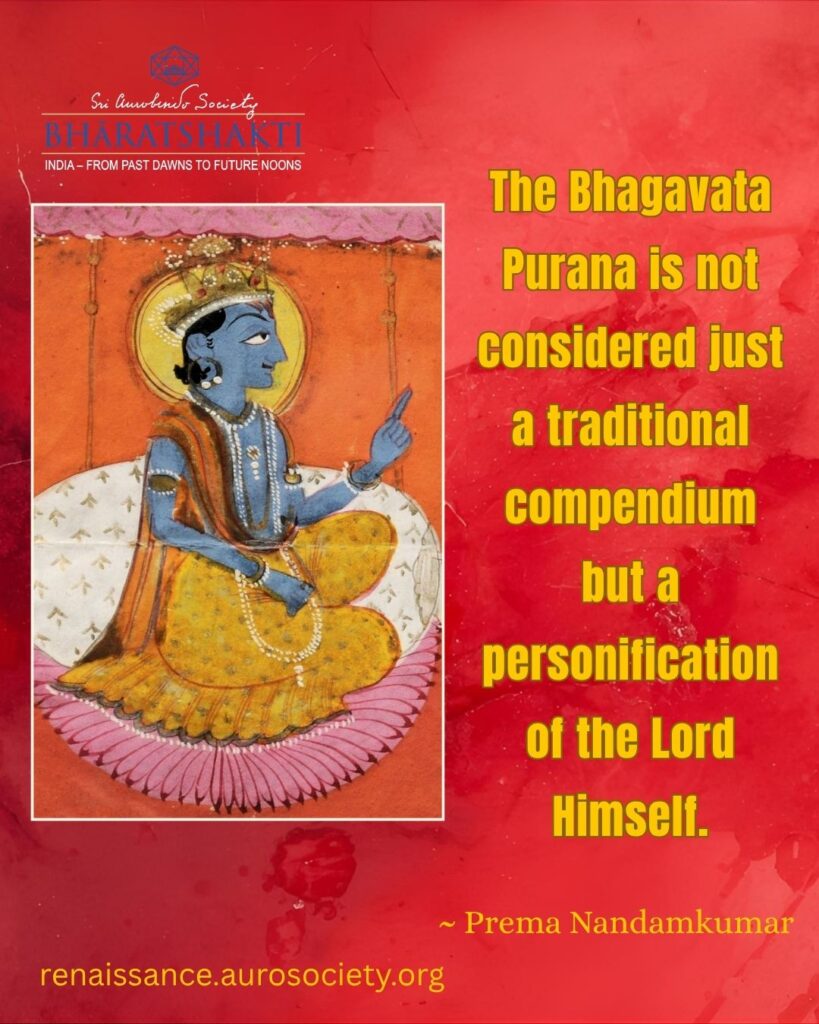
While the Vishnu Purana thus became the parent-treasury of Vishnu’s manifestations in general and Krishna’s life in particular, the Bhagavata which came a little later after the Alwars, continues to be the most popular. And even as the former helped disseminate Krishna consciousness in the sub-continent, the Bhagavata has been doing the same now at a global level. For the Purana is not considered just a traditional compendium but a personification of the Lord Himself.
This is brought out clearly in the Padma Purana, in the cantos on “The Bhagavata Mahatmya”. Incidentally, it reveals the mutual good will among editors, writers, poets and scholars in those days whose single-minded aim was to save India’s hoary tradition mid all the problems posed by the large-scale invasion by Islamic hordes since the Hindu kingdom of Dahir in Sindh fell to an Arab invasion led by Muhammad Quasim in 711 A.D.
Within two hundred years India would be devastated by the repeated attacks of Mahmoud of Ghazni. If the Vedic tradition along with its Upanishadic Vedanta and Itihasic riches were safeguarded for posterity, it was due to those sages and scholars who remained in rural countryside or dire forests and recorded all the yesterdays in the Puranas.
The Padma Purana which is one of the six major Puranas that uphold the supremacy of Vishnu has a dialogue between Narada and the personification of devotion as the Lady Bhakti. What was happening around at that time was not unlike the extremism of these days when civilised life gets challenged at all levels. The greater tragedy of such times is that there can be no open condemnation. The Puranas thus enveloped their distress in the stories they told to the common man. The Padma Purana story of Narada and Bhakti is one such reference.
Once Narada went on a pilgrimage to the holy places on the earth as it is “the best of all spheres” (sarvottama). He went to Pushkara and Prayag, Kasi, Nasik, Kurukshetra, Srirangam and Rameswaram. But he was unhappy with what he saw. There was a general deterioration in the moral fabric. Truth, tapasya, physical and mental purity, charity and other good qualities were all in the decline, while people had become quite materialistic.
Running after pelf to fill their bellies, they had no shame in uttering falsehood (udarambharino jeeva varaakah kootabhaashinah). To add to all this, any number of ashrams, temples and pilgrim spots had been destroyed without compunction by these wicked people and had come under the control of foreigners, the Yavanas.
It is of course a reference to the way large parts of North India were ravaged by the Islamic hordes who targeted the religious institutions of the Hindus with incredible savagery. The natural consequence was a weakening of the rituals of Hinduism. Where large scale killings have taken place, whole families converted and huge libraries destroyed, it is but natural that rituals suffer a great deal.
When one is fleeing or begging for life, where is the time to engage oneself in austerities and other observances of Sanatana Dharma? The Padma Purana says: “Hermitages, places of pilgrimage and rivers are controlled by foreigners and temples here have been destroyed in large numbers by those wicked people. There is no Yogi, nor one who has attained perfection, no enlightened soul and no man performing righteous deeds. All spiritual discipline stands consumed by the wild fire of Kaliyuga.”2
At last Narad came to Brindavan where Krishna had sported long, long ago, at the close of Dwapara Yuga. A strange sight met him. He found a distraught young woman with two old men fallen unconscious at her feet. On Narada asking her, she tells him that she is Bhakti (Devotion) and the two old men are her sons, Jnana (spiritual knowledge) and Vairagya (desirelessness). She says she was born in South India and had since then travelled wide:
I was born in the Dravida country and attained maturity in Karnataka. I was respected here and there in Maharashtra and attained a ripe age in Gujarat. Mutilated by heretics due to the arrival of the fearful age of Kali, and continuing in that state for a long time, I grew weak and developed sluggishness along with my two sons. Reaching Vrindavana, however, I stand refreshed as it were and endowed with extreme comeliness.”3
The reference to Dravida country relates the origin of the Bhakti Movement which began with the Alwar (devotees immersed in god-experience) movement in Tamil Nadu. Sri Aurobindo recognised the Bhagavata to be “the culmination of the movement which had the most important effects on the future, the evolution of the emotional and ecstatic religion of Bhakti.” (CWSA 20: 375)
To be continued in the next issue
Notes
READ:
Part 1
Part 2
Part 3
~ Design: Beloo Mehra