Vol. VII, Issue 7
Tale told by The Mother
Video by Biswajita Mohapatra
Narration by Chitra Kolluru
Editor’s Note: This issue includes a new offering in the Children’s Corner – visualisation of a tale told by the Mother on the significance of creating order in life.
The Mother adapted and translated into French several stories from F. J. Gould’s 1911 book (“Youths’ Noble Path: A volume of moral instruction designed for the use of children, parents, and teachers and mainly based on Eastern tradition, poetry, and history’’) for the children of the Ashram school. First published under the title Belles Histoires, in 1951 Sri Aurobindo Ashram brought out an English re-translation under the title Tales of All Times.
Watch a short video on a tale on Order from this book; the story about an antique grandfather clock has been read in Hindi. Biswajita Mohapatra has curated and edited the video; Chitra Kolluru has narrated the story.
Before the tale which speaks to us about why order is important, we present a few insights from the Mother on the deeper value of order. We have also included the story in English for non-Hindi readers.

Order in the World: Insights from the Mother
Men in ancient India had a very poetic idea about the earth and the world—an idea intended to express order.
The land inhabited by men was called Jambu Dvipa and it was surrounded by a sea of salt. Then came a ring of land and then a sea of milk. Another ring of land, and a sea of butter. More land, and a sea of curds. Land again, and a sea of wine. More land, and after that a sea of sugar. Still more land, and at last, the seventh and final ring of pure water: the sweet, the sweetest of all seas!
If you look at a map of the world like the ones we now use in schools, you will not find the sea of sugar, or the sea of milk, or the others. Nor did the Indians think that these seas really existed, but for them it was an original way of expressing a profound idea.
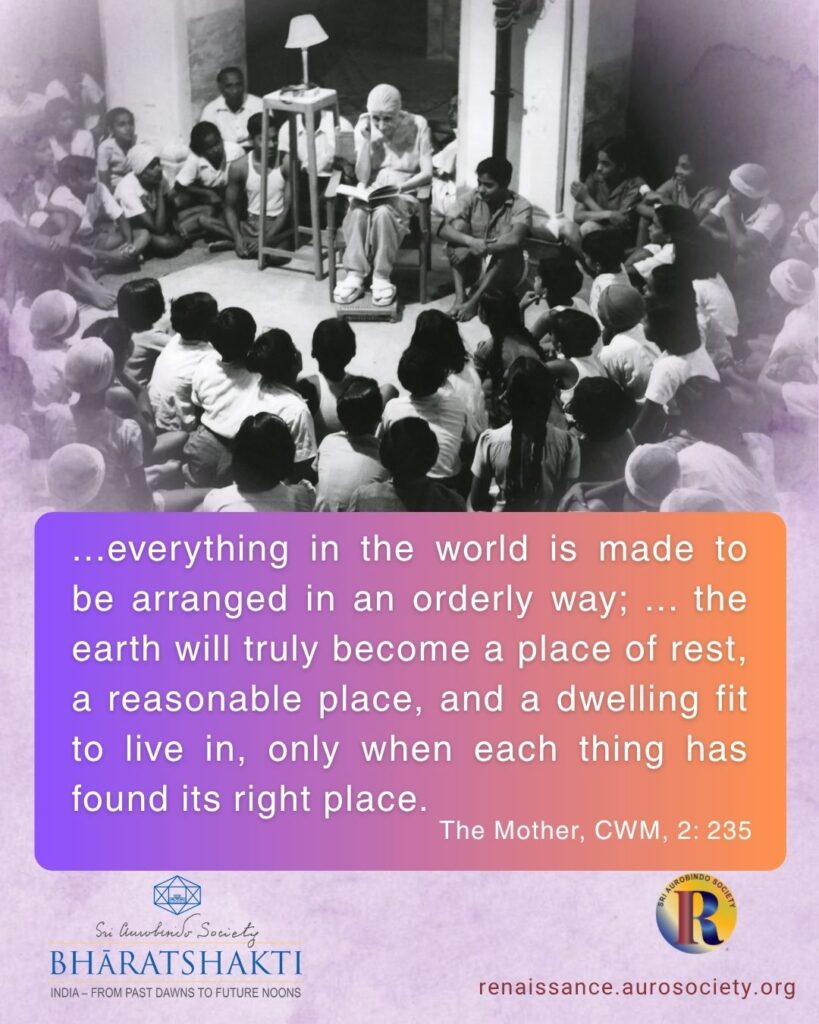
The ancient legend meant among other things that everything in the world is made to be arranged in an orderly way; that the earth will truly become a place of rest, a reasonable place, and a dwelling fit to live in, only when each thing has found its right place. Indeed, how could one enjoy even the best things, salt, milk, butter, wine, sugar, water, if instead of being kept apart in an orderly way they were to form the frightful mixture you can imagine?
***
Order, Knowledge and Harmony
All the religious books of mankind, by means of the most varied images, teach this law of order.
The Hebrew Book of Genesis, in its own way, also tells a story of order.
In the beginning there was chaos, that is, disorder and darkness. And the first act of God was to throw light upon this disorder, just as a man shines the light of his lamp into the gloom of the dark and dirty cellar he wants to enter.
After that the Bible tells how, day by day, things emerged from the chaos in an orderly way until at last the human race appeared.
It is the glory of man to create order and to discover it everywhere.
The astronomer looks up towards the stars and makes a map of the heavens; he studies the regular paths of the heavenly bodies and names them, he calculates the motions of the planets around the sun and forecasts the moment when the moon, passing between the earth and the sun, will cause what we call an eclipse. The whole science of astronomy depends on a knowledge of order.
Arithmetic is also a science of order. Even a very small child takes delight in repeating numbers in the right order. He soon discovers that there is no meaning in saying: one, five, three, ten, two, as he counts his fingers or his marbles. He counts: one, two, three, four; and all mathematics comes from that.
And without order, what would become of that lovely thing, music? There are seven notes in the scale: do, re, mi, fa, sol, la, si. If you play these notes one after another, it is all right, but if you strike them all together, and mix their sounds, it will make a frightful noise. They can produce a harmonious sound together only when they are played in a certain order. Do, mi, sol, do, for example, sounded together, form what is known as a “chord”. The whole science of music is based on that order.
And it could be shown that order is also the basis of every other science and of all the arts that man can invent.
***
WATCH
Read the story
In the parlour of an old farmhouse there was an antique grandfather clock which for more than a hundred and fifty years had never ceased ticking faithfully. Every morning at daybreak when the farmer came down, the first thing he would do was to visit the clock to be sure that it was right. Now it happened one morning that as he went into the parlour as usual, the clock began to speak:
“For more than a century and a half,” it said, “I have been working without a stop and keeping perfect time. Now I am tired; don’t I deserve to take a rest and stop ticking?”
“Your complaint is unjustified, my good clock,” the shrewd farmer replied, “for you are forgetting that between each tick you have a second’s rest.”
After a moment’s thought, the clock began to work again as usual.
Children, what does this story show? That in orderly work fatigue and rest balance each other, and that regularity avoids much pain and effort.
~ The Mother, CWM, 2: 235