Vol. VII, Issue 8-9
Author: Prema Nandakumar
Editor’s Note: Having explored the author’s detailed essays on the two great itihasa-s, Ramayana and Mahabharata (see HERE), we now begin a new series focusing on the Puranas. Starting with this issue, we will be featuring in various parts a series of essays she wrote for Mother India on the literary, cultural and spiritual significance of the Puranas in the light of Sri Aurobindo.
We are keeping the original title given by Prema Nandkumar. In the current issue we feature in 2 parts bulk of the first essay published in October 2003 issue of Mother India, Vol. 56 (10), pp. 857-863. Rest of the essay will be taken up in the next issue. As always we have updated the references and made a few formatting revisions for easier digital reading.

I. The Purana Phenomenon
In the vast spaces of Indian literature, the Puranas are a phenomenon of vital importance as a continuation-link with the past and the future. It is of some concern to the conservators of Indian culture that this body of significant recordation in historical times has not been studied as widely and deeply as it should be to enrich ourselves.
Now that we are in the 21st century, we should at least draw closer to some of the Puranas for this could help us have a healthier view of all our yesterdays and rejuvenate us to face all our tomorrows.
In the last century, some leading academics initiated serious attempts to make the common reader interested in these great works which were too often brushed aside by Western-educated professors as “puerile puranic stuff”. Yet, quite early in the century we had Sri Aurobindo writing in the Arya on the need to get back to the Puranas if we wished to understand the Vedic and Upanishadic past as well as the great literatures that have been inspired by them. He said:
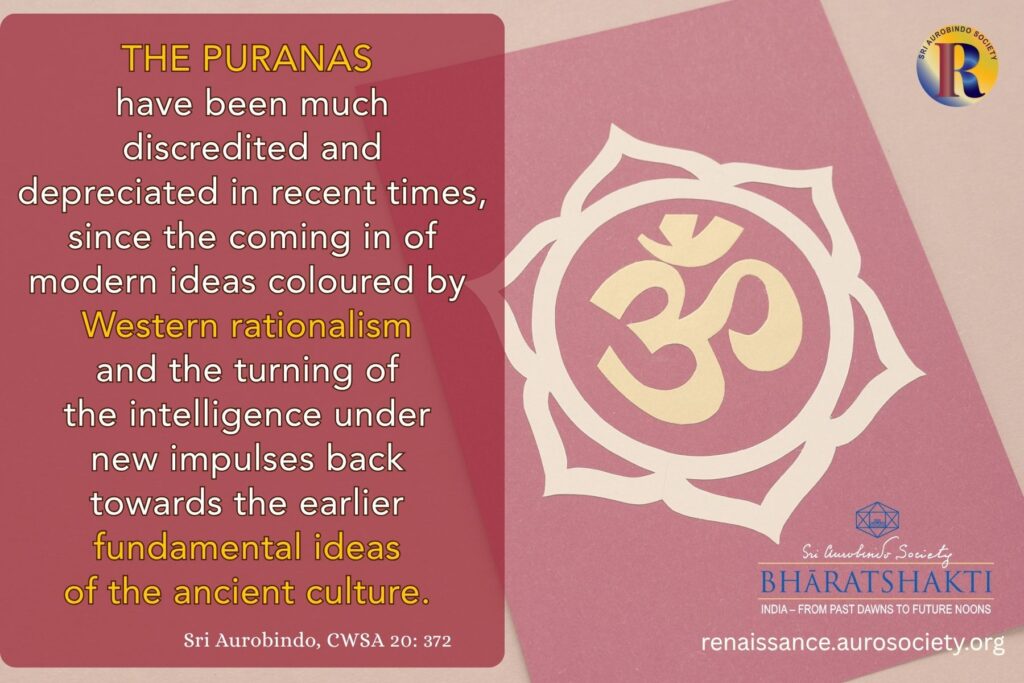
The Puranas have been much discredited and depreciated in recent times, since the coming in of modern ideas coloured by Western rationalism and the turning of the intelligence under new impulses back towards the earlier fundamental ideas of the ancient culture. Much however of this depreciation is due to an entire misunderstanding of the purpose, method and sense of the mediaeval religious writings. It is only in an understanding of the turn of the Indian religious imagination and of the place of these writings in the evolution of the culture that we can seize their sense.
How can such a vast body of writing be termed totally subversive of our cultural past and be no more than puerile pontifications of fictional claptrap? Some of the statements set sailing around general conversation have also alienated the common reader from the Puranas.
“Totally Puranic mad”, “a veritable king in singing self-Puranam” are some of the Tamil proverbs that create a negative view of Puranic literature. Yet, the same Tamil language (as surely it is in other Indian languages) has given high praise to Puranas in its literature. The Supreme is known as the Ancient One, the Puranan, as in Silappadhikaram: “The truth, the pure, the Ancient, the seer” (porulan, punithan, puranan, pulavan).
The writing and recitation of Puranas has also received high commendation in the classics. The Tamil hymn Tiruvachakam says:
I shall speak with a glad heart
The puranam of Sivan
To destroy in toto all the sins
Of my past.
The ancient Tamil dictionary, Namadeepa Nighantu, has thirteen words to indicate what is ancient. Of them, Puranam is one. The same work gives four words to refer to ancient history: muturai, puranam, mutuchol, kathai. Thus the Purana has been received as the religious and spiritual compendium of the Indian experience; at the same time it has been accepted as a record of India’s political and social history.
Writing two decades after Sri Aurobindo, the eminent scholar, V.R. Ramachandra Dikshitar, spoke highly of the historical value of the Puranas. In an essay contributed to the Poona Orientalist more than sixty years ago he said:
“The Ramayana gives the hint that the term Purana meant a prophecy made in ancient times. This means that though the Puranas were reduced to writing about the fifth century B.C. much of the material they treat of goes back to the remote antiquity. In fact the Vedic legends are reproduced in a different form in these Puranas. There is a significant verse in the Vayu Purana and repeated by the Matsya Purana which says that the Purana was first remembered by Brahma and then came out the Vedas from the mouth of the Creator:
Prathamam sarvasaastraanaam puraanam brahmanaa smrutham
Anantharam cha vakthebhyo vedanthasya vinismruthaah.”1
From Dikshitar we also come to know how the western scholars spoke of the Puranic literature as Kshatriya literature as against the Vedas being Brahminical literature. According to him such a division was wholly untenable and that there are Kshatriya hymnologists in the Vedas also and only a small portion of the Puranas deal with the Kshatriya dynasties, the rest being about Manus, Prajapatis and sages.
According to Dikshitar, the Puranic literature (which consists of eighteen Major Puranas and as many Minor Puranas not to mention the innumerable Sthala Puranas) “is altogether an encyclopaedia of information and therefore very useful in writing a history of Indian culture and civilisation. By culture and civilisation we mean a history of Indian polity, of Indian society, a history of religion and philosophy, legal history, a history of arts and crafts, architecture and iconography.”2
Dikshitar’s own books drew out much authentic material from the Puranas to explain ancient Indian polity as well as that of the Mauryas and Guptas, while his epoch-making Purana Index is an invaluable support to any historical research in India.
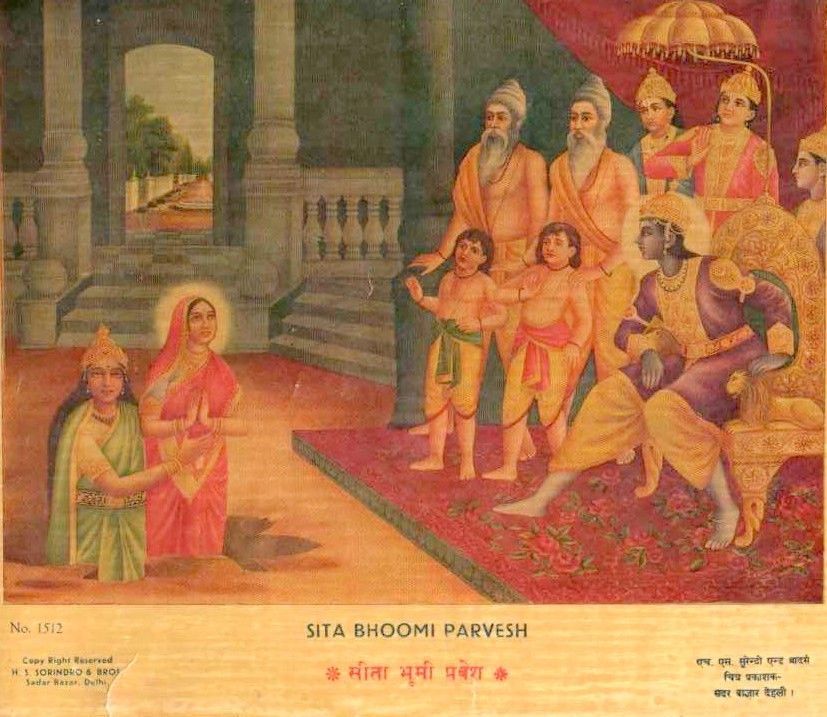
The Indian spirit has devised various ways to keep this vast body of work alive ever since the first Purana was compiled. We have no idea of the first Purana, though Vishnu Purana is referred to as the oldest. However, in ancient times, yagas were held regularly and once the elaborate rituals of the morning were over, a scholarly member imbued with good memory and mastery of the spoken language spoke of history, culture, legends, the ethical codes of Dharma and the practises of aspirants for the spiritual life.
In the course of time, these memory tanks must have become so complicated that Vyasa compiled them into eighteen distinguishable works. The term Vyasa means “a compiler” and since within a few centuries of such compilation further literature branched forth, the originals were called the Major or Maha Puranas. Those that came later were termed Upa-Puranas.
Once temple worship began to replace the huge satra-yagas, localised Puranas began to be written. Relating the temple or holy place with a legend from one of the earlier Puranas, the local Purana was structured as a compendium of miracles, faith, ritualism, local flora and fauna.
Altogether they made a handbook for the local residents to lead a life of piety and helped them imbibe a sense of pride in their place of residence. They could go to new places in search of adventure or livelihood or pilgrimage, but they always came back to their original place of residence, keeping total faith in their “kula daivam” represented by the presiding deity of the local temple and recorded in the Sthala Purana.
Till today, listening to lectures on the Puranas given as a series (Hari Katha Kalakshepam, which literally means spending the time telling stories of the Lord) has kept the Puranas a living experience for the common man.
In this context, one may also remember that the Puranas teach ethical ways of living through the stories as well as direct teachings. Sri Aurobindo says that the teachings imbedded in the Puranas are a natural consequence of the Classical Age in Sanskrit which revelled in sense-induced pleasures leading to a certain degeneracy in public morality. The Puranas became the instruments to get the Indian mind back to its spiritual homeland that begins with the Vedas.
Continued in Part 2
Notes
- See Nagasamy, R. (ed.), Studies in South Indian History and Culture (1997), p. 142. ↩︎
- Ibid., p. 144. ↩︎
~ Design: Beloo Mehra