Vol. VII, Issue 8-9
Author: Prema Nandakumar
Editor’s Note: This part emphasises Puranas as a continuation of the Vedas, while simultaneously making the ancient legends a contemporaneous experience for the listeners.

Continued from Part 1
Of the eighteen Major Puranas, the Vishnu, Bhagavata, Naradiya, Garuda, Padma and Varaha Puranas uphold the primacy of Narayana; the Brahma, Brahmanda, Brahmavaivartsa, Markandeya, Bhavishya and Vamana Puranas speak of the superiority of Brahma; Shiva is the supreme presence in Vayu, Linga, Skanda, Agni, Matsya and Kurma Puranas.
As mentioned earlier, the Vishnu Purana is considered to be the oldest (2nd century A.D.) and has been described as the best of them all, the “Purana ratna”. The Bhagavata appears to be the youngest and is set around the 6th century, a date supported by Swami Tapasyananda.
As in the Upanishads, the Puranas also are presented as answers to questions addressed to the Suta Puranika Ugrasravas by the sages residing in the Naimisharanya forest. Did Suta belong to the Kshatriya caste? This too has been debated a good deal. Dikshitar has his own reservations in accepting this view.
According to him the term Suta has different meanings like a great sage or a charioteer or one belonging to a mixed caste. Since it is not quite conceivable that a Suta of a lower caste gained admission to the sanctum of the sacrificial halls and was elevated by the assembled sages as a medhaavi and a mahaabhaaga, the Suta Pauranika of the Puranas must be taken as a great sage who had a command over an assembly for several days (or months) together.
Tradition has outlined a structure for the Puranas as well. According to the Amara Kosa, a Purana should deal with cosmogony (sarga), dissolution and renewal (pratisarga), chronology (vamsha), cosmology (manvantara) and genealogy (vamsaanucharitham).
The Puranas do not always conform to this pattern. The range of the subjects dealt with in these compendiums is much wider and often do we tarry for long in particular Puranic spaces for the sheer beauty and wonderment of the conception and telling, as when we hear of the symbolism of the mystic lotus as a seat of Brahma in the Padma Purana. The Garuda Purana is a treasure trove of astronomy.
The most important consideration for us is that the Puranas are a continuation of the Vedas. The Vedic deities are very much here, though they have undergone a lot of transformation in consonance with the movement of the religious temper of the Indian as the centuries pass by.
For instance, the symbolic beginnings of the Savitri-Satyavan legend presented as an Upakhyana by Vyasa in the Mahabharata are to be found in the Vedas; some of the Puranic retellings bring in subtle changes and extensions without losing the core-significance of the tale. The same legend is handled by Matsya Purana (cantos 208-214) which came much later than the Mahabharata.
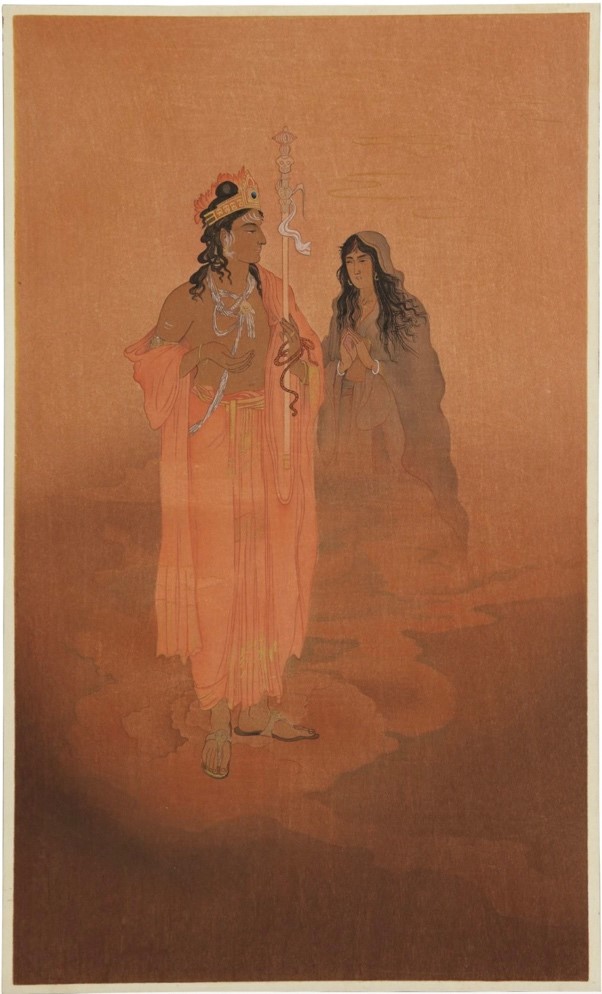
We find that in the Purana, it is Aswapathi who arranges the wedding of Savitri with Satyavan. Rishi Narad comes and warns him. Aswapathi is worried but he decides that “a daughter is given away only once” (sakrut kanyaa pradeeyanthe), using the words uttered by Savitri in Vyasa’s Upakhyana. A significant addition is a canto of thirty-five verses in which Savitri and Satyavan wander around in the forest watching the glories of nature.
Only Savitri is aware that her husband’s hours are numbered. Satyavan speaks romantically pointing to the mango tree, the Ashoka, the Kimsuka trees full of fiery blossoms, the wind that blows sweetly, the Karnikara trees, the creepers that close in on the foootpath, the earth lovely with flowers, the drone of bees that sounds like Cupid readying his bow and arrow “to strike at couples like us”. With the music of the nightingales, “the forest is beautiful like you” (vibhaati chaarutilakaa tvamivaishaa vanasthali). He also points out the loving pairs of koels, bees, crows, Teetar birds, the sleeping lion and lioness, the tigers and the deer moving in pairs, the elephants, the Chakravaka birds.
The fascinating paean to Nature is followed by the rest of the narrative, with some minor modifications, especially in the words of wisdom spoken by Savitri. The Upanishadic command of honouring one’s mother, father and teacher is presented by Savitri in her opening words:
Imaam lokaam maatrubhaktayaa pitrubhaktayaa tu madhyamam
Guru sushrushayaa chaiva brahmalokam samashnute
By worship of mother this world is gained; by worshipping father the middle and by worshipping one’s teacher Brahmaloka is gained.
At the conclusion of their conversation, Yama releases Satyavan’s life saying he is pleased with Savitri’s prayerful attitude and blesses them with five hundred years of married life (it is four hundred years in Vyasa).
Hence, contrary to the Western assault on our psyche about the Puranas being nothing more than a bundle of old wives’ tales, the works become cleansing and transformatory agents as man struggles forward in his spiritual journey. As the example of the Savitri legend shows, the Puranas made the ancient legends a contemporaneous experience for the listeners:
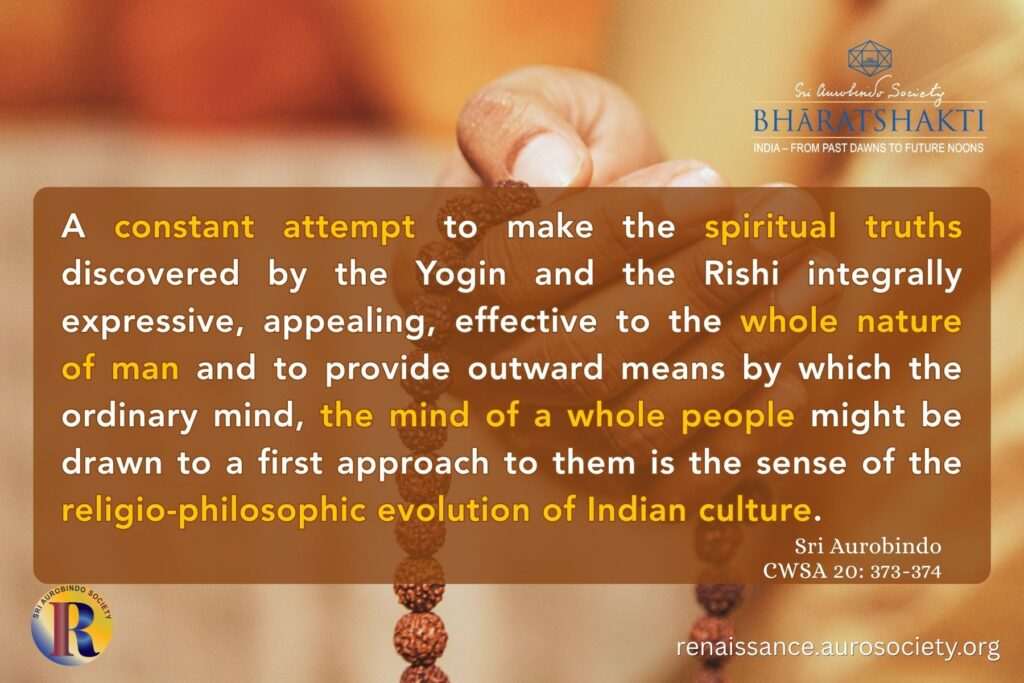
… the Puranas carried forward this appeal to the intellect and imagination and made it living to the psychic experience, the emotions, the aesthetic feeling and the senses. A constant attempt to make the spiritual truths discovered by the Yogin and the Rishi integrally expressive, appealing, effective to the whole nature of man and to provide outward means by which the ordinary mind, the mind of a whole people might be drawn to a first approach to them is the sense of the religio-philosophic evolution of Indian culture.
~ Sri Aurobindo, CWSA 20: 373-374
To be continued in next issue
Read Part 1
~ Design: Beloo Mehra