Vol. VII, Issue 8-9
Author: K.R.Srinivasa Iyengar
Editor’s Note: In this part, the author pinpoints to the precision and liberality with which Sri Aurobindo uses words, and says that “he is both voluble in appearance and compact in effect.” He gives an example of one of the thousands of letters Sri Aurobindo had written to his disciples and marvels at is impeccable phrasing.
Continued from Part 1
Born Lord of Language
Sri Aurobindo, being a literary artist, has perforce to use words as the medium of his expression. If his father had sent him, not to the Loretto Convent School at Darjeeling and thence to London and to Cambridge, but to native schools and colleges in Calcutta, Sri Aurobindo might have early familiarized himself with his mother tongue and become in the fullness of time another Bankim Chandra or Rabindranath, wielding with power and grace the most dynamic of modern Indian languages. But that was not to be.
English became for all practical purposes Sri Aurobindo’s mother tongue and he acquired in an incredibly short time an astonishing mastery over this difficult language. A profound knowledge of Greek and Latin and a fair acquaintance with French, Italian and German helped him to study the language and the literature of the English people both in their origins and in their present European setting.
Back in India at long last, Sri Aurobindo started reading Sanskrit and Bengali, and quickly grew proficient in both—but English remained his mother tongue. He loved Sanskrit and Bengali and mastered them much as a Sir William Jones loved Sanskrit and studied it. Be that as it may, Sri Aurobindo was now, at the age of twenty-five, a master of many languages and knowledges, and a gifted writer in English who found it as easy and natural to turn his thoughts into limpid verse as to give them the “other harmony of prose” (John Dryden).
In the course of a long and varied career, Sri Aurobindo has been writing incessantly; writing prose and verse; letters, journalistic essays, reviews, exhortations, critical and philosophical expositions, commentaries and treatises, all in prose; and in verse, epigrams, translations, adaptations, lyrics, narrative poems, dramas, and, in recent years, a set of remarkable exhibits in futurist poetry.
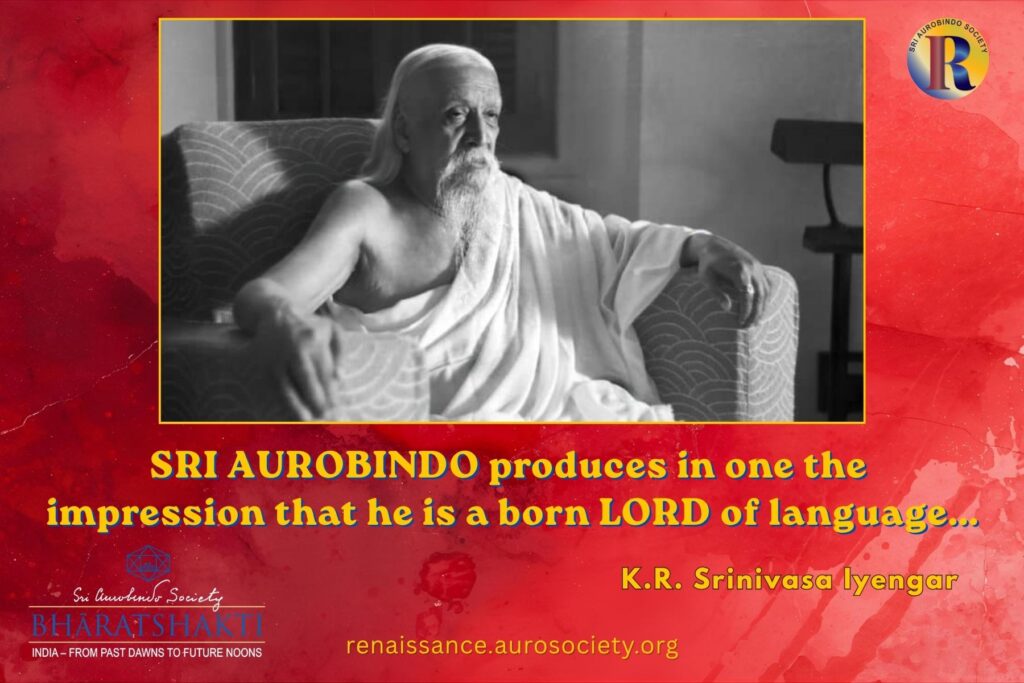
In result, Sri Aurobindo produces in one the impression that he is a born lord of language; he scatters words about, at once with precision and with liberality; he is both voluble in appearance and compact in effect; he is so consummate a literary artist that his art ever covers up the traces of its toils, leaving only the well-cut diamond behind.
When we refer to an artist’s toils, we do not necessarily mean that the pursuit of art is but a travail of “double, double toil and trouble” (William Shakespeare, Macbeth). Creative composition is almost always a matter of taking considerable—if not infinite—pains but neither should pleasure be ruled out altogether; indeed, the pains of labour admitted, is there not also a fury of pleasure as well in the throes of parturition?
Moreover, once an artist has gone through a severe discipline in works, artistic activity becomes almost second nature to him and he seems to paint or to sing or to write easily, effortlessly and as it were involuntarily. How much more true is it in the life of a true yogi, who has undergone the severest disciplines in the vital, mental and spiritual planes, and who has transformed them all into engines of purposeful activity dedicated to the Life Divine?
Yoga is indeed skill in works—and there is nothing surprising in a yogi wielding the instrument of language with ease, skill, dexterity, and unfailing success.
WATCH
Yoga and Skill in Works
Read Sri Aurobindo’s letters—there are, perhaps, several thousands of them—and they all hum and sparkle and whisper, at once a voice near one’s ear and a voice from above; they are neither poems, nor rhetorical pieces of prose, but they reproduce rather the delicate rhythms of common speech; they are best described as verbal curtains that shut us in—and then we almost decipher the very features and recognize the unique modulations of the voice of the remarkable writer of these letters. Quotation is difficult, but this one will do for a specimen:
“Dilip,
I cannot say that I follow very well the logic of your doubts. How does a brilliant scholar being clapped into prison invalidate the hope of the Yoga? There are many dismal spectacles in the world, but that is after all the very reason why Yoga has to be done. If the world were all happy and beautiful and ideal, who would want to change it or find it necessary to bring down a higher consciousness into earthly Mind and Matter?
Your other argument is that the work of the Yoga itself is difficult, not easy, not a happy canter to the goal. Of course it is, because the world and human nature are what they are. I never said it was easy or that there were not obstinate difficulties in the way of the endeavour.
Again I do not understand your point about raising up a new race by my going on writing trivial letters ten hours a clay. Of course not—nor by writing important letters either; even if I were to spend my time writing fine poems it would not build up a new race.
Each activity is important in its own place: an electron or a molecule or a grain may be small things in themselves, but in their place they are indispensable to the building up of a world; it cannot be made up only of mountains and sunsets and streamings of the aurora borealis—though these have their place there.
All depends on the force behind these things and the purpose in their action—and that is known to the Cosmic Spirit which is at work; and It works, I may add, not by the mind or according to human standards but by a greater consciousness which, starting from an electron, can build up a world and, using a tangle of ganglia, can make them the base here for the work of the Mind and Spirit in Matter, produce a Ramakrishna, a Napoleon, a Shakespeare.
~ Sri Aurobindo, CWSA 31: 672
The phrasing is impeccable, and even the two unusual words ‘canter’ and ‘ganglia’ but enrich the passage; the rhythms are akin to those of subdued conversational speech and play on one’s tongue with disarming familiarity.
One can picture to oneself this imaginary scene—the chela agitatedly putting forward one animadversion after another, the guru patiently and almostly smilingly meeting them, explaining, arguing, persuading. Only a casual letter—a “trivial” letter!—but it reveals the writer, explains the core of his faith, and, incidentally, illustrates his prose art.
To be continued…
Read Part 1
~ Design: Beloo Mehra