Vol. VII, Issue 8-9
Author: K.R.Srinivasa Iyengar
Editor’s Note: This essay was first published in 1943, in Volume 2 of Sri Aurobindo Mandir Annual, a journal published by Sri Aurobindo Pathamandir, Kolkata. Sri Aurobindo Pathmandir was the first public institution outside Sri Aurobindo Ashram, Pondicherry, dedicated to the study and dissemination of Sri Aurobindo’s and the Mother’s vision and teachings.
Starting with this issue of Renaissance, we will be serialising this long essay. In the current issue, we feature first two parts. In part 1, the author gives a broad outline of the various motives which inspire an artist, with a specific focus on the work of a literary artist.
For the ease of virtual reading, we have taken the liberty of making minor formatting changes with no alteration in the original text. We have also added headings and sub-headings for easier organisation in this digital version.
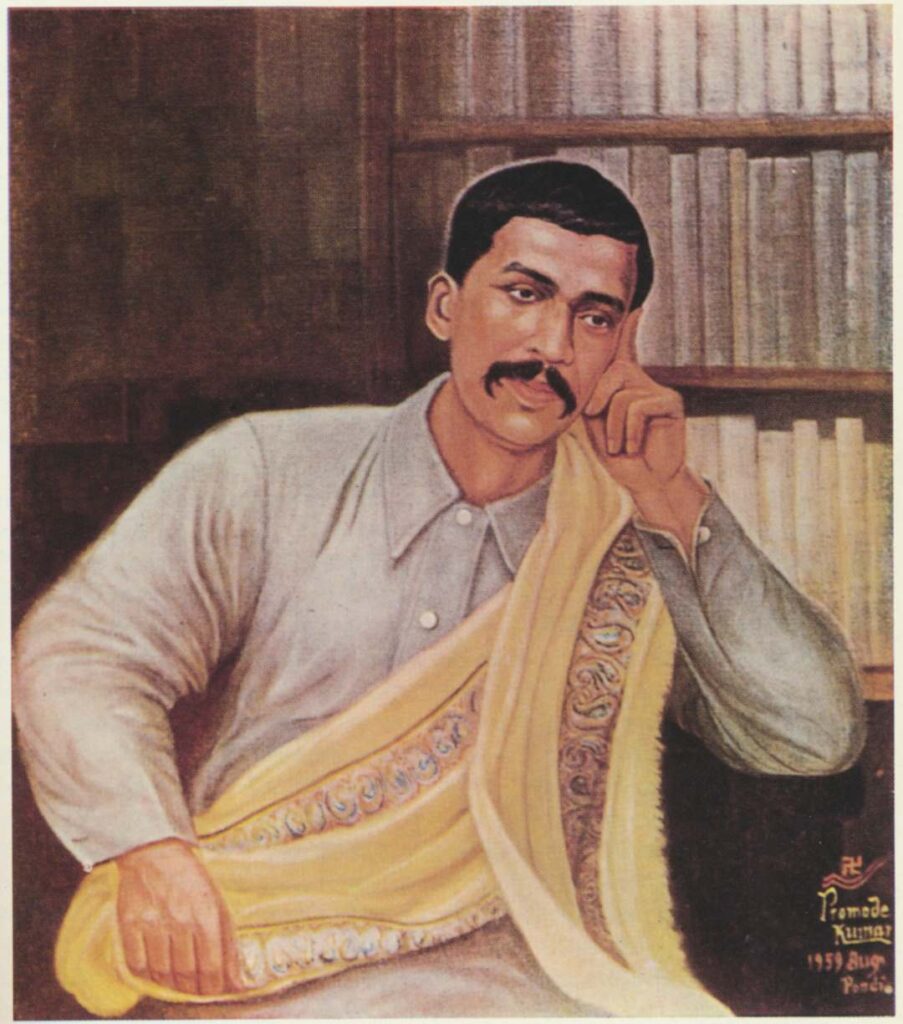
There are people who read Sri Aurobindo for the mystery and glamour surrounding his terrestrial career, more exclusive people who see in him the promise—nay, the reality—of the Superman and read him as the propounder of integral yoga, others who remember him mainly as the apostle of virile nationalism and read him as the living soul of renascent India. And there are some others still to whom he is primarily a literary artist and hence read him merely to lose themselves in the luminous radiances of his poetry or in the many enchanting expanses of his weighty prose works.
It is the last named aspect of a many-faceted achievement that is the subject of this diffident attempt at appraisement.
Aim of an Artist
An artist is ever one who strives to induce form into seemingly formless matter, who wrestles with the raw-stuff of reality to explore its significances and exhibit them to the world; he is thus something of an explorer and creator in his own sovereign right.
The potter handles only foul, frail clay, but his exertions end in the production of a beautiful and useful article; the carpenter slaves at his task, sawing and splitting huge masses of timber, but he ends by creating a chair or a chandelier or a chariot; the weaver and the basket-maker, the master-builder of churches and bridges and mosques and temples, the music-makers who waft the human soul to the seventh heaven of felicity, the painter and the poet whose inspired creations offer the balm of incommensurable hope to ailing humanity, they are artists all, explorers of reality and creators of beauty which at the same time that it is beautiful is also purposive.
From archives
The Purpose of Art – From Beauty to Bliss
The distinction that is often elaborated between the ‘mechanical’ arts on the one hand and the ‘fine’ arts on the other does not really touch the root of the matter. It is not as though the former are wholly utilitarian and the latter are utter superfluities in life. So long as there is no difference in their capacity, why does one prefer a beautiful to an ugly basket?
Beauty may have, strictly speaking, no ‘use’ for us, but it is of much ‘value’ to those who can respond to it—and where is the man with a soul so dead that he has never felt his sensibilities quicken in the presence of beauty? On the other hand, the so-called ‘fine’ arts—music, painting, sculpture, architecture and poetry—are not mere luxuries, delectable toys in one’s exclusive Ivory Tower, but rather the oxygen whose inhalation helps the human soul to realize, at auspicious moments, that
A life of intensities wide, immune
Floats behind the earth and her life-fret,
A magic of realms mastered by spell and rune,
Grandiose, blissful, coloured, increate.~ Sri Aurobindo, The Life Heavens, CWSA 2: 549
Art can be neither wholly utilitarian (in its lesser, material sense) nor can it be pursued or professed or practised in an absolute vacuum. It is as meaningless to cry down an artisan because he produces marketable chairs and baskets as it is to extol a Bright Young Thing that loudly proclaims the heresy that Art is ever for Art’s sake alone. Even the basket-maker is an artist, for he too is conscious of beauty, and is able to realize it here and now; and even the most gifted of poets is something of an artisan, for he too has laboriously to learn to master his material by using the delicate tools of his own forging.
All products of artistic activity must thus possess value in our eyes; we go to them, we cherish them, because they are useful to us in one way or another, because they both serve us and enlighten us, because they make life livable and enjoyable in its different planes and diverse manifestations.
While all the arts are no doubt reared on a common base, they nevertheless differ from one another in their possibilities and in their completed development. It is, in the main, a question of lesser or greater comprehension, and this, again, is largely determined by the nature of the medium in each particular instance; the more intractable the medium is, the less scope has the artist to achieve a totality of comprehension.
Explore
The Spirit and Forms of Indian Art
In general terms, every artist aims at storming the citadel of Reality and revealing its purposive core and manifold significances; he aims—to vary the metaphor—at bridging the seeming chasm that divides the real from the ideal, Time from Eternity, the human from the Divine; he aims at portraying infinity in a grain of sand, ineffable beauty in a few dots and dashes, the music of the spheres in a song or a lyric.
An Artist’s Medium
The aim is the same—but the media vary, and the different arts offer, in consequence, an interesting study in secondary diferentiation. Architect or sculptor or painter or musician or poet, the artist would glimpse Infinity and attempt to realize it in terms of his medium—stone, marble, palette, sound, symbol, as the case may be.
The architect can really give his visions a local—almost a material—habitation and a name; the finished structure is there before us, it immediately makes an assault upon our emotions and imaginations. But the medium at the disposal of the architect is essentially intractable; it can be made to convey only a limited number of ideas.
The grandeur of a Gopura or of a Gothic church or of a Taj bathed in moonlight is certain to transport the human soul from its prosaic habitation on the earth; but the experience comes in a flood, overwhelms us at once, and anon leaves us behind amidst the shallows and miseries of our humdrum occupations.
Explore in Renaissance
Indian Sacred Architecture
The nuances, curves, and gradations that make life a rich and varied store of significance, the embracing fluidities of love and play and laughter, these cannot come within the purview of architecture, nor yet that of sculpture—for, although human and divine features may be portrayed by a sculptor, he can never reproduce the dynamics of passion, the fluctuations in the fever and the fret that agitate the perennially human in us all; although wonders have been achieved with masses of stone and blocks of marble or brass, a great deal must yet always elude the grasp of the architect and the sculptor.
The painter is better placed in respect of his medium than are the architect and the sculptor. Colours are fluid things, they are fascinating and intriguing things; you can choose your colours, you can mix them in any way you please, and you can load the canvas less or more with the many colours at your disposal. Since a two-dimensional canvas has to do duty for a three-dimensional material world and a multi-dimensional spiritual world, the painter has to leave much to illusion.
Less strictly realized in terms of matter, painting is none the less more suggestive than is either sculpture or architecture; movement, the dynamics of action, variety, multiplicity, all these can be subtly insinuated by the accomplished painter. In other words, painting is a more inclusive—more variously comprehending-art than are architecture and sculpture, which, in their turn, are more inclusive and vitally comprehensive than are merely mechanical arts like pottery or carpentry or basket-making.
Explore in Renaissance
Indian Painting
Music and poetry, the most ethereal of the arts, are also the most inclusive among them. The musician’s medium is sound,—and music is therefore called an art of the ear in contrast to painting, sculpture and architecture, which are called arts of the eye. Now sounds are deceptively fluid and they can be made to signify almost the entire gamut of human emotions, passions, and aspirations.
The musician is thus in a position to convey the very rhythm of life in its different altitudes; he can make the stream of sound mirror the darkling current of human life; and music can accurately reiterate life’s significances and emphasize their splendorous unity.
The Medium of a Literary Artist
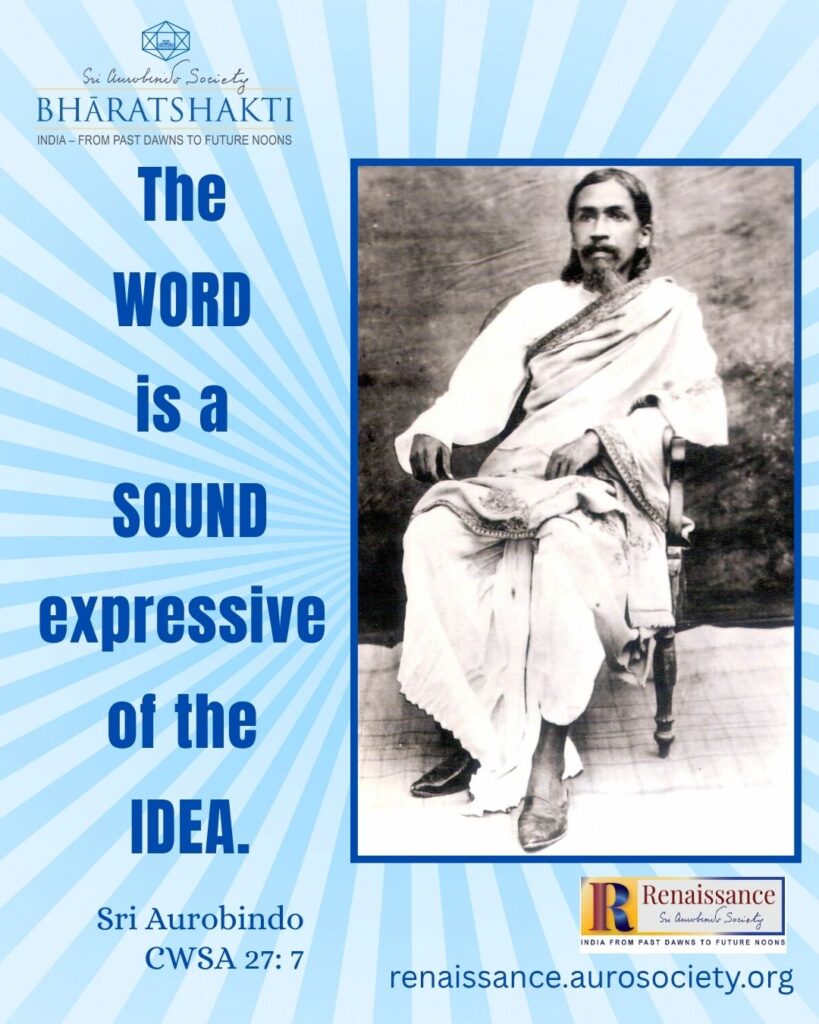
Tenuous, indeed, is the musician’s medium, but even sound is more concrete than the medium at the disposal of a literary artist. Poets and prose writers are alike compelled to use words—words only, words alone—in the practice of their art. But what are words! When words are printed, they no doubt catch the eye, but words were not always printed or even written; when words are spoken, they are doubtless heard by the human ear, but words are not always spoken.
What is the true content of a word, then? It has a particular look on the printed page, it conveys a particular sound to the ear, it communicates something akin to an idea to the mind; but a word is more than what it looks and what it sounds and what it seems to mean; it is a symbol, it is a wave that floats in the ocean of Eternity, sometimes carrying a whisper from God to man or a prayer from man to God.
In logical phraseology we might say that a word has both a definite denotation and an unknown, almost limitless connotation; we might say that a word has both a semantic import and a phonetic significance; but we cannot ever hope to dispossess words of their potency, their mystery and their magic.
Medium, Capable of Infinite Variation
A literary artist has greater potentialities of expression, not because as an artist he has aims other than those that inspire the musician or the painter or the sculptor or the architect, but because his medium is capable of infinite variation, it is the most ethereal and comprehensive medium of all.
A block of wayside stone may appear to be a crude and useless thing; but the gifted sculptor sees the form implicit in it, chisels away the superfluous masses, and lo and behold, a beautiful image results from his exertions! It is not as if he has created the image—he has only released it from its amorphous prison-house and allowed it to pursue its career of beauty and breathe the air of freedom.
In like manner, stray words in the Dictionary, like so many wayside stones, may appear prosaic and harsh and crude; but the magic touch of the literary artist will kindle them into a flame of beauty, that radiates “thoughts that wander through eternity” (John Milton, Paradise Lost).
The words that a literary artist uses are in physical appearance just like the words in a Dictionary; but they are not so to be understood or apprehended. A poet’s words are not printed bundles of letters, nor are they a grouping of pleasure-giving sounds. While poetry does appeal to the ear and although it is now-a-days preserved in print, the poetic word ever attempts to reach the inward ear, to sink into the human soul and enrich it.
The poetic word is the least material of all media and is akin rather to a winged squadron of the spirit that annihilates space and time and links the human soul with infinity and eternity.
Continued in Part 2
~ Design: Beloo Mehra