Vol. VII, Issue 10
Author: K.R. Srinivasa Iyengar
Continued from Part 2
Editor’s Note: The focus in this part shifts to Sri Aurobindo’s monumental prose writings such as The Life Divine and Essays on the Gita. The author helps us appreciate the remarkable balance, clarity and the vigour of the phrasing Sri Aurobindo employs which he says, “are almost as worthy of reverent study as are their logical structure and their close-grained fabric of thought”.

Sri Aurobindo’s Prose Writings
Sri Aurobindo’s more deliberate compositions in prose are distinguished by the same qualities of quiet assurance, classical phrasing, and appropriateness to the theme and the mood and the occasion. You may tackle any of his prose ‘tracts for the times’ or journalistic effusions or massive treatises—there is no faltering at the exordium, no thinness in the structure of the argument, no weakness in the peroration.
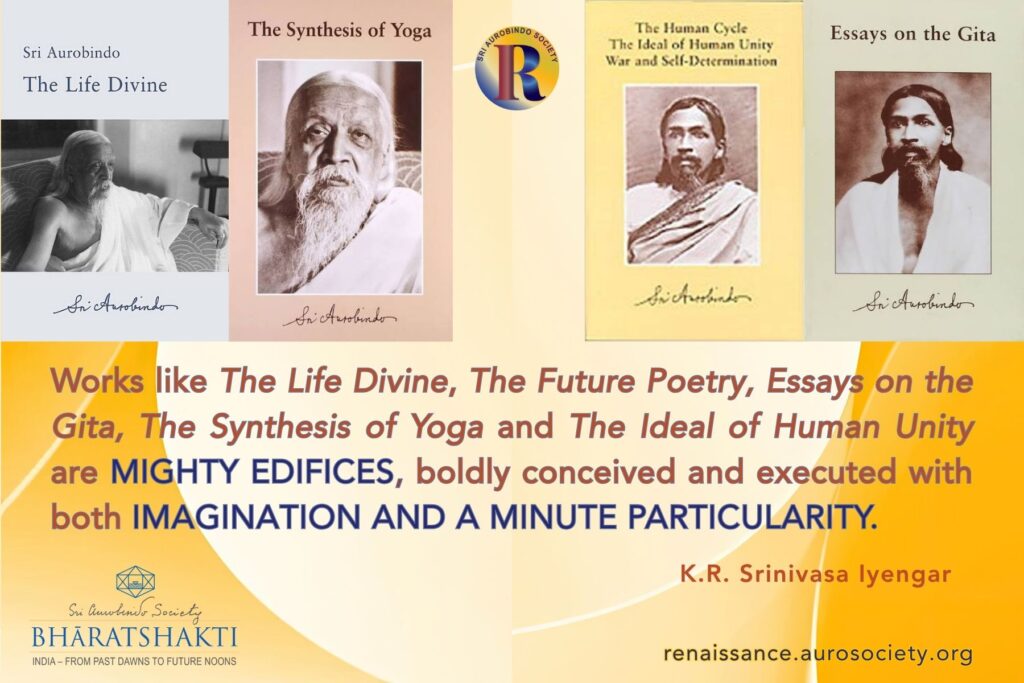
Works like The Life Divine, The Future Poetry, Essays on the Gita, The Synthesis of Yoga and The Ideal of Human Unity are mighty edifices, boldly conceived and executed with both imagination and a minute particularity. Sri Aurobindo has never felt it beneath his notice to attend to details; a true artist, he has always realized that even seeming trifles have their own appointed place in the fullness of the final achievement.
Although the above sequences were originally written under the peculiar exigencies of periodical publication, they nevertheless preserve form and unity of impression, and claim and secure for Sri Aurobindo a place among the great modern masters of English prose.
It is, perhaps, convenient as it is also necessary to study in particular the two monumental works, Essays on the Gita and The Life Divine, because these have gone through a process of revision since their publication in the Arya….
The Essays are in intention exegetical; the Gita is paraphrased, often verse by verse; Lord Krishna’s uttered and unuttered thoughts are sifted, arranged, illustrated, expanded; seemingly and endlessly repetitive, the Essays are seen in the end to be somehow endowed with a marvellous compactness and unity of its own.
What has happened is this: while doubtless deriving his primary inspiration from the Song Celestial, Sri Aurobindo has created out of it his own individual music that enchants and exhilarates the reader and gradually effects in him a heightened awareness and a keener sensibility.
Likewise, when superficially considered, a work like The Life Divine would appear to be a severely—forbiddingly—abstruse treatise, bristling with obscurities and technical terms and hair-splitting differentiations.
On the other hand, closer acquaintance with it makes one realize that the whole Himalayan edifice is only a vast prose symphony. There are discussions, no doubt, and in so far as they are discussions they give adequate proof of a virile mental forge at work; no mere logician developed a thesis or elaborated an argument better than Sri Aurobindo does in The Life Divine. And how admirable—metallic in its hardness and lucid clarity—is a summing-up like this:
This then is the origin, this the nature, these the boundaries of the Ignorance. Its origin is a limitation of knowledge, its distinctive character a separation of the being from its own integrality and entire reality; its boundaries are determined by this separative development of the consciousness, for it shuts us to our true self and to the true self and whole nature of things and obliges us to live in an apparent surface existence. (Sri Aurobindo, CWSA 22: 659)
It is, of course, not the story of Jack and Jill going up the hill and fetching water in a pail; it is the crest of an argument that has taken Sri Aurobindo some five hundred pages to elaborate. But it is not spoilt by any avoidable obscurity—on the contrary! Here are some more specimens of such granite phrasing picked at random from these two books:
Harmony is the natural rule of the spirit, it is the inherent law and spontaneous consequence of unity in multiplicity, of unity in diversity, of a various manifestation of oneness. In a pure and blank unity there could be indeed no place for harmony, for there is nothing to harmonise; in a complete or a governing diversity there must be either discord or a fitting together of differences, a constructed harmony. But in a gnostic unity in multiplicity the harmony would be there as a spontaneous expression of the unity,… (CWSA 22: 1077)
***
There is a Reality, a truth of all existence which is greater and more abiding than all its formations and manifestations; to find that truth and Reality and live in it, achieve the most perfect manifestation and formation possible of it, must be the secret of perfection whether of individual or communal being. This Reality is there within each thing and gives to each of its formations its power of being and value of being. (CWSA 22: 1085)
***
The love of the world spiritualised, changed from a sense-experience to a soul-experience, is founded on the love of God and in that love there is no peril and no shortcoming. Fear and disgust of the world may often be necessary for the recoil from the lower nature, for it is really the fear and disgust of our own ego which reflects itself in the world. But to see God in the world is to fear nothing, it is to embrace all in the being of God; to see all as the Divine is to hate and loathe nothing, but love God in the world and the world in God. (CWSA 19: 245)
One comes across many such passages in the body of Sri Aurobindo’s prose writings and indeed their balance, their clarity and the vigour of their phrasing are almost as worthy of reverent study as are their logical structure and their close-grained fabric of thought.
Continued in Part 4
Read
Part 1
Part 2
~ Design: Beloo Mehra