Vol. VII, Issue 10
Author: K.R.Srinivasa Iyengar
Continued from Part 3
Editor’s Note: The author gives several examples to illustrate that Sri Aurobindo’s brilliant prose writings can’t hide the poet that he was, and in many a places, the knife-edge clarity and sharpness of his prose dissolve into poetic imagery and symbolism.
Poetry of Sri Aurobindo’s Prose
Not infrequently, however, Sri Aurobindo’s prose art emits unexpected poetic flashes which subtly illumine and transfigure whole sentences and paragraphs. Simile and metaphor trespass upon the domain of cogent prose and language crystallizes into glittering images like these:
We do not belong to the past dawns, but to the nouns of the future. (CWSA 19: 10)
***
For now the world Being appears to him as the body of God ensouled by the eternal Time-spirit and with its majestic and dreadful voice missions him to the crash of battle. (CWSA, 19: 301)
***
It has enormous burning eyes; it has mouths that gape to devour terrible with many tusks of destruction; it has faces like the fires of Death and Time. (CWSA, 19: 380)
***
…Kali with her garland of skulls trampling naked in battle and flecked with the blood of the slaughtered Titans… (CWSA, 19: 380-381)
***
Knowledge waits seated beyond mind and intellectual reasoning, throned in the luminous vast of illimitable self-vision. (CWSA, 21: 129)
Dialectical skill gives place to direct vision, the knife-edge clarity and sharpness of prose dissolve into poetic imagery and symbolism; and Sri Aurobindo is seen to be poet no less than the wielder of an animated and effective English prose style.
“Minor” works
Some of Sri Aurobindo’s characteristically epigrammatic or impassioned bits of prose are contained in his “minor” works—notably in The Mother, Thoughts and Glimpses, The Riddle of this World and Bases of Yoga. One is occasionally overwhelmed by a whole shower of epigrams as in:
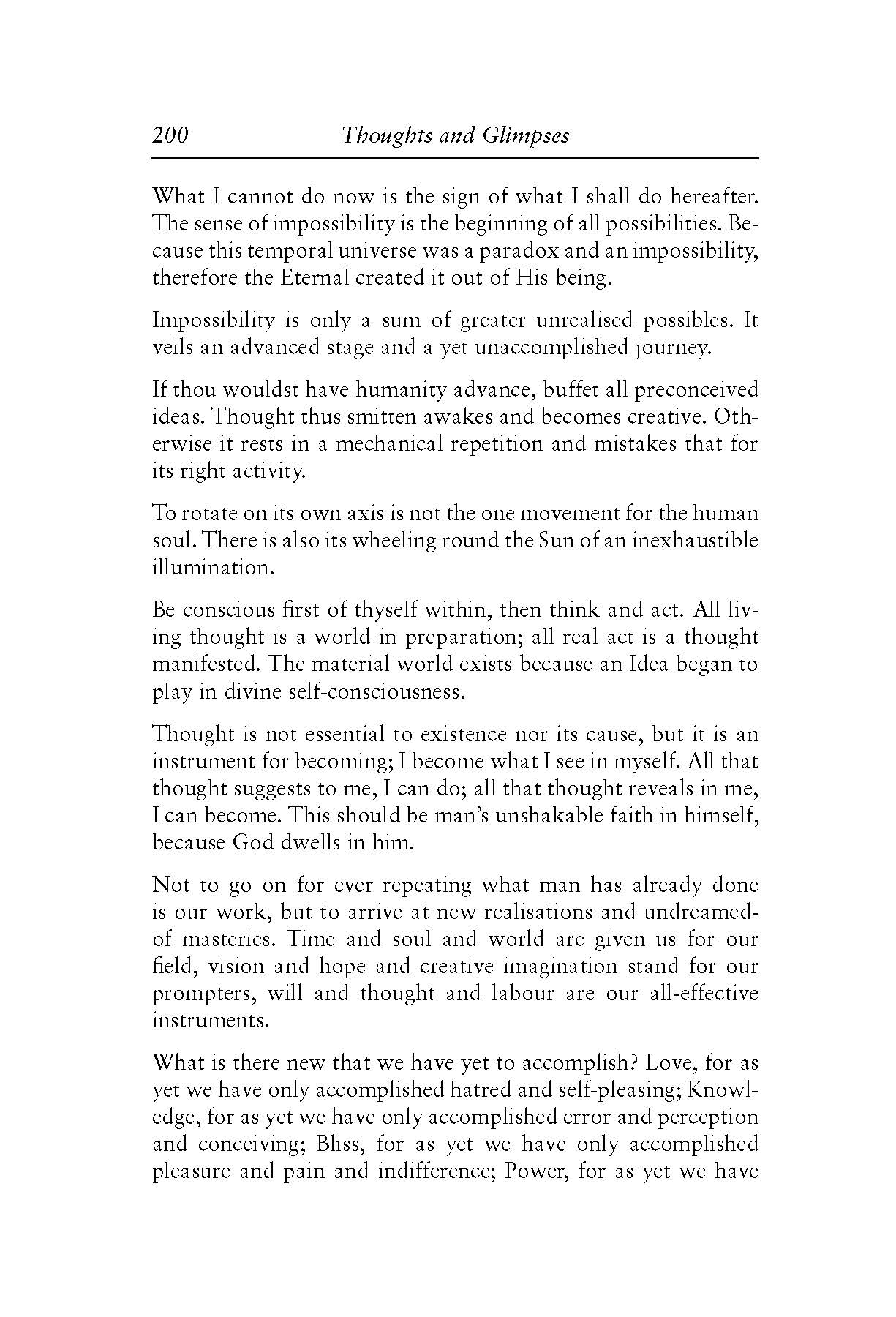
What is there new that we have yet to accomplish? Love, for as yet we have only accomplished hatred and self-pleasing; Knowledge, for as yet we have only accomplished error and perception and conceiving; Bliss, for as yet we have only accomplished pleasure and pain and indifference; Power, for as yet we have[p.200] only accomplished weakness and effort and a defeated victory; Life, for as yet we have only accomplished birth and growth and dying; Unity, for as yet we have only accomplished war and association.
In a word, godhead; to remake ourselves in the divine image. (CWSA 13: 200-201)
***
And what is the end of the whole matter? As if honey could taste itself and all its drops together and all its drops could taste each other and each the whole honeycomb as itself, so should the end be with God and the soul of man and the universe.
Love is the keynote, Joy is the music, Power is the strain, Knowledge is the performer, the infinite All is the composer and audience. We know only the preliminary discords which are as fierce as the harmony shall be great; but we shall arrive surely at the fugue of the divine Beatitudes. (CWSA 13: 204)
Elsewhere Sri Aurobindo’s wit and imagination fuse into gem-like images, fascinating, clear-cut and profoundly true:
God and Nature are like a boy and a girl at play and in love. They hide and run from each, other when glimpsed so that they may be sought after and chased and captured. (CWSA 13: 203)
***
What is God after all? An eternal child playing an eternal game in an eternal garden. (CWSA 13: 202)
How pretty, you’ll say—but also how suggestive and how true! The author of The Life Divine is not the crusty metaphysician some take him to be—he was a sensitive humanist before ever he dreamed of yoga, and he remains a humanist still.
Parts of Sri Aurobindo’s great little book, The Mother, reveal his verbal suppleness at its best. In particular, the sixth section that evokes with intuitive certainty and imaginative precision the manifold “powers” and “personalities” of the Mother—the home-of-all, womb-of-all created things—is surely among the very finest achievements of Sri Aurobindo as an impassioned literary artist. We have to content ourselves with but one significant extract from the book—which, indeed, suffers somewhat in being taken out of its context:
Wisdom and Force are not the only manifestations of the supreme Mother; there is a subtler mystery of her nature and without it Wisdom and Force would be incomplete things and without it perfection would not be perfect. Above them is the miracle of eternal beauty, an unseizable secret of divine harmonies, the compelling magic of an irresistible universal charm and attraction that draws and holds things and forces and beings together and obliges them to meet, and unite that a hidden Ananda may play from behind the veil and make of them its rhythms and its figures.
This is the power of Mahalakshmi and there is no aspect of the Divine Shakti more attractive to the heart of embodied beings. Maheshwari can appear too calm and great and distant for the littleness of earthly nature to approach or contain her, Mahakali too swift and formidable for its weakness to bear; but all turn with joy and longing to Mahalakshmi.
For she throws the spell of the intoxicating sweetness of the Divine: to be close to her is a profound happiness and to feel her within the heart is to make existence a rapture and a marvel, grace and charm and tenderness flow out from her like light from the sun and wherever she fixes her wonderful gaze or lets fall the loveliness of her smile, the soul is seized and made captive and plunged into the depths of an unfathomable bliss. Magnetic is the touch of her hands and their occult and delicate influence refines mind and life and body and where she presses her feet course miraculous streams of an entrancing Ananda. (CWSA 32: 20-21)
Is it a recordation of demonstrable fact or only the subtle elaboration of a poet’s fancy? In any case it is a passage that a Sir Thomas Browne or a Walter Pater might have felt proud to have written, and The Mother is full of such beautiful and memorable things.
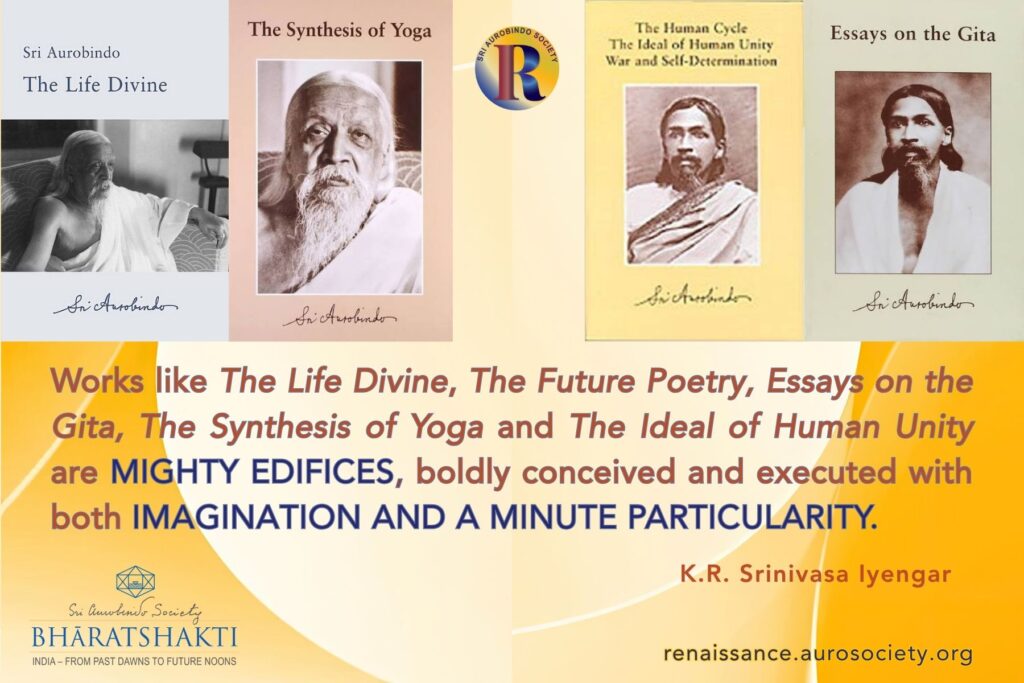
Of Sri Aurobindo’s prose treatises and essays one might say, borrowing his own words, that “the language… the structure of thought, the combination and balancing of ideas belong neither to the temper of a sectarian teacher nor to the spirit of a rigorous analytical dialectics cutting off one angle of the truth to exclude all the others, but rather there is a wide, undulating, encircling movement of ideas which is the manifestation of a vast synthetic mind and a rich synthetic experience” (CWSA 19: 8). Here have we, in pointed brevity, both the material for an appraisement of Sri Aurobindo as a literary artist in prose—and a judicious appraisement as well!
To be continued in the next issue
Read
Part 1
Part 2
Part 3
~ Design: Beloo Mehra