Vol. VII, Issue 10
Author: Narendra Murty
Editor’s Note: The author elaborates on a mesmerising poetic description of the beauty of dawn we find at the very start of Sri Aurobindo’s Ilion. This excerpt is from a larger book project on which the author is working.

Dawn has a special significance in Sri Aurobindo’s writings because it is a harbinger of a new evolutionary possibility; of a new birth. His spiritual epic Savitri begins with the break of dawn in a forest in the foothills of the Himalayas where Savitri is staying in a humble cottage with her beloved Satyavan. On that fateful day Savitri wakes up knowing “This was the day when Satyavan must die”, the dreadful prophecy uttered by Devarshi Narad a year back. After a terrible ordeal and an epic battle with the God of Death, Savitri wins back the soul of Satyavan from the clutches of Death. “Fate was changed by an unchanging Will.”
If Savitri is about victory over Death, then the epic Ilion (Sri Aurobindo’s longest poem after Savitri) is about the victory of Death. Death, not just of a man, but of an entire race, a whole city. Of the city of Ilion – which is another name for Troy.
The Greeks destroyed the city of Troy because it refused to give up Helen who chose to be with her lover Paris, the prince of Troy. This led to an army of Greek nobles and princes, including Helen’s husband Menelaus, declaring a war on Troy. No wonder, Helen has been spoken of the “face that launched a thousand ships”1.
The battle between the Trojans and the Greeks went on for ten long years without any conclusion and with significant losses on both sides. However, the impregnable walls of Troy could not be breached by the Greeks even after ten years. Then came the fateful day when Trojans fell for the ruse of the Trojan Horse and their city was reduced to ruins and all its citizens were massacred. The women of Troy were taken as slaves by the victorious Greeks.
In Sri Aurobindo’s Savitri, the heroine of the story wakes up with the knowledge of the impending death of her husband Satyavan; and she had prepared herself with her sadhana for the heroic confrontation with Death2. But on the fateful dawn in Ilion, the fortress city wakes up without knowing that it is going to die that day. In the lines of Ilion that follow, what we read is sheer Nature Poetry of Sri Aurobindo.
There are numerous passages in Savitri which paint a sublime picture of Nature’s abundant beauty in a forest. But in Ilion, the setting is a fortress city; the scene is that of battle. But the Kavi starts with an exquisite description of Nature.
The Story Begins
The story of Ilion begins with the dawn of the last day of Troy, and what transpired during the day. The matter of the Trojan Horse and the night of destruction which followed, are all outside the ambit of Ilion. The events that are described are what happened during the day – starting from the dawn of that last day.
Let us imagine, for a moment, that we are standing outside the walls of Troy. It is dawn. The light is spreading across the ancient land; the towers and walls of Ilion are being touched by the first radiance of dawn. Within the city, men and women are still asleep and are going to begin a new day as they have done for ages. Yet this morning is different.
It is the last dawn of Troy. In the night, the city that has withstood the ravages of Time and the last ten years of continuous war will have fallen. Its palaces and towers will burn; its warriors will die and the long heroic story of Troy will come to a terrible end. But the people within those walls do not know this yet. And it is here, at this extraordinary moment between the first light of dawn and the everlasting night of Death that awaits the city, that Sri Aurobindo begins Ilion.
Ilion has eight Books and an unfinished ninth Book. Unlike Savitri, it has no Cantos. The first Book of Ilion is named The Book of the Herald. And the first lines are:
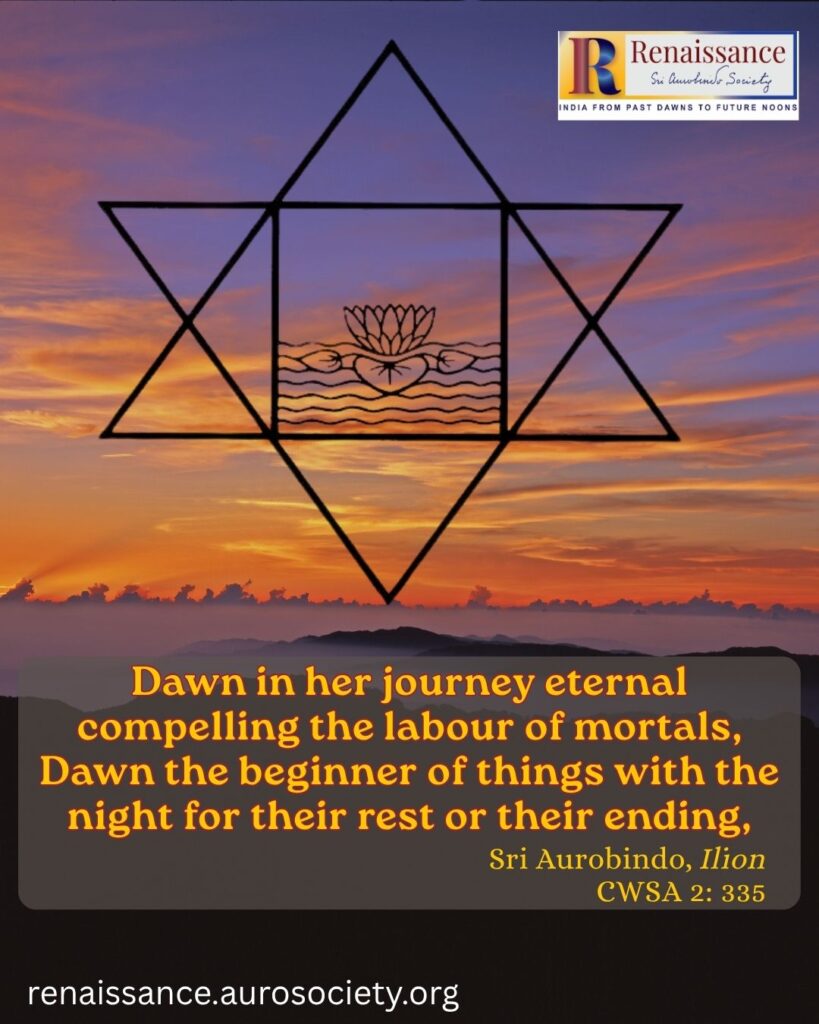
Dawn in her journey eternal compelling the labour of mortals,
Dawn the beginner of things with the night for their rest or their ending,
Pallid and bright-lipped arrived from the mists and the chill of the Euxine.
The passage from night to dawn and the coming of the new day is an eternal journey as decreed by the cosmic Ṛta. It is an endless, recurring cycle of change alternating between light to darkness and from darkness to light. Dawn is the beginning of the waking state and sets the stage for “the labour of mortals”.
All life and the activities of life have their beginning in dawn just as night happens to be the end and the resting place of all the hustle and bustle of life. Dawn, initially pale with a mere hint of a smile of the brightness on its lips, revealed itself from the darkness of the mists and the chillness of the Euxine – the ancient Greek name for the Black Sea – located to the east of Troy.
Earth in the dawn-fire delivered from starry and shadowy vastness
Woke to the wonder of life and its passion and sorrow and beauty,
All on her bosom sustaining, the patient compassionate Mother.
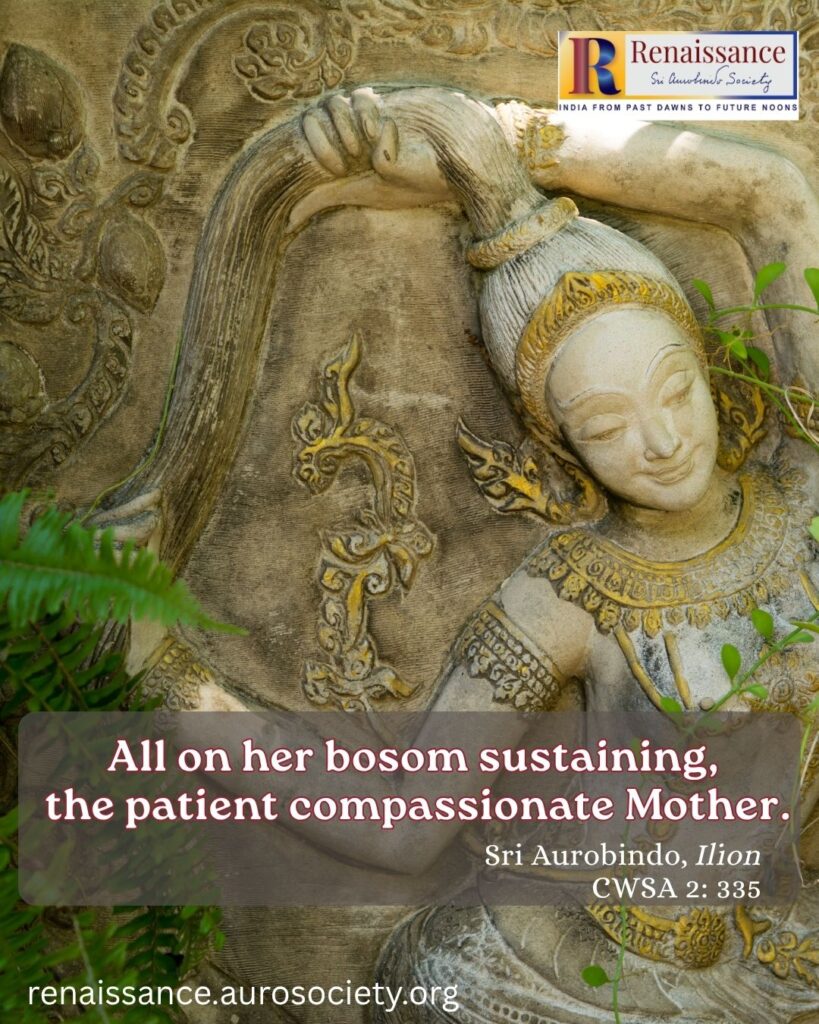
The first light of dawn has arrived on the Eastern skies like a faint smile from across the Black Sea and the earth is slowly awakening to life. Bathed “in the dawn-fire”the sleeping Mother Earth is liberated from the darkness of the starry night and its shadows and awakens “to the wonder of life”. Life that brings with it the vitality of “passion and sorrow and beauty”of all living creatures, who all have their play in the nurturing bosom of Mother Earth who bears all, upholds all and forgives all.
Out of the formless vision of Night with its look on things hidden
Given to the gaze of the azure she lay in her garment of greenness,
Wearing light on her brow.
Coming out of the darkness of Night we do not see and do not perceive forms for they are hidden to our vision. In other words, coming out of the night of ignorance, the journey from darkness to light happens only when we have our sight fixed on the clear blue sky of knowledge (azure). Though we may be rooted in our earthly nature – “garment of greenness”,our mind would receive the light of knowledge as we awaken, when our brow is touched by light. These lines express a beautiful truth where the awakening of the Mother Earth is symbolic of an awakening from the darkness of ignorance to the light of knowledge; “light on her brow”suggesting an awakening of consciousness.
In the dawn-ray lofty and voiceless
Ida climbed with her god-haunted peaks into diamond lustres,
Ida first of the hills with the ranges silent beyond her
Watching the dawn in their giant companies, as since the ages
First began they had watched her, upbearing Time on their summits.
Troas cold on her plain awaited the boon of the sunshine.
After describing Dawn and the awakening of Mother Earth with the first light of dawn, the poet describes the mountains of Ida situated near Troy. In the golden rays of dawn, the lofty heights of Ida shone with a diamond like lustre. Ida’s peaks are “god-haunted”, that is, they are an abode of the gods. In Greek mythology, the gods are believed to reside on Mount Olympus as well as Mount Ida, signifying the sacredness of the mountains, much like our own Himalayas.
Ida was only first of the visible mountains which could be seen from the plains of Troy but beyond it lay vast ranges of hills which stood in silence gazing at the coming dawn, as they have been gazing since the very beginning of Time itself in the dim past – a silent witness to all that had passed through the centuries. And today also they would remain a silent witness to the fate of Ilion. Troas,the cold land and coast of Troy, “awaited the boon of the sunshine.”
Forests looked up through their rifts, the ravines grew aware of their shadows.
Closer now gliding glimmered the golden feet of the goddess.
As the light of dawn touched the land, the forests too were awakened and looked up through the gaps of their rich foliage at the approaching light. The valleys of the hills of Ida became aware of their shadows because now light had crept into their nooks and corners. As the sun rose slowly over the horizon, its light spread across the land; as if touched by “the golden feet of the goddess”. Usha, the goddess of Dawn in Vedic cosmology is known as Eos in Greek pantheon and as Aurora in Roman mythology. This is significance of “Auro” in everything related to Sri Aurobindo, including his name as well as that of Auroville, the City of Dawn.
Over the hills and the headlands spreading her garment of splendour,
Fateful she came with her eyes impartial looking on all things,
Bringer to man of the day of his fortune and day of his downfall.
As the dawn goddess spread the garment of splendour of her golden light across the land of Ilion, she maintained a calm impartial look on all things and all that would come to pass on that fateful day. As dawn, she was the “bringer to man of the day of his fortune” – to the Greek who would emerge victorious at the end of ten long years of battle. And to the Trojan, she would bring the “day of his downfall” – the day of destruction when Troy would be reduced to cinder and ashes.
This is how Ilion begins.
Notes
- The Tragical History of Doctor Faustus by Christopher Marlowe ↩︎
- As described in Book VII, The Book of Yoga ↩︎
Explore more Poetry in Renaissance
~ Design: Beloo Mehra