Vol. VII, Issue 8-9
Author: Beloo Mehra
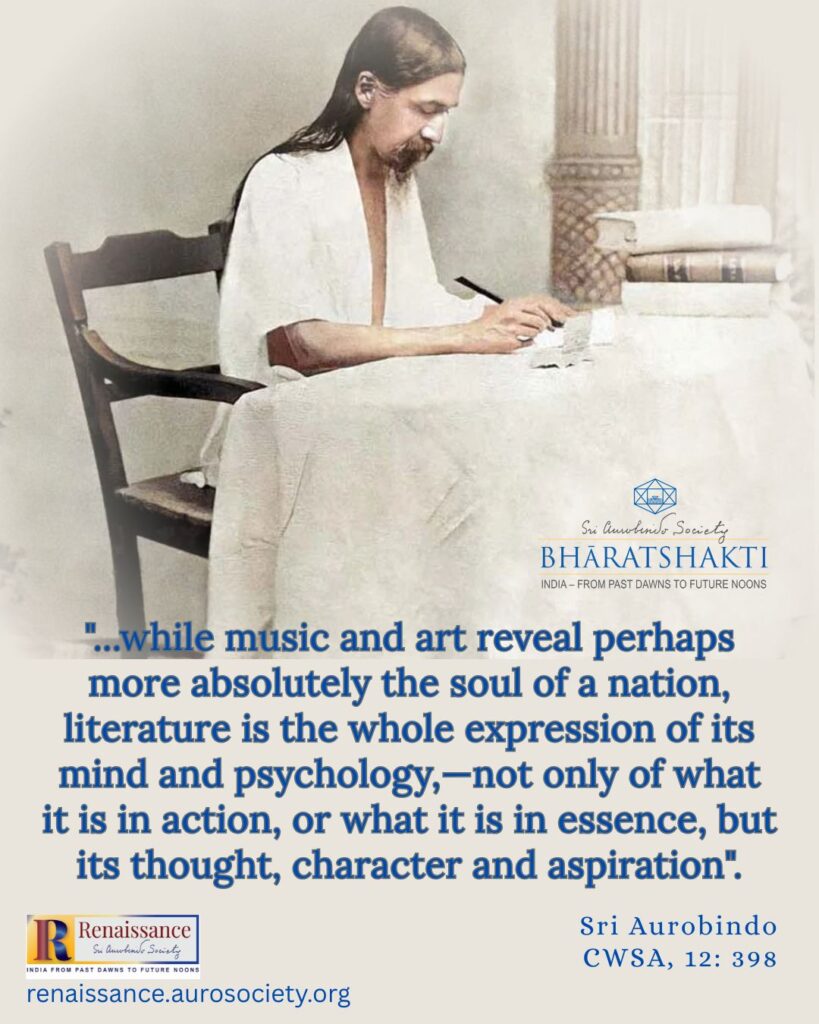
Sri Aurobindo once wrote that “while music and art reveal perhaps more absolutely the soul of a nation, literature is the whole expression of its mind and psychology,—not only of what it is in action, or what it is in essence, but its thought, character and aspiration” (CWSA, 12: 398).
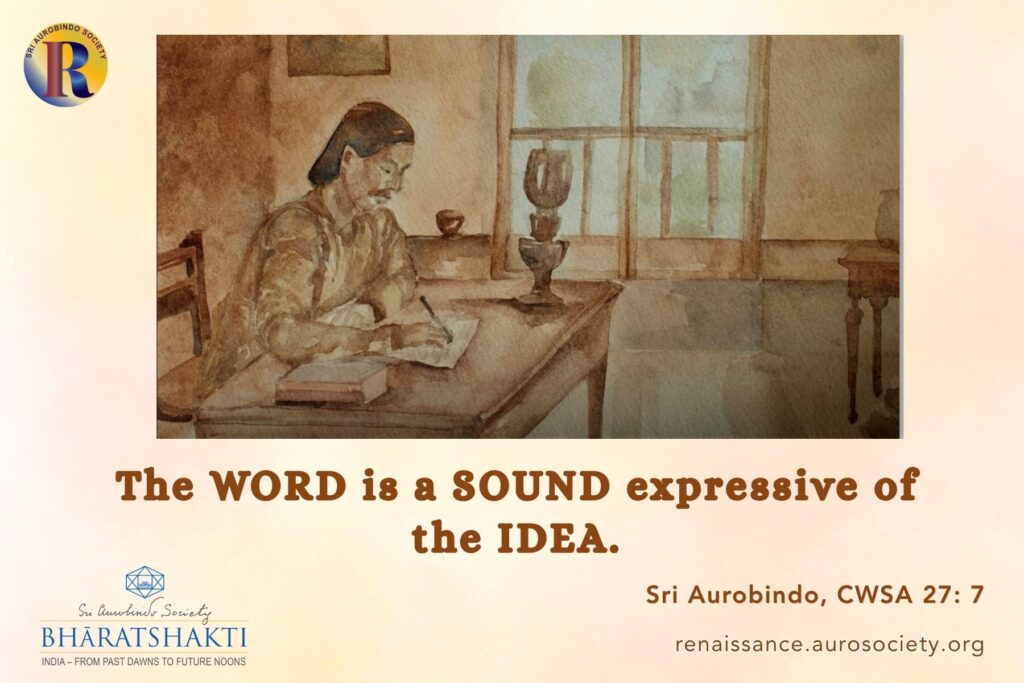
Keeping this definition of literature in mind, every bit of Sri Aurobindo’s voluminous writings — from the most profound spiritual poetry to rigorously and precisely organised essays in prose, from the fiery political commentaries to most sublime sonnets, from deeply revealing letters on every aspect of sadhana and yoga to the enchanting full-of-humour letters to some of the disciples — becomes a sublime work of literature that delights, inspires, and elevates as it expresses the highest thought, character and essential aspiration of Bharat which Sri Aurobindo not only embodied but also gave to it a new orientation, a new ideal.
In a new series at Renaissance, starting with this issue, we will take a look at some aspects of Sri Aurobindo’s literary side. His literary work spans an extraordinary range — poetry, epic verse, translations (from Bengali, Sanskrit, Tamil), philosophical essays, reviews, literary criticism and letters on poetics — created across several decades from his childhood in England through his final years in Pondicherry.
While there will be no attempt to address this theme in totality, what will guide the selections is the idea that across all the dimensions of Sri Aurobindo’s literature — poetry, epic, translation, criticism, and correspondence — one can sense a unified vision of literature being inseparable from spiritual and cultural truth. That will inspire the selections which will appear in the next several issues of Renaissance.
Sri Aurobindo, the Literary Artist
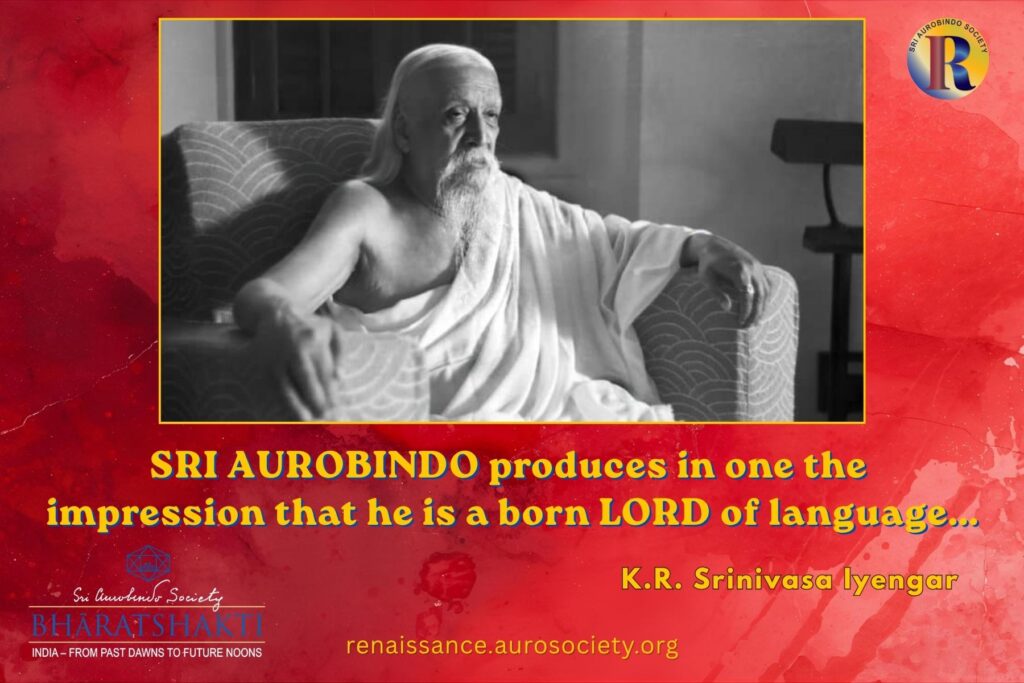
We begin with serialising a remarkable essay, titled Sri Aurobindo as a Literary Artist by Prof. K. R. Srinivasa Iyengar. This was first published in 1943, in Volume 2 of Sri Aurobindo Mandir Annual, a journal published by Sri Aurobindo Pathamandir, Kolkata. Sri Aurobindo Pathmandir was the first public institution outside Sri Aurobindo Ashram, Pondicherry, dedicated to the study and dissemination of Sri Aurobindo’s and the Mother’s vision and teachings. We are republishing the essay here with the permission of the publishers.
In the current issue, we feature first two parts of the long essay. In part 1, the author gives a broad outline of the various motives which inspire an artist, with a specific focus on the work of a literary artist. In part 2, the author pinpoints to the precision and liberality with which Sri Aurobindo uses words, and says that “he is both voluble in appearance and compact in effect.” He gives an example of one of the thousands of letters Sri Aurobindo had written to his disciples and marvels at is impeccable phrasing.
On Puranas
Sri Aurobindo has given a rigorous and nuanced assessment of the Puranas as literary works. Seeing them from literary, spiritual, philosophical, cultural, and historical perspectives, he speaks of them as “a new form and extension of the truth of the ancient spirituality” (CWSA, 20: 372) and has also carefully defended them against modern mind’s depreciation.
In this light, we begin another series titled The Puranas and Our Century by Dr. Prema Nandakumar. Having explored the author’s detailed essays on the two great itihāsa-s, Ramayana and Mahabharata (see HERE), starting with this issue we will be featuring in various parts a series of essays she wrote for Mother India on the literary, cultural and spiritual significance of the Puranas in the light of Sri Aurobindo.
In the current issue we feature in 2 parts bulk of the first essay published in October 2003 issue of Mother India, Vol. 56 (10), pp. 857-863. Rest of the essay will be taken up in the next issue.
Shantha Rajan joins the authors’ team with this issue. She reminds us all of true meaning of Sri Aurobindo’s call, an invitation to join him in the grand adventure of consciousness as she reflects on the Master’s poem titled Invitation.
We hope our readers will enjoy going through these offerings in this issue. As always, we offer this work at the lotus feet of Sri Aurobindo and the Mother.
In gratitude,
Beloo Mehra (for Renaissance Editorial Team)
~ Design: Beloo Mehra