Artha Sādhana as a Spiritual Pursuit
What is sādhana of wealth? How does a householder’s purusharthā of earning money take the form of a sādhana? What is the role of inner purification in this?
Artha Sādhana as a Spiritual Pursuit Read More »

What is sādhana of wealth? How does a householder’s purusharthā of earning money take the form of a sādhana? What is the role of inner purification in this?
Artha Sādhana as a Spiritual Pursuit Read More »
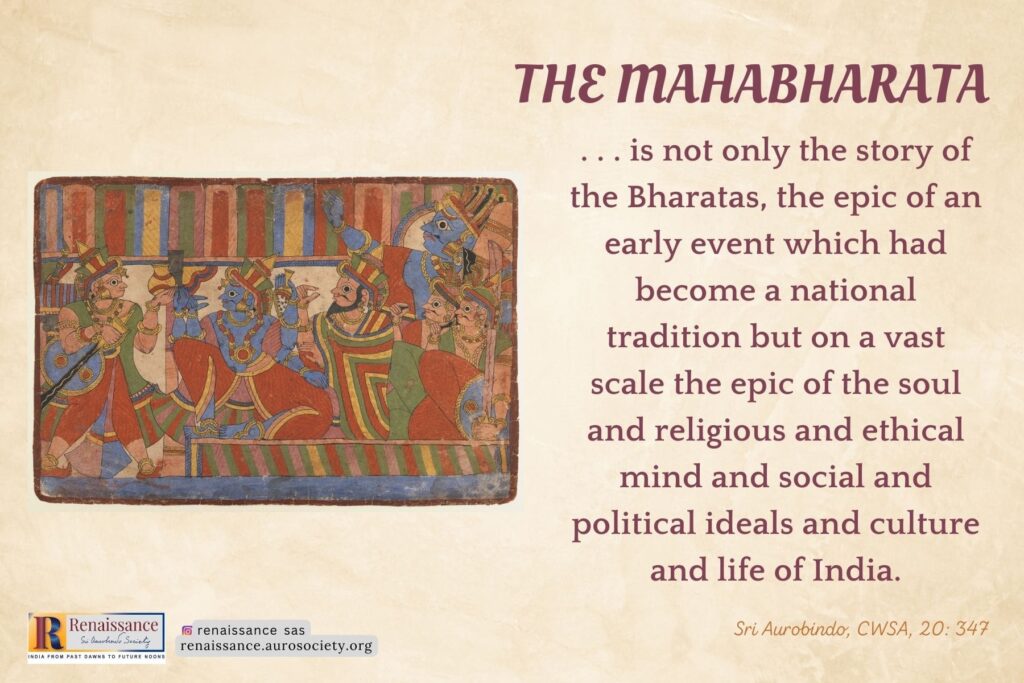
In this part, we see how Sri Aurobindo takes “with a reverent hand” a few myths and legends from the Mahabharata, and cleanses “them of soiling accretions, till they shine with some of the antique strength, simplicity and solemn depth of beautiful meaning.”
Sri Aurobindo’s Interpretation of Indian Culture: The Mahabharata – 4 Read More »
Read here a few translations of Sri Aurobindo from Vyasa’s Mahabharata including a sample of the “free poetic paraphrase” of the story of Vidula.
Sri Aurobindo’s Interpretation of Indian Culture: The Mahabharata – 3 Read More »
The Kurukshetra war must have been caused by several political factors. Sri Aurobindo analysed the preceding political tangle which is as important as the war.
Sri Aurobindo’s Interpretation of Indian Culture: The Mahabharata – 2 Read More »
With this issue we begin serialising Dr. Prema Nandkumar’s essay focusing on the Mahabharata in the light of Sri Aurobindo.
Sri Aurobindo’s Interpretation of Indian Culture: The Mahabharata – 1 Read More »
Values cannot be imposed through textbooks. Teachers and parents must serve as living examples. Rich stories can also expose children to higher ideals.
Sri Aurobindo on Education for Character Development Read More »
Sri Aurobindo felt that when dealing with the human personality of Rama one should get into the spirit of his age and race. Read more in this part.
Sri Aurobindo’s Interpretation of Indian Culture: The Ramayana – 4 Read More »
Watch this video for some insights into new challenges for parents now that the new consciousness is at work on the earth. Also reflect on a fundamental question: why does one want to have a child?
Parenting in the New Age (Video) Read More »
Briefly describing the dharma of a householder, this essay highlights the relevance of the Indian view of gradual human development through stages of life.
Gṛhasthadharma: The Dharma of a Householder Read More »
Kunti epitomises the heroic motherhood and stands out as a symbol of patience, courage, sacrifice and forbearance.
Kunti – A Paradigm of Conscious Parenting Read More »